China Drops the Ball Screw — Electromagnetic Direct-Drive as the New Lane to Overtake the West
For 40 years the West held two cards that kept China's high-end machine tools caged: the precision ball screw and the closed-source CNC system. China's answer is not to catch up on the old track — it is to abandon the track.
- What changed: A growing group of Chinese makers (the case study here is Kerex / 广东钶锐锶数控) removes the entire mechanical transmission chain — servo motor, coupling, ball screw, nut — and drives the table directly with electromagnetic force from a linear motor, paired with a self-developed PWM CNC "brain." When engineers opened the guard, the ball screw was simply gone.
- Why it matters: The competition shifts from precision mechanical machining to a new battlefield — linear-motor field control, high-precision sensing, and nanosecond-level motion-control algorithms. The shackles are still locked on the old door; China has taken the door off its hinges and built a new road.
- Honest caveat: This is a translated third-party industry commentary, not our independent audit. Several headline figures (localization rates, Kerex self-sufficiency %, market shares) come from a single Chinese source and should be cross-checked against annual reports and VDW/Gardner data before being quoted as fact. Read the credibility note.
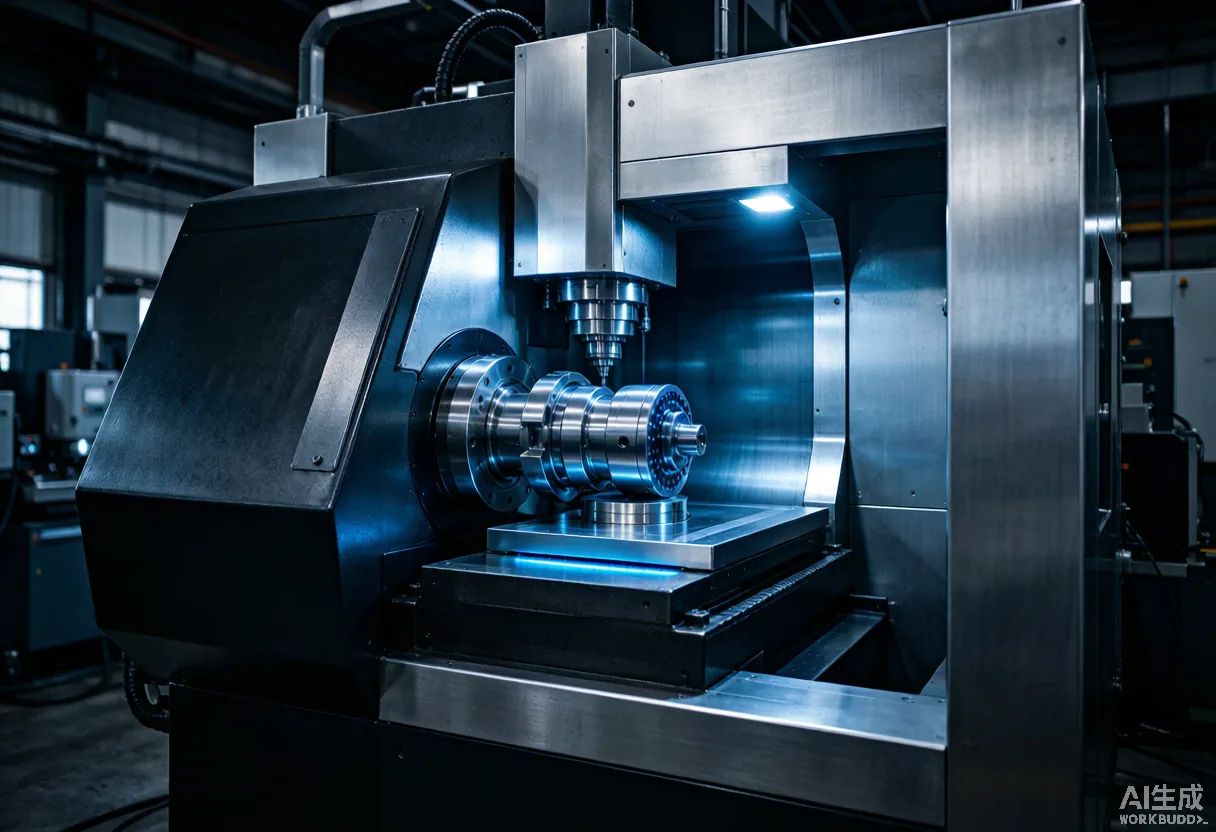
1 · Two Technological Shackles That Bound China for Decades
Why have high-end CNC machine tools long been the West's weapon of choice for technology containment? The root goes back to the 1987 Toshiba incident (东芝事件) that rang alarm bells across the Western world. Toshiba illegally exported four nine-axis CNC milling machines to the Soviet Union; the Soviets used them to machine submarine propeller screws, whose surface smoothness jumped sharply and submarine noise dropped by ~20 decibels, transforming underwater stealth. A handful of machine tools rewrote the underwater arms balance.
From then on, multi-axis linkage machine tools and underlying CNC systems were placed on export-control lists. The West built layer upon layer of barriers against China — from complete machines down to precision parts, source code, and even remote-maintenance rights.
Shackle 1 · The ball screw's near-unbreachable micron-level error wall
A traditional CNC table relies on a long mechanical transmission chain:
Servo motor rotates → coupling drives the ball screw → screw nut pushes the table
The principle is exactly like an old chain-driven bicycle: the pedal turns the chainring, which drives the chain and the rear cog. Any loose or worn part adds power delay.
Mechanical transmission carries built-in, incurable flaws: metal parts rubbing create wear; long high-speed runs heat the screw, causing micron-level thermal expansion; and direction reversal introduces backlash — like free play in a steering wheel. Deviations invisible to the naked eye are enough to scrap a part in aerospace, semiconductor, or AI liquid-cooling work. Japanese leaders THK and NSK spent decades perfecting screw material, heat treatment and ultra-precision grinding — a process moat built by generations of engineers.
Industry data cited in the source (2026):
- Domestic localization rate of high-end ball screws is only about 5%; Japanese and German makers monopolize ~90% of the market.
- THK, NSK and Bosch Rexroth together hold roughly 90% of supply.
- In 2023 the domestic ball-screw supply-demand gap reached 4.92–5.66 million sets.
- Overseas makers stably produce C1-grade screws; domestically, equivalent stability is not yet achieved.
Shackle 2 · The closed-source CNC system: an invisible remote-control right
Errors from the mechanism can be compensated in real time by the CNC system — tool-path, spindle speed, and micron-level thermal correction all depend on it. But Western giants have locked the core interpolation algorithms inside a black box. Chinese factories can buy the machine and run the panel, but never touch the source code.
Many imported high-end machines carry posture-monitoring devices that force a lockout the moment parameters look abnormal. The factory must submit a fault report and wait for overseas engineers to remotely approve and issue a dedicated unlock key.
The ball screw locks hardware precision; the closed-source CNC locks software control. With a double shackle, foreign firms bind the equipment, parts, service and upgrades — and monopolize the high-end track.
2 · Jumping Out of the Rat Race: Ditching the Ball Screw Entirely
Chasing the West on its own track means grinding screws, assembling bearings, compensating thermal error, cracking interpolation — a long R&D cycle, strewn with foreign patents ready to block at any moment. Chinese engineers chose a different problem to solve: simply discard the whole mechanical transmission chain and switch to electromagnetic direct-drive.
A full direct-drive machine mounts a permanent-magnet array and drive coils under the table; changes in current create electromagnetic thrust that moves the table directly. Compared with a screw machine:
It is like swapping a chain-driven bicycle for a maglev train — flip the magnetic field and the table responds instantly. The screw, nut, coupling and all intermediate transmission parts are eliminated.
With the transmission structure stripped away, the traditional pain points — mechanical friction, wear, thermal expansion, reversal backlash — all dissolve at once. But the new power architecture imposes brutal demands on the CNC's response speed: like converting a family sedan into a race car, the steering and braking must keep pace, or the tool path drifts.
Kerex developed a PWM-type domestic CNC system that regulates coil current in real time with high-frequency pulses: load forward current as the tool advances; cut thrust the instant it nears the work point; flip the field direction the moment the table must reverse. Old systems approximated curves with countless tiny straight segments, leaving a sawtooth surface. The domestic direct-drive CNC has compressed command response latency from microsecond to nanosecond level, outputting denser commands for a smooth, burr-free tool path.
Kerex self-sufficiency trajectory (as cited):
| Core component | 2023 self-made ratio | 2025 self-made ratio |
|---|---|---|
| Drive units (drivers) | 66.67% | 99.95% |
| Linear-motor magnet plates | 53.37% | 99.71% |
- In 2024 Kerex's full direct-drive machine sales ranked #1 among domestic makers.
- In 2025 its share of China's high-end CNC milling market was 2.21% overall, and 11.61% within domestic high-end milling.
- Its self-developed CNC systems passed 20,000+ installations — commercialization far ahead of expectations.
3 · The AI Compute Boom: Liquid-Cooling Plates as the Proving Ground
A prototype's spec sheet at an exhibition proves nothing; the real test is sustained mass production — stable precision after tens of thousands of parts, low failure rate, controllable yield. The first battlefield where Chinese electromagnetic direct-drive machines have gained a foothold is the red-hot AI server component line.
New-generation high-performance GPU chips now exceed 1,000 watts; stacked in server racks, air cooling has hit its ceiling and liquid cooling is now mandatory. The liquid-cooling plate — the core heat-dissipation part — needs a dense network of internal flow channels just 0.1–0.2 mm wide. Made mostly of soft red copper that easily gums the tool, machining these micro-channels is like carving fine drainage grooves into soft tofu: a tiny tool vibration leaves burrs, and a few microns of channel drift disrupts coolant flow and wrecks the whole unit's cooling.
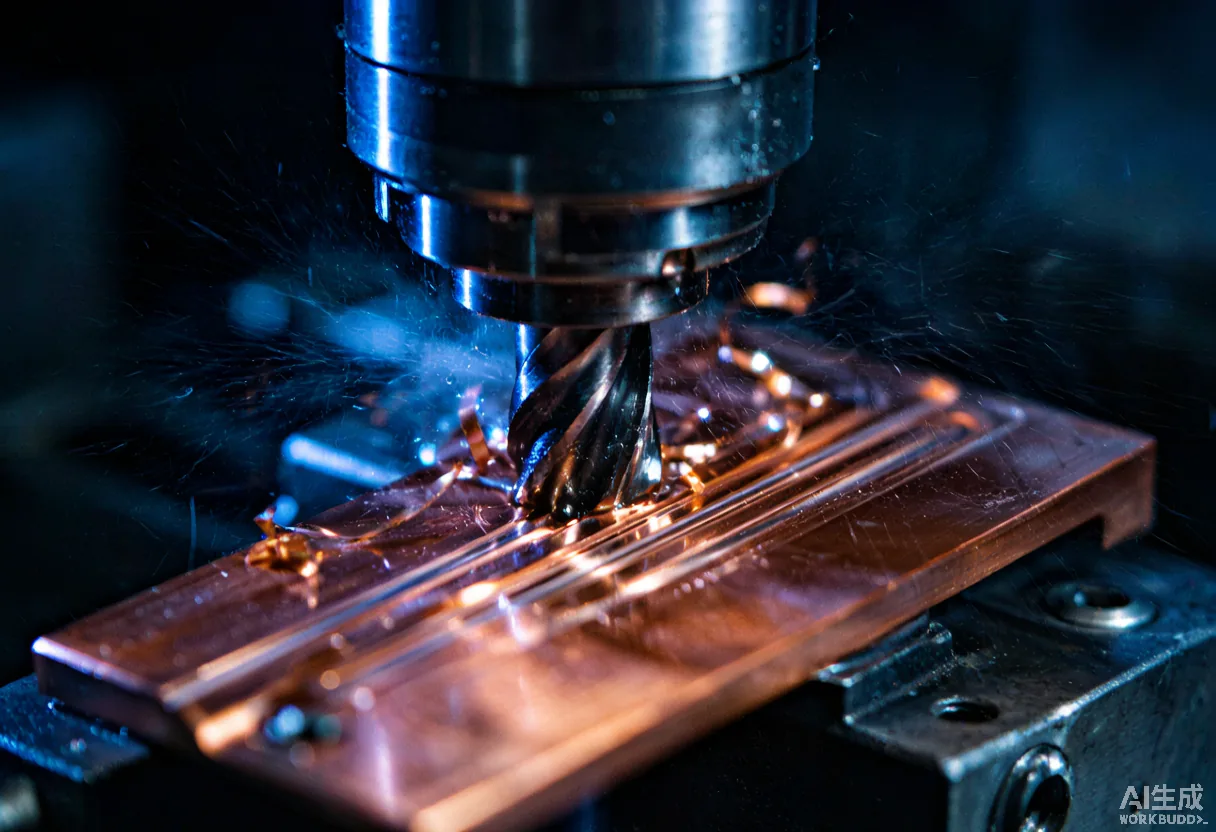
A traditional ball-screw machine transmits reversal gap and mechanical vibration straight to the tool:
At a micro-channel corner the tool can decelerate, turn and keep cutting at extreme speed. Reversal dwell time shrinks, copper gumming and surface scoring drop sharply, and the scrap rate of expensive copper plates falls. Beyond AI compute, semiconductor equipment parts fit the same advantages — wafer-handling arms, precision cutting bases, short-stroke high-speed components inside inspection instruments. Traditional transmission shocks on every reversal; electromagnetic thrust flips direction instantly, running smooth and jitter-free.
Mature lines like automotive manufacturing are locked to legacy import suppliers, with固化 supply chains hard to penetrate. But AI servers and semiconductor precision machining carry no old-equipment baggage — Chinese direct-drive machines took the high-end stations, honed stability through volume orders, and used real production data to close the decades-long experience gap with overseas makers.
First-half 2026 industry sentiment (as cited):
- Jan–May: the machine-tool sector booked revenue of RMB 431.9 billion, +6.7% YoY.
- Metal-cutting machine tools: +14.4% YoY.
- New orders for metal cutting: +7.8% YoY; backlog +12.6% YoY.
- Liquid cooling, humanoid robots and aerospace parts are emerging as the sector's new growth engines.
4 · Rewriting the Rules of the Global Machine-Tool Race
High-end CNC is called the "industrial mother machine" (工业母机). For a long time the West defined the technical route and locked China's manufacturing upgrade with two shackles — hardware patents and software rights. Foreign firms perfected ball-screw precision and error-compensation algorithms, forcing latecomers to grind on the set track.
The West assumed Chinese manufacturers would only ever copy and攻克 the ball screw. But the R&D teams chose not to walk the old road. The full direct-drive architecture moves the race from precision mechanical machining to a brand-new battlefield: linear-motor field control, high-precision sensors, and nanosecond motion-control algorithms.
- Tear out the whole transmission shaft — electromagnetic force drives the table directly.
- Abandon the encrypted closed system — build a fully domestic, controllable PWM CNC brain.
Inside the workshop, tools spin at high speed and copper chips keep falling. The ball screw that once held the lifeline of precision has formally left the core transmission station.
As demand from AI compute, semiconductors and aerospace high-end manufacturing keeps exploding, China's electromagnetic direct-drive machines are digging into the high-end precision-processing track — holding up the foundations of domestic high-end manufacturing. This road has only just begun.
Source & Credibility Note
About this page. This is an English translation and light editorial adaptation of a Chinese-language industry commentary titled “西方攥住40年机床底牌卡脖子,中国直接换赛道:舍弃滚珠丝杠,启用电磁直驱” (originally published by “老韩闲话” on 2026-08-10, WeChat public account).
It is presented for industry-context value, not as an independent audit. Headline figures — ~5% domestic ball-screw localization, ~90% foreign share, the 4.92–5.66M-set supply gap, C1-grade capability, Kerex's 66.67%→99.95% driver self-sufficiency and 53.37%→99.71% magnet-plate self-sufficiency, 2024 #1 domestic sales, 2025 market shares of 2.21% / 11.61%, 20,000+ CNC installations, and the H1-2026 sector revenue/order growth rates — are reproduced as reported by that single source and have not been independently verified against annual reports or VDW/Gardner data. Treat them as directional, credibility-rated signals rather than established fact. GREE CNC Insights takes no position on the underlying company and is not affiliated with the original author.