China's CNC Component & Accessory Ecosystem — The Invisible Layer
- Executive Summary
- 1 · Why the Accessory Layer Decides Everything
- 2 · Anchor A — Topstar (拓斯达): a systems player that builds its own parts
- 3 · Anchor B — Yiheda (怡合达): the one-stop FA parts platform
- 4 · The Component Map: where China stands
- 5 · This Week's Gree CNC Angle
- 6 · Objective Limits & Risks
- 7 · Data Credibility Rating
- 8 · Guidance by Use Case
Under every Chinese CNC machine sits an accessory and component layer that most buyers never see — and it is where China's real cost, lead-time and capability edge (and its remaining gaps) actually live. We map it with two Dongguan anchors: Topstar (拓斯达, a systems maker that also builds its own five-axis and core parts) and Yiheda (怡合达, the one-stop standardized-parts platform almost every Chinese builder buys from).
- Real strengths: A deep, fast and increasingly self-made component base. Yiheda turns formerly custom parts into a catalogue of hundreds of thousands of SKUs (2025 revenue RMB 2.948B, audited). Topstar's CNC arm (via 埃弗米 / Evermill) makes its own spindle, rotary table, dual-swing milling head and power turret — five-axis orders ~400 units in 2025 (+37%).
- Real positioning: The ecosystem compresses cost and lead time for the whole machine-tool chain — which is why Chinese machines are increasingly "good enough, fast and cheap." But the top-tier accuracy parts (P-grade ball screws, high-end bearings, encoder scales) are still where Japan/Europe leads.
- One line: The accessory layer is China's quiet competitive moat in volume CNC — and the exact layer Gree is betting on by in-housing its spindle and linear motor.
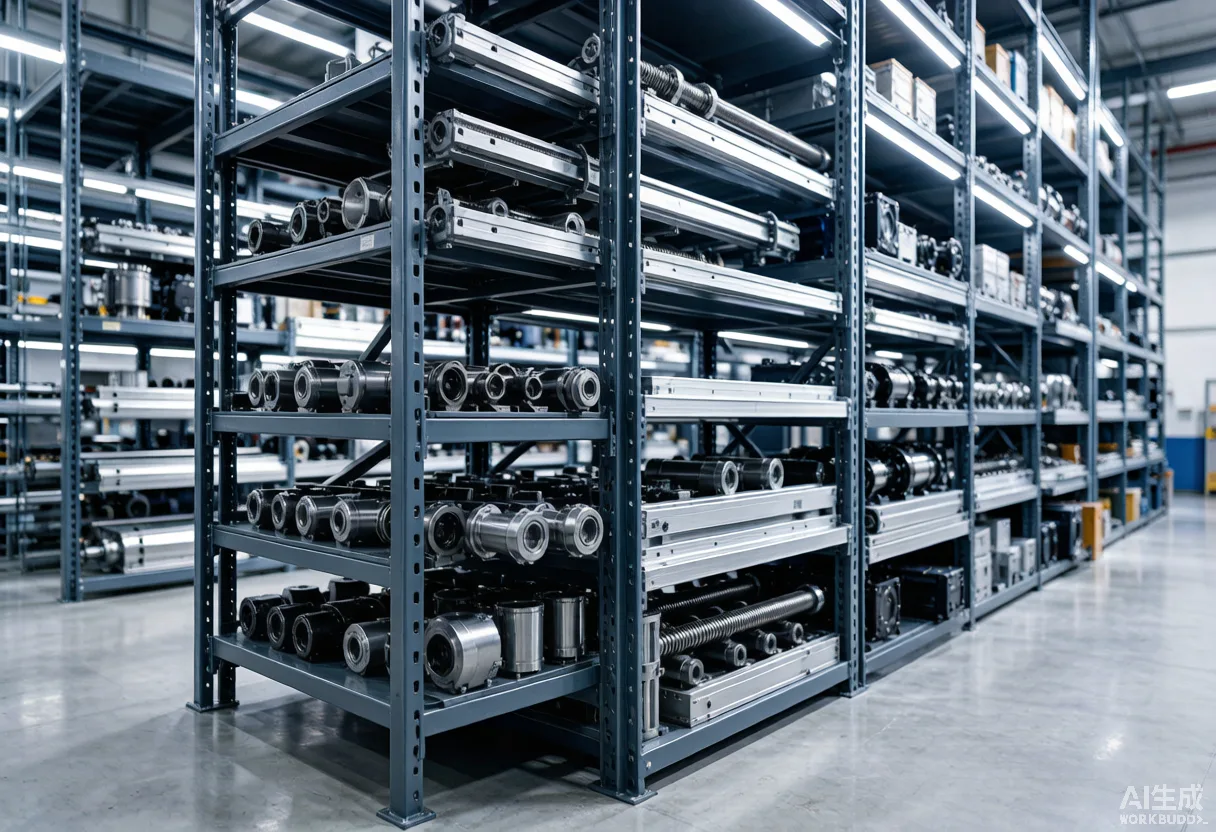
1 · Why the Accessory Layer Decides Everything
When overseas buyers compare a Chinese machine tool with a German or Japanese one, they usually look at the whole machine — rigidity, controller, accuracy. But the machine is an assembly of parts, and three things about that parts base shape the purchase more than the brochure admits:
- Cost. A machine is mostly bought-in components. A deep local parts market means a Chinese OEM pays less and waits less for spindles, guides, screws, couplings, pneumatics and fixtures.
- Lead time. Standardized, catalogue-available parts (the Yiheda model) turn a custom build into a configure-to-order build — weeks shaved off delivery.
- Achievable precision class. The hard parts — high-end ball screws, bearings, encoder scales, the spindle itself — set the ceiling on accuracy and surface finish. Owning these (as Topstar and Gree do) is the difference between "good enough" and "top-tier."
This brief is the ecosystem overview. Deeper dives on electric spindles, linear motors, high-end bearings & scales, and five-axis linkage are scheduled as separate issues — here we set the map and use two Dongguan companies as concrete anchors.
2 · Anchor A — Topstar (拓斯达): a systems player that builds its own parts
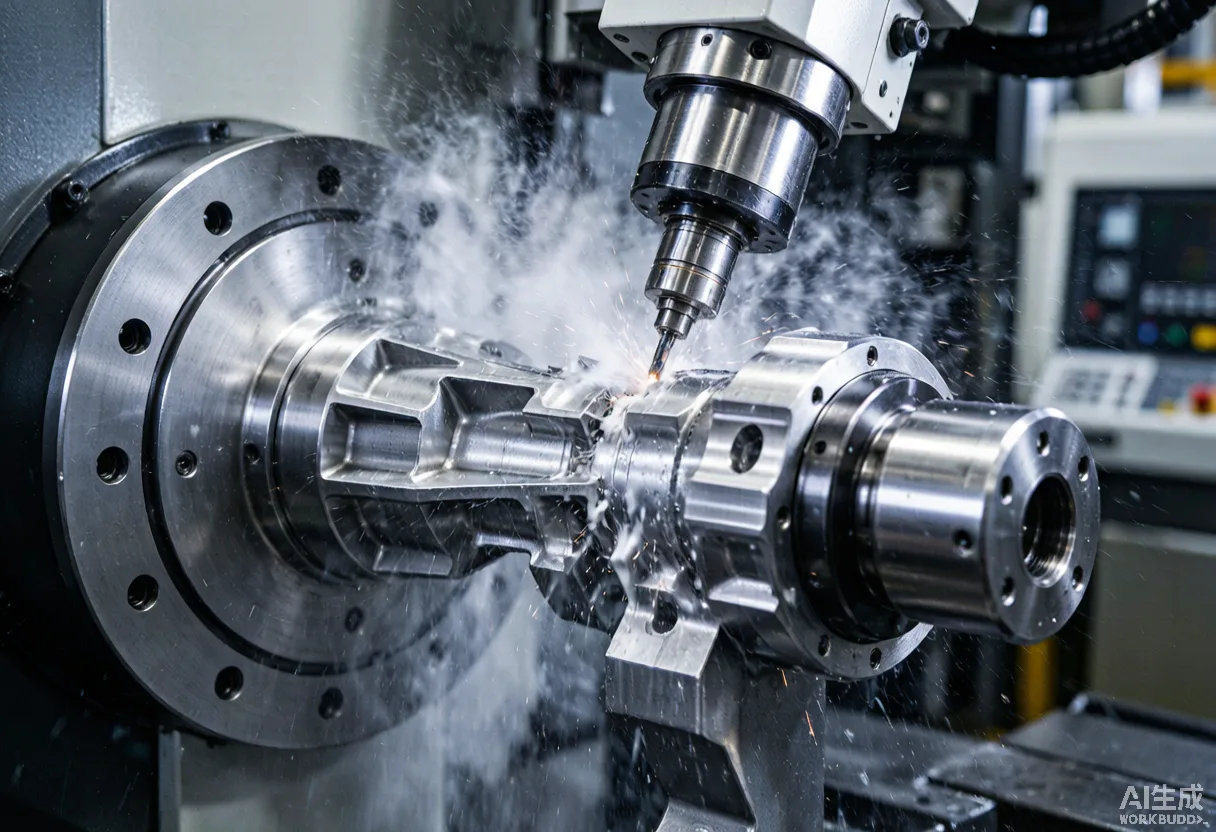
Topstar (300607.SZ, founded 2007, Dongguan) is best known for industrial robots and injection equipment, but its CNC arm — via subsidiary 埃弗米 (Evermill) — is a window into the "make-your-own-parts" trend. Rather than only assembling bought-in components, Evermill develops the harder internals itself.
| Attribute | Detail |
|---|---|
| Listed / founded | SZSE 300607 · founded 2007, Dongguan, Guangdong |
| 2025 revenue | RMB 2.51B (audited); turned profitable — net profit attrib RMB 73.87M (+130% vs 2024 loss) |
| Segment mix (2025) | Robots & automation 27.3% (RMB 685M, margin 35.8%) · injection 19.9% (RMB 499M) · CNC 12.95% (RMB 325M, +5.5%, margin 25.9%) · energy/env. systems (divesting) 36.5% |
| CNC products | Five-axis machining centers (五轴联动数控机床), high-speed machining centers, high-precision slider grinders, high-speed graphite centers |
| Self-made core parts | Spindle (主轴), rotary table (转台), dual-swing milling head (双摆铣头), gear milling head (齿轮铣头), power turret (动力刀塔) |
| Five-axis momentum | 2025 orders ~400 units (+37%); shipments ~300 (+15%); 2026 Q1 CNC revenue RMB 53.1M (+62.5%) |
| Overseas | 2025 overseas revenue 26.3% (RMB 660M, +~10%) |
Source: Topstar 2025 annual report (audited) and 2026-05 investor Q&A. Five-axis order counts are company-stated.
Why Topstar matters for the accessory story
It shows the strategic direction: a Chinese systems OEM that decided the spindle, rotary table and milling head are worth owning, not buying. Humanoid-robot part machining (torso, limbs, joints, load-bearing connectors, precision transmission parts) is now a visible five-axis demand driver for Evermill — the same demand pulling five-axis capacity across the industry. For an overseas buyer, Topstar is a signal that "Chinese five-axis" is no longer just assembled imports; the hard internals are increasingly local.
3 · Anchor B — Yiheda (怡合达): the one-stop FA parts platform
If Topstar is the "make-your-own-parts" anchor, Yiheda (301029.SZ) is the "buy-anything-standardized" anchor. Founded 2010 in Dongguan and listed on ChiNext in 2021, its model is to turn formerly custom, non-standard automation parts into a standardized, catalogue-driven supply — its slogan is "让智能制造更简单" (make smart manufacturing simpler).
| Attribute | Detail |
|---|---|
| Listed / founded | SZSE 301029 · founded 2010, Dongguan · CEO 金立国 |
| 2025 revenue | RMB 2.948B (audited, +17.7%); net profit attrib RMB 512M (+26.6%); gross margin 39.1%, net margin 17.4% |
| Model | One-stop FA (factory automation) parts — standardizes non-standard parts (服务型制造) into a large SKU catalogue across 9 categories |
| Top categories | Linear-motion parts RMB 829M (28.1%) · aluminum profiles & accessories RMB 444M (15.1%) · machined parts RMB 410M (13.9%) |
| Customer mix | Other industries 33.5% · new-energy/Li-ion 23.0% · 3C 22.5% |
| Scale | ~3,503 employees; ROE 12.1%; South China 43% / East China 39% of revenue |
Source: Yiheda 2025 annual report (audited) and company disclosures.
Why Yiheda is the supply-layer keystone
Almost every Chinese machine builder, automation integrator and OEM fixture shop buys from a platform like Yiheda. By standardizing linear guides, couplings, profiles, connectors and machined parts, it collapses lead time and BOM cost for the entire downstream chain. For an overseas buyer sourcing automation or fixtures in China, Yiheda-class supply is the reason quotes come back fast and cheap — and why a Chinese machine-tool OEM can price aggressively without sacrificing gross margin.
4 · The Component Map: where China stands
Putting the two anchors in the wider map — a quick, credibility-graded snapshot of the component categories. (Each gets its own deep-dive issue later; this is the landscape.)
| Component | China status | Confidence |
|---|---|---|
| Standardized FA parts (guides, screws, couplings, profiles) | Strong — volume domestic supply; Yiheda-class platforms ubiquitous | High |
| Electric spindles (电主轴) | Maturing — domestic players (e.g. Haozhi 昊志机电) + in-house at Topstar / Gree | Medium |
| Ball screws / linear guides (mid-grade) | Strong — volume supply adequate for general machining | High |
| P-grade precision ball screws | Gap — still import-reliant for top-tier accuracy (THK / NSK class) | Medium |
| CNC systems | Advancing — Huazhong HNC-10, Gree, KEDE GNC (see prior issues) | High |
| High-end bearings & encoder scales (光栅尺) | Weak point — Japan/Europe (Heidenhain, NSK) still lead at the top | Medium |
| Rotary tables / precision reducers | Emerging — Qingdao/Yiheda-class + RV/harmonic in development | Medium |
5 · This Week's Gree CNC Angle
Gree is betting on the same layer
Gree's in-house spindle and linear motor (covered in the Gree flagship report and the five-axis pieces) is a direct play on this invisible layer — the same logic that drives Topstar's Evermill to make its own spindle and rotary table. Two readings for overseas buyers:
- Convergence: Gree, Topstar and KEDE all concluded that owning the spindle / controller / core motion parts is the real moat. Gree's edge is pairing that with a machine + robot + thermal + process package for production-scale buyers.
- Where the platform helps Gree: a Yiheda-class standardized-parts base lowers BOM and lead time on Gree's volume models, freeing engineering attention for the hard, owned parts. The ecosystem is Gree's tailwind, not a rival.
- Honest framing for buyers: when Gree quotes fast and competitively, part of that is this Chinese component ecosystem. The credibility question is always the same — which precision parts are owned vs bought, and at what accuracy class.
6 · Objective Limits & Risks
Top-tier accuracy parts still import-dependent
For the highest precision class, P-grade ball screws, high-end bearings and encoder scales remain a Japanese/European stronghold. A machine can be "five-axis" and still ship with bought-in top-tier screws/scales — fine for many jobs, but not parity with a DMG MORI or Mazak at the accuracy ceiling. Verify the bill of materials.
Topstar's CNC is a minority of a diversified group
Topstar's CNC segment is ~13% of revenue; robots and injection equipment dominate. Its five-axis momentum is real and fast-growing, but it is one of several pillars — not a pure-play five-axis champion like KEDE. Weigh it as a systems+components story, not a head-to-head with dedicated machine-tool makers.
Commodity-component margin pressure
Yiheda's standardization strength is also a moat that others can imitate; price competition in standardized FA parts is structural. Its 39% gross margin reflects scale and catalogue depth today — a watch item, not a flaw.
7 · Data Credibility Rating
| Claim | Source | Confidence |
|---|---|---|
| Topstar 2025 revenue / profit / segment split | Topstar 2025 annual report (audited) | High |
| Yiheda 2025 revenue / profit / margin / categories | Yiheda 2025 annual report (audited) | High |
| Topstar five-axis orders ~400 (+37%), self-made parts | Company IR / annual commentary | Medium |
| Component substitution status (spindles / screws / scales) | Industry consensus + prior issues; varies by tier | Medium |
| "Ecosystem compresses cost / lead time" thesis | Our analytical framing of the two anchors | Medium |
8 · Guidance by Use Case
Overseas buyer / distributor
If you source machines or automation from China, the accessory ecosystem is your friend: fast quotes, short lead times, competitive pricing — largely thanks to a Yiheda-class parts base and makers like Topstar owning their hard internals. Do ask for the BOM on precision parts (screws, bearings, scales) and the achievable accuracy class before assuming German/Japanese parity at the top end.
Investor
Both anchors are listed (Topstar 300607, Yiheda 301029) with audited 2025 figures — verifiable, unlike the private vendors in earlier issues. Topstar is a turnaround-and-pivot story (profitable in 2025, leaning into embodied intelligence); Yiheda is a steady, high-margin platform compounder. Treat five-axis-order growth and component-substitution progress as the leading indicators.
Technology / supply-chain partner
Yiheda is a concrete procurement entry point for any automation or fixture build in China; Topstar/Evermill is a benchmark (and potential partner) for in-housing spindles and five-axis internals. Both show where the Chinese machine-tool value chain is thickening — useful for Gree's own supplier and partner mapping.
Frequently Asked Questions
What is the "accessory layer" of Chinese CNC?
It is the component and supply base under the visible machine: standardized FA parts (linear guides, ball screws, couplings, aluminum profiles, pneumatics), plus the harder self-made parts — electric spindles, rotary tables, dual-swing milling heads, CNC systems. It decides a machine's cost, lead time and achievable precision class. Yiheda (怡合达) is the one-stop standardized-parts platform; Topstar (拓斯达) is a systems player that also makes its own five-axis and core components.
Is Yiheda just a parts distributor?
No. Yiheda runs a one-stop FA (factory automation) parts model: it standardizes formerly non-standard parts (服务型制造) into a catalogue of hundreds of thousands of SKUs across 9 categories, with in-house production of linear-motion parts and machined parts. 2025 revenue was RMB 2.948B (audited), gross margin 39.14%. It is the supply-layer enabler almost every Chinese machine builder or automation integrator buys from.
Does Topstar make its own CNC machines?
Yes, via its subsidiary 埃弗米 (Evermill). Its CNC business focuses on five-axis machining centers (五轴联动数控机床), high-speed machining centers and precision grinders, with self-developed spindle, rotary table, dual-swing milling head, gear milling head and power turret. 2025 five-axis orders were ~400 units (+37%). The CNC segment is ~13% of Topstar's RMB 2.51B 2025 revenue; robots and injection equipment are larger today.
Where is China still import-dependent in components?
Volume supply of linear guides, ball screws and couplings is now largely domestic. The remaining weak points for top-tier accuracy are high-end precision ball screws (P-grade), high-end bearings and encoder scales (光栅尺), where Japanese/European brands (THK, HIWIN, NSK, Heidenhain) still lead. Gree's own in-house spindle and linear-motor bet is a strategic play on exactly this layer. Deeper component briefs (electric spindles, linear motors, bearings & scales) follow separately.