The model-by-model view behind this review — where each five-axis family fits, and the honest note on controllers.
Gree CNC · Honest Review
Is Gree CNC Reliable? An Honest Review of Track Record, Strengths & Limits
Executive summary — read this first.
- Gree is a young but genuinely fast-maturing machine-tool builder. The programme started in 2013 as an automation department inside Gree Electric; the company was formed in 2015 with its first engraving machine, and the first five-axis machine (GA-F500) shipped in June 2017. That is roughly a decade of field history — real, but short next to builders with half a century.
- The flagship has external recognition and a published spec sheet. The high-speed double-five-axis gantry GA-FMB3020D won a gold medal at the 50th International Exhibition of Inventions Geneva (April 2025). Gree's own product material lists 120 m/min rapid traverse, 1.1 G, 20,000 rpm, ±0.012 mm repeat positioning and 2 s tool-to-tool.
- There is hard, non-marketing quality data. A Guangdong provincial industry project report records key machined-part defect rate falling 11.4% → 4.3% and in-warranty whole-machine failure rate 7.6% → 5.8% for the high-speed direct-drive precision line — government documentation, not a brochure claim.
- Four limits are honest and testable: a shorter field record, a top-end controller layer we treat as partner-led rather than fully in-house, accuracy retention over long duty cycles (an industry-wide gap, not unique to Gree), and a service radius that varies sharply by market.
- Our verdict: credible and often under-priced for mid- to upper-mid work — especially large aluminium structural parts for new-energy vehicles. Verify it the way you would verify any brand: on your own parts, with a written protocol.
What "reliable" should actually mean
Before any brand comparison, it helps to define the word. In a machine shop, reliability is not a brochure number. It is the combination of four measurable things:
- Uptime under your duty cycle — mean time between failures measured on your shift pattern, not in a demo cell.
- Accuracy retention — whether the geometry still holds after six, twelve and thirty-six months of production, not only on the day of commissioning.
- Service response — how long until a qualified engineer and the right spare part are physically at your machine.
- Process support — whether the supplier can help you hold tolerances on your material, with your tooling, at your volume.
Judged on those four axes, brand age matters far less than evidence. That is the standard we apply below — to Gree, and to ourselves.
The track record, on dates and documents
Gree's machine-tool programme is documented in Chinese industry and state media with consistent dates. Note that "2013" is the start of the internal automation department, not the company's founding — a distinction many summaries blur.
| Year | Milestone | Why it matters to a buyer |
|---|---|---|
| 2013 | Automation Equipment Manufacturing Department established inside Gree Electric; a small team begins studying machine tools | Starting point of in-house know-how — not yet a business |
| 2015 | Zhuhai Gree Intelligent Equipment Co. formally established; first machine tool, engraver GA-V2310 | First shipped product, entry-level |
| 2016 | First vertical prototyping machine GA-VZ820 and GA-VZ460; six models in volume production | Moves from prototype to series |
| June 2017 | First self-developed five-axis GA-F500, repeat positioning 5 µm; applied to Gree's own compressor impellers | Enters five-axis; validated on its own production first |
| 2019 | GA-F350 five-axis at 2 µm repeat positioning | Precision ladder 5 → 2 µm in two years |
| 2023 | GA-FM3020 direct-drive bridge gantry wins iENA Nuremberg silver | First European invention award |
| April 2025 | GA-FMB3020D wins gold at the 50th Geneva International Exhibition of Inventions | Current flagship, externally assessed |
Sources: China Industry News (cinn.cn) and China Securities Journal / Chinese Mechanical Engineering Society retrospectives on the 2013–2017 timeline; Gree Intelligent Equipment official site (gie.gree.com) for the Geneva award.
Why the "validated on its own line first" detail matters. Gree ran early five-axis machines on its own compressor impellers and fan blades — high-precision curved parts, running year-round — for roughly three years before selling externally. Internal duty-cycle exposure is a genuine (if not unique) reliability input: it is real production time, not a test cell.
What the evidence actually supports
1. A flagship product with a published, checkable spec
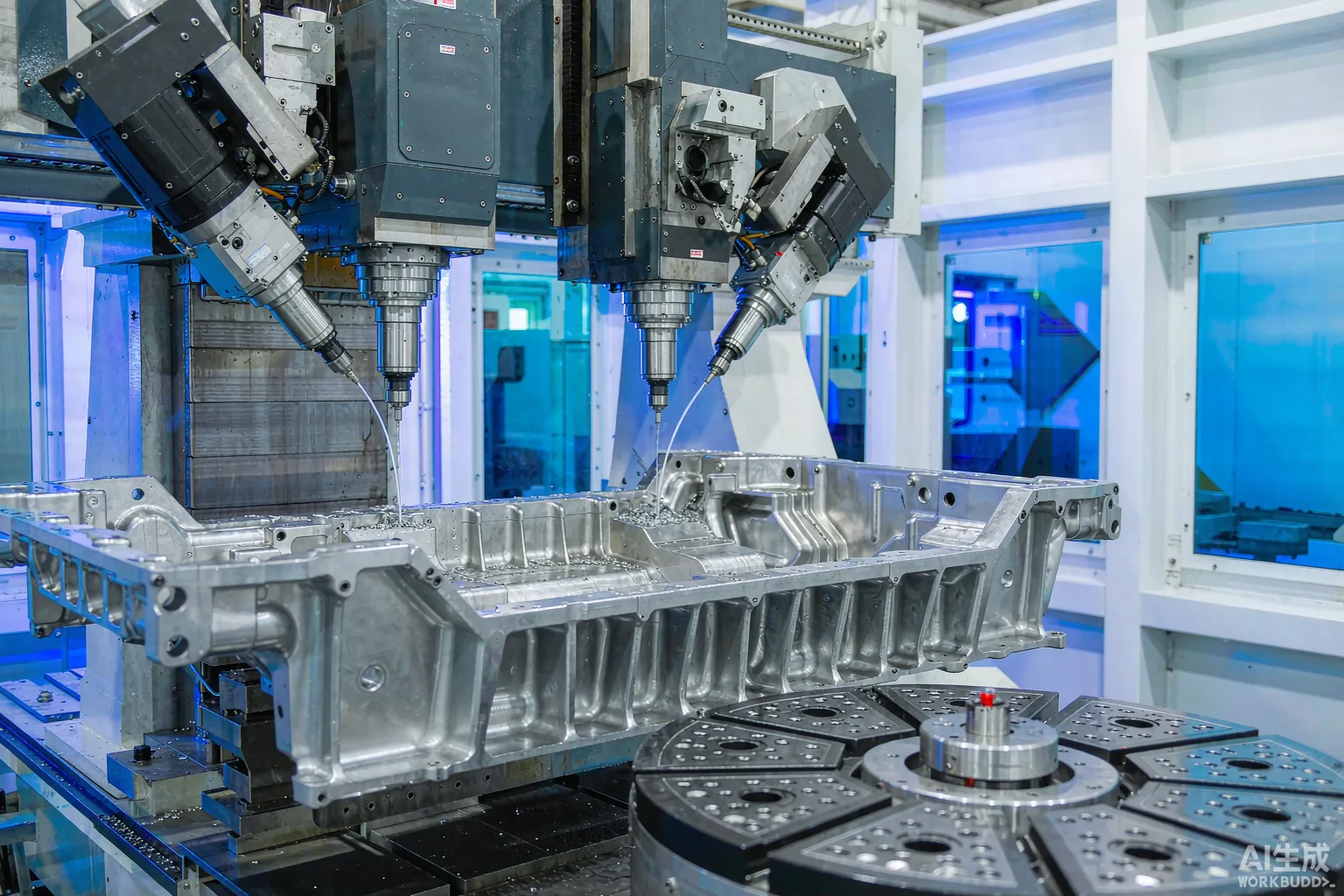
The GA-FMB3020D is built for one job done at volume: large aluminium structural parts for integrated die casting — front cabin, rear floor, battery-pack housings. Gree's product material states 120 m/min rapid traverse, 1.1 G acceleration, 20,000 rpm spindle, ±0.012 mm repeat positioning accuracy, and 2 s tool-to-tool, with linear-motor direct drive and full-closed-loop glass-scale feedback.
A specification discipline note. A figure of ±0.003 mm for this machine circulates widely in Chinese media and encyclopedia entries. We could not confirm it in Gree's official product material, so we publish the official ±0.012 mm and flag the other as unverified. If a supplier quotes you a number better than the official sheet, ask for the test report — that question is worth more than the number itself.
2. Core motion parts are developed in-house
State industry reporting credits Gree with self-developed motorized spindles (24,000–40,000 rpm), linear motors, servo drives, direct-drive AC swing heads and rotary tables. Assembly runs in temperature- and humidity-controlled conditions. This matters for a practical reason: a builder that makes its own motion chain can usually repair or revise it without waiting on a third party's queue.
3. A documented quality improvement, from a government source
11.4% → 4.3%
key machined-part defect rate
7.6% → 5.8%
in-warranty whole-machine failure rate
5 → 10 /month
output capacity on the same line
16 → 14 months
development cycle per model
These figures come from a Guangdong provincial industry and information technology department project disclosure on high-speed direct-drive high-precision CNC development — a government document, not marketing copy. Read them correctly: they describe a specific machine line and a before/after comparison against other machine types, not a fleet-wide reliability statistic. They also show where the baseline started — a 7.6% in-warranty failure rate is not a number a mature builder would publish about itself, and Gree's willingness to have it documented is part of why we treat it as credible.
4. Fit to one fast-growing application
Integrated die casting created a machining problem that did not exist at scale before 2020: very large, thin-walled aluminium parts that a standard vertical five-axis simply cannot hold or reach. Gree's gantry line is purpose-built for it. Industry reporting puts external supply at over 75% of output and NEV-parts equipment at roughly 70% of machine-tool production — Medium single-source figures, but directionally consistent with what we see in the field.
5. Delivery speed
Chinese media commonly quote around 90 days for domestic standard models against six to eighteen months for some Japanese high-end machines. Treat this as Medium: it depends on configuration, and a configured export order with compliance documentation is not the same as a domestic standard unit. Ask for the lead time in your configuration, in writing.
Where we are honest about the limits
We are an authorised distributor, so the following is not neutral curiosity — it is the list of things we would want tested if we were buying.
1. Younger field record
Being able to build a machine and being durable are different competences. Japanese and European builders accumulated decades of process, assembly and application craft — fixture design, thermal behaviour under real duty, failure-mode libraries. Gree is closing that gap quickly, and in one segment (large aluminium structures) has arguably already closed it. Outside that segment, assume the gap is still there.
2. Top-end controller: partner-led, and you should ask
Gree self-develops the core motion chain. At the highest controller layer — the "brain" that governs five-axis interpolation, look-ahead and adaptive control — we treat the platform as partner-led rather than fully in-house, consistent with our comparison pages. Chinese media frequently claim 100% self-development; we do not repeat that, because the practical answer differs by model and by market. Get the exact controller platform on your machine in writing before you sign.
3. Accuracy retention is the real test
Short-term repeatability and long-term retention are different measurements. Chinese industry commentary commonly cites domestic high-end machines around 2,000 h MTBF against roughly 5,000 h for German and Japanese machines, with faster geometric drift over multi-year duty. We rate those figures Low–Medium — they are media figures without a cited test protocol — but the underlying point is well established and applies industry-wide: plan a re-test at six and twelve months, not only at acceptance.
4. Service radius varies by market
A young global service network means your response time depends heavily on your local distributor. This is the single most underestimated variable in a Chinese-machine purchase, and it is why regional parts and service points — such as our Malaysia hub for Southeast Asia — change the risk profile more than any specification. Insist on a written local response time and a priced spares package.
A five-point verification protocol (use it on any brand)
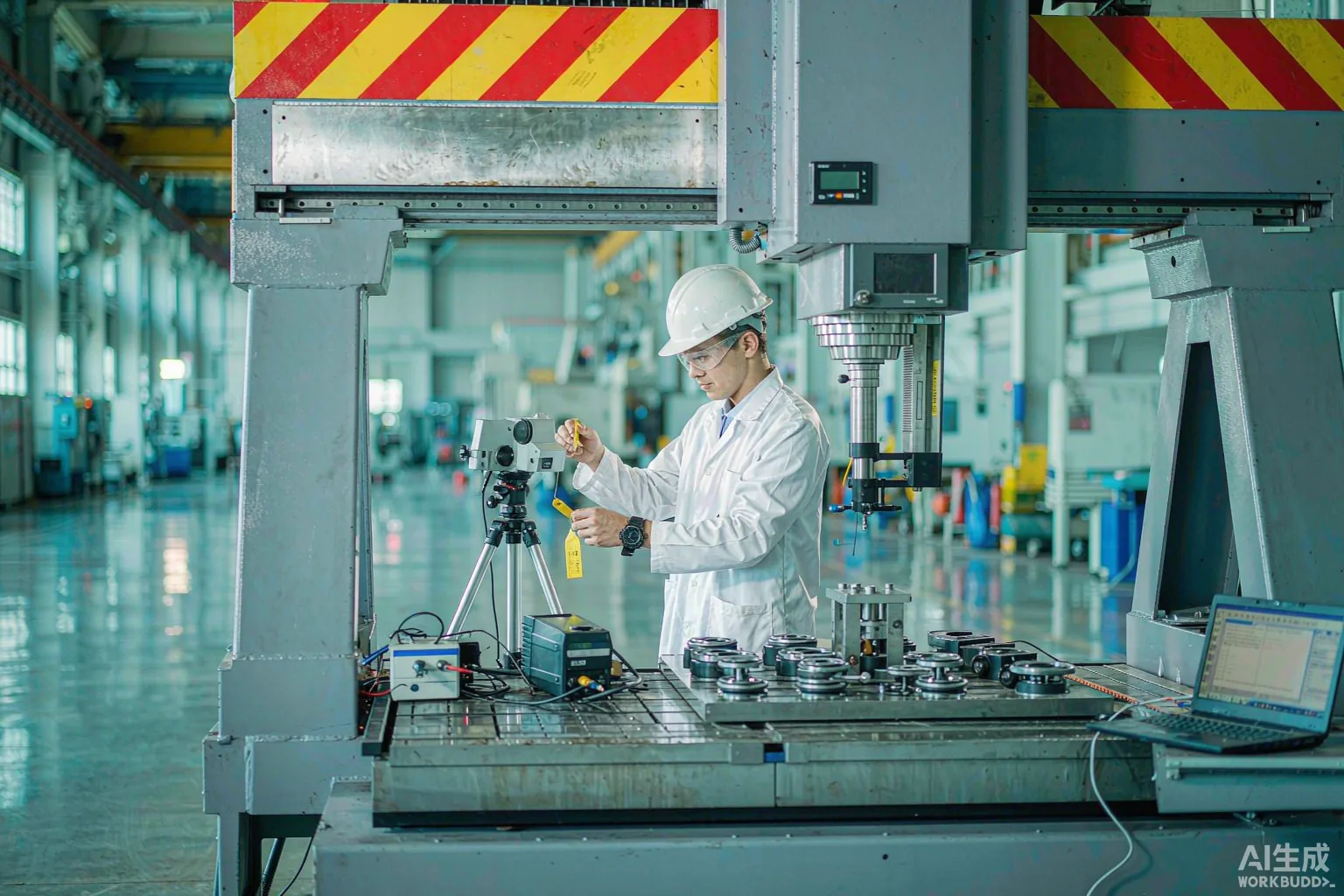
- Demand a third-party test report, not a catalog number. Repeatability should come from a documented measurement — laser interferometer, bidirectional, per ISO 230-2 / GB/T 17421.2 — with temperature, axis travel, payload and method on the page.
- Run off on your parts. Define cycle time, first-pass yield and Cpk for your critical dimensions, with target values, sample size and run duration, in a signed protocol.
- Get the controller platform in writing. Model-specific, in the contract — not "our own system".
- Confirm certification for your market — CE, UKCA, or your local standards — before contract, not after installation.
- Price the service, not just the machine. A recommended spares package with prices, a written local response time, and remote-diagnostics access (OPC UA / MTConnect).
Who should — and should not — consider Gree
| Situation | Our read |
|---|---|
| Large aluminium structural parts at volume (NEV, battery trays, e-motor housings) | Strong fit purpose-built segment with external recognition and field volume |
| General precision, 3C, moulds, job-shop versatility | Good fit competitive mid- to upper-mid range; verify service locally |
| Aerospace titanium, hardened steel, long heavy-duty cycles | Evaluate carefully compare run-off data against your duty profile; process databases are thinner |
| No local service partner in your market | Do not buy on price alone service radius dominates total cost of ownership |
Data credibility rating
| Claim | Source | Rating |
|---|---|---|
| GA-FMB3020D gold medal, 50th Geneva International Exhibition of Inventions, April 2025 | Gree Intelligent Equipment official site (gie.gree.com, Honor page) + CIMT 2025 exhibition reporting | High first-hand |
| Spec: 120 m/min, 1.1 G, 20,000 rpm, ±0.012 mm repeat positioning, 2 s tool-to-tool | Gree official GA-FMB3020D product material; corroborated by industry press | High first-hand |
| ±0.003 mm repeat positioning (widely circulated variant) | Encyclopedia and media entries only; not found in official spec material | Unverified not used as fact |
| Defect rate 11.4% → 4.3%; in-warranty failure 7.6% → 5.8%; output 5 → 10 units/month | Guangdong Provincial Department of Industry and Information Technology project disclosure | High government, but line-specific |
| 2013 department / 2015 company + GA-V2310 / June 2017 GA-F500 at 5 µm | China Industry News; China Securities Journal; CMES — consistent across three sources | High multi-source |
| Self-developed spindle 24,000–40,000 rpm, linear motors, servo drives | China Industry News (state industry outlet) | Medium single outlet; consistent with official product scope |
| External supply >75%; NEV equipment ~70% of output | China Industry News; echoed by Chinese media | Medium single-source family |
| Lead time ~90 days vs 6–18 months Japanese high-end | Chinese media, repeated | Medium configuration-dependent |
| Domestic high-end MTBF ~2,000 h vs ~5,000 h Germany/Japan | Chinese industry commentary, no cited protocol | Low–Medium directional only |
| Efficiency gain vs conventional single-five-axis | Media quotes range 30%–80%; we publish a conservative +25% cap | Capped depends on part & process |
Guidance
- Weight evidence by application, not by award count. Geneva gold tells you one machine impressed a jury. A run-off on your part tells you what your line will do.
- Treat the official spec sheet as the reference. If a quoted figure beats it, the burden of proof is a test report, not an assertion.
- Buy the service package with the machine. Spares pricing, written response time and remote diagnostics turn an unknown into a manageable cost.
- Re-test at six and twelve months. Retention, not commissioning accuracy, is what determines whether the machine is still earning in year three.
Bottom line. Gree CNC is a credible, fast-improving builder with one genuinely strong application niche and one documented quality record from a government source — and it is roughly a decade old in machine tools. That combination argues for qualified confidence, not blind faith and not dismissal. Buy it where the evidence is strongest, verify it where it is thinnest, and write the service terms down before you sign. That is how you make a young brand a safe purchase.
Frequently asked questions
Is Gree CNC reliable enough for production work?
For mid- to upper-mid duty — large aluminium structural parts, 3C, general precision — yes, there is documented evidence. For aerospace, hardened materials or very long duty cycles, judge it on a run-off against your own profile rather than on brand age or awards.
Does Gree make its own CNC controller?
Gree self-develops the core motion chain — spindle, linear motors, servo drives, direct-drive AC swing head and rotary table. At the top controller layer we treat the platform as partner-led, and recommend getting the exact platform for your machine in writing.
What is the real repeat positioning accuracy of the GA-FMB3020D?
Gree's official product material lists ±0.012 mm, with 120 m/min, 1.1 G, 20,000 rpm and 2 s tool-to-tool. A ±0.003 mm figure circulates in media and encyclopedia entries but is not in the official spec, so we publish the official number.
Why do you only claim +25% efficiency when media quote 30–80%?
Because the gain depends on part geometry, alloy and fixturing, and an unverifiable headline number does not help a buyer decide. We cap our published figure at +25% and let your run-off establish the real number.
What should I verify before buying?
Five things: a third-party ISO 230-2 / GB/T 17421.2 test report, a run-off on your own parts with Cpk targets, the controller platform in writing, certification for your market, and a priced spares package with a written local response time.
Related reading
Want this review applied to your parts?
Send your part drawing, material, tolerance and target volume. Our application engineers will tell you honestly whether a Gree machine is the right fit — and where another route would serve you better.