Is Your CNC Machine Dual-Use? A Plain-English 2B201 Self-Check
The short answer: your machine is dual-use controlled under 2B201 if it crosses any one of three technical gates — (1) compensated positioning accuracy better than 6 µm on a mill or lathe (4 µm on a grinder), (2) two or more rotary forming axes, or (3) five or more axes that can simultaneously coordinate contouring control. Standard 3-axis VMCs and turning centres fail all three gates and are not controlled — but they still carry a mandatory dual-use declaration on Chinese customs forms from 30 June 2026.
1 · What 2B201 actually is
"2B201" is the alphanumeric entry for machine tools in the multilateral Wassenaar Arrangement dual-use control list. National governments copy it into their own regulations, which is why you meet the same thresholds under slightly different labels: 2B201 in China's Catalogue of Dual-Use Items administered by the Ministry of Commerce (Wassenaar Arrangement; China export-control information portal) and 2B001 in the US Commerce Control List under the EAR (eCFR, CCL Category 2). The numbers move together because every signatory transplants the same technical text.
The entry covers machine tools that can cut metal with enough precision or geometric freedom to make strategic parts — turbine discs, guidance components, moulds for controlled items. The controls are deliberately written around measurable hardware capability, not price, brand, or what you tell the supplier you will do with the machine. That is good news for a buyer: the classification can be worked out from the machine's own test data, with no guessing about intent needed at the first pass.
Since 30 June 2026, GACC Announcement No. 77 requires the Chinese exporter to put the 2B201 outcome and the underlying parameters (positioning accuracy, simultaneously controlled axes) directly on the customs declaration. Background on how that fits the wider rule set is in our compliance hub, section "Which machines are controlled (2B201)". This page goes one level deeper: it teaches you how to reach that outcome yourself.
2 · The three technical gates
Read them as an OR list. One match is enough; a machine has to clear all three to sit outside the entry. All accuracy figures below assume measurement per ISO 230-2 with every compensation the machine offers switched on.
1Positioning accuracy (the micrometre gate)
- Lathes / turning centres: controlled when the machine can turn diameters greater than 35 mm and any linear axis has a positioning accuracy better than 6 µm.
- Milling machines / machining centres: controlled when any linear axis has a positioning accuracy better than 6 µm.
- Grinding machines: controlled when any linear axis has a positioning accuracy better than 4 µm.
There is a deliberate carve-out for very large, relatively loose machines: a milling-type machine with X-axis travel over 2 m whose X positioning accuracy is worse than 30 µm falls outside the accuracy gate only when both conditions hold together. A 3-metre-gantry machine holding 12 µm does not get the carve-out.
2Rotary forming axes
A machine with two or more rotary axes that can be used simultaneously for forming control is controlled. This is what catches trunnion-style and cradle-style 5-axis machines even when their linear accuracy is ordinary. Note the word forming: a simple rotary indexer that only positions and then clamps (no interpolation while cutting) generally does not count; a live contouring rotary axis does. When the rotary function is an option the machine was designed to accept, the machine's capability is assessed as if the option were fitted.
3Five-axis simultaneous contouring
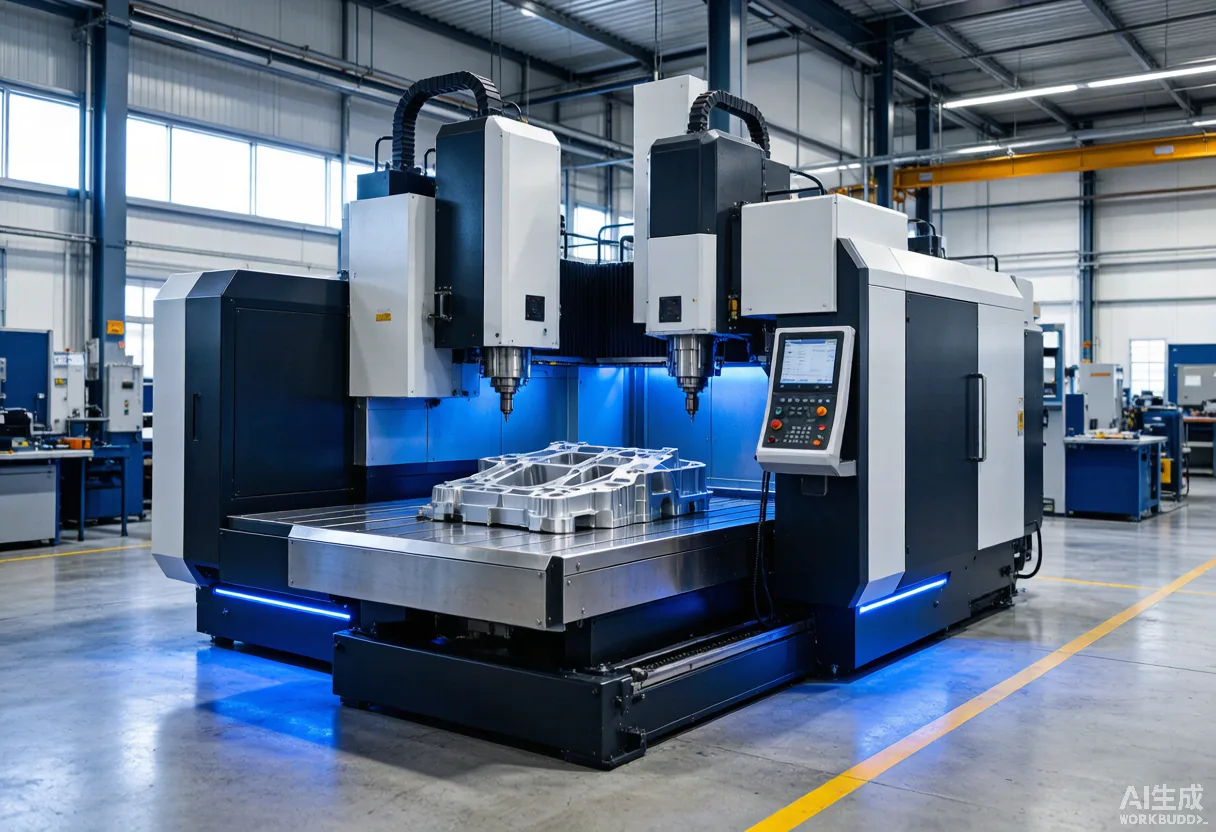
Any machine tool with five or more axes capable of simultaneous coordinated contouring control is controlled. This gate is pure geometry — accuracy does not matter. A 5-axis machining centre, a mill-turn centre with enough interpolating axes, or a multi-axis gantry all cross it on axis count alone. For background on how Gree builds these machines, see the Gree five-axis technology page.
3 · Why the spec-sheet number usually lies
This is the single place buyers get the classification wrong. A brochure line such as "positioning accuracy ±0.005 mm" looks like 5 µm — under the gate — but it usually is not comparable to the threshold, for three reasons:
- Different test definitions. Marketing sheets often quote per-300 mm travel or a single-axis bidirectional figure. 2B201 references ISO 230-2:1988, which defines positioning accuracy from statistical parameters measured over the full axis stroke (the standard is maintained by ISO TC39; search the current edition on the ISO catalogue).
- Compensation state. The controlled number is measured after all compensation (laser pitch correction, ball-screw mapping) is applied. A raw machine and a compensated machine give different numbers; the entry wants the best the machine can do.
- Environmental conditions. ISO 230-2 prescribes warm-up and ambient-temperature discipline. A value measured on a cold machine in a hot warehouse is neither better nor worse legally — it simply is not the number the gate uses.
The document that settles the question is the machine-specific ISO 230-2 inspection report, by serial number. Any serious exporter can produce it. If a salesperson only has a brochure number and no test report, treat the 2B201 classification as undetermined until the report arrives — not as "probably fine".
4 · Gree lineup against the gates
The table below applies the three gates to the Gree machine classes overseas buyers order most. Accuracy columns are indicative class ranges for orientation only; the controlling document is always the serial-numbered ISO 230-2 test report, which we provide on request before order confirmation.
| Machine class | Simultaneous contouring axes | Compensated accuracy (indicative class) | Gate result |
|---|---|---|---|
| Standard 3-axis VMC (MV856-class vertical machining centres) | 3 linear | Typically above 6 µm full stroke | Outside 2B201 |
| Drill-tap / tapping centres | 3 linear | Above 6 µm | Outside 2B201 |
| CNC turning centres (VT640-class), bar & chucking work | 2 linear (+ driven-tool positioning where fitted) | Typically above 6 µm; turning diameter gate still checked | Usually outside |
| Large gantry 3-axis / 5-face mills, X travel > 2 m | 3 linear (5-face indexing ≠ 5-axis contouring) | Carve-out checked: X accuracy must be worse than 30 µm | Verify per model |
| 5-axis machining centres (trunnion / cradle) | 5 simultaneous | Irrelevant — gate 3 met regardless | Controlled |
| Twin five-axis / twin-spindle gantry line | 5 simultaneous per spindle | Irrelevant — gate 3 met regardless | Controlled |
| High-precision grinders (if quoted) | Machine dependent | 4 µm gate checked from test report | Verify per model |
How to read this honestly: axis count is knowable from the brochure; the accuracy gate is knowable only from the test report. For a controlled model, Gree CNC coordinates the lawful export-licence route with the manufacturing factory and supplies the complete spec, end-use and final-user documentation. For a non-controlled model, we still hand you the test report, because the customs declaration now demands the parameters either way.
5 · Not controlled ≠ nothing to do: three exceptions
Passing all three gates answers one question (is the machine listed?). It does not answer whether paperwork, or even a licence, is still required.
Exception 1 — The No. 77 declaration still exists
From 30 June 2026 the exporter must self-declare dual-use status on the customs form even when the answer is "not controlled", and must file the accuracy and axis parameters, the full HS code and the real manufacturer's name. Simplified cross-border e-commerce filing is not available for machine tools.
Exception 2 — Catch-all / end-use control
China's export-control framework (and analogous rules in the EU and US) contains a "catch-all": an unlisted machine can still require a licence if the exporter knows or is informed it may be used for weapons of mass destruction or specified military end-uses, or if the destination is under an embargo. A 3-axis VMC heading to a sanctioned entity is not automatically legal merely because 2B201 does not list it.
Exception 3 — Your own border and re-export
Import-side rules, duties and end-user undertakings are governed by your country, and re-exporting the machine later can trigger the licensing rules of the country where it ends up. The 2B201 self-check is about leaving China; it is not an import permit for Germany, India or the United States. Country-by-country clearance is mapped in our companion research on GREE CNC.
6 · Printable pre-order checklist
Work through these before you sign the PI:
- Count the simultaneously contouring axes on the ordered configuration and on the machine as designed (options included). Five or more → controlled, stop here and plan the licence route.
- Count live rotary forming axes. Two or more that interpolate while cutting → controlled.
- Request the ISO 230-2 test report by serial number (or factory inspection protocol equivalent), compensation applied, and read the full-stroke positioning accuracy — not the brochure shorthand. Compare against 6 µm (lathes also check the 35 mm turning-diameter condition; grinders use 4 µm).
- For large mills, check the carve-out: X travel > 2 m and X accuracy worse than 30 µm, together.
- Confirm the supplier will state "controlled" or "not controlled" in writing and file the matching No. 77 customs declaration with full HS code and manufacturer name.
- Check end-use, end-user and destination against sanctions lists and your own import rules; prepare the end-user certificate wording early.
- If anything is borderline or contradictory between documents, ask the authority channel or a dual-use-experienced broker before shipping — a ruling in week one is cheap; a container held in week ten is not.
This page is formatted to print: use your browser's print function (Ctrl/Cmd-P) and the checklist and exception cards break onto paper cleanly.
7 · Primary sources
- Wassenaar Arrangement — List of Dual-Use Goods and Technologies, Category 2, entry 2B201 (machine tools): wassenaar.org, section "Controlling Exports".
- China Ministry of Commerce / export-control portal — Catalogue of Dual-Use Items and licensing guidance: exportcontrol.mofcom.gov.cn.
- US EAR / Commerce Control List, Category 2, entries 2B001 (machine tools) and 2B002: eCFR, 15 CFR Part 774, Supplement No. 1.
- ISO 230-2 — Test code for machine tools, determination of accuracy and repeatability of positioning of numerically controlled axes: ISO standards catalogue.
Thresholds quoted above track the Wassenaar list transplants in force as of September 2026. List versions are revised periodically; confirm the current revision with the issuing authority before a binding declaration.
8 · FAQ
My spec sheet says positioning accuracy ±0.005 mm. Is that below the 6 µm threshold?
Not necessarily. Shorthand figures are usually quoted per 300 mm of travel under an unspecified protocol. The gate uses full-stroke positioning accuracy measured per ISO 230-2:1988 with all compensation applied. Request the serial-numbered test report; that number — not the brochure — decides gate 1.
Can the factory just disable the fourth or fifth axis so the machine is not controlled?
No. Control follows native hardware capability, not the shipped configuration. A 5-axis-capable machine delivered with rotary functions switched off, or split into kits, stays controlled, and software-locked shipments are a recognized enforcement red flag.
I am buying a standard 3-axis VMC from China. Does it need an export licence?
Usually no: no rotary forming axis, no five-axis coordination, and compensated full-stroke accuracy normally above 6 µm means none of the gates is met. The test report is still required because No. 77 makes dual-use status and the technical parameters a mandatory customs field either way.
If the machine is not controlled under 2B201, is there any paperwork left?
Yes. The exporter still self-declares it as non-controlled with technical parameters, full HS code and manufacturer name. Catch-all clauses can additionally require a licence because of sensitive end-use, end-user or destination, and your own import-side and re-export rules apply independently.
Who makes the final determination?
The competent export-control authority — in China, the Ministry of Commerce administers the dual-use catalogue and licensing while customs verifies declarations. This self-check prepares buyers and suppliers; it is not a legal classification, and the authority's ruling on the actual machine and transaction prevails.
Ask us for the ISO 230-2 test report and 2B201 classification note
Tell us the model and destination. We return the serial-level accuracy data, an axis-capability statement and a written "controlled / not controlled" indication you can hand your customs broker — before the PI is signed.