The three faces of Chinese five-axis, side-by-side for buyers.
WeChat Intel Monitor · 2026-08-17
Embodied AI & the Humanoid Supply Chain: A CNC Buyer's Read on China's Robotics Boom
Executive summary — read this first.
- Embodied AI (让机器人像人一样感知和动作的人工智能 — AI that lets robots perceive and act like humans) has become China's fastest-moving deep-tech theme: embodied-AI financing reached ¥93.5 billion in H1 2026, nearly double the full-year 2025 total.
- The real signal for CNC buyers is the core-component supply chain: harmonic reducers, dexterous hands, six-axis force sensors and servo motors are scaling at triple-digit rates — the same precision parts that sit inside a machining center's motion system.
- Localisation is jumping: servo motors ~23% (2023) → ~70% (2026); harmonic reducers 27% → 48% in the humanoid segment; six-axis force sensors moved from <10% to volume supply in 2026.
- One gap remains honest: planetary roller screws — domestic yield still trails global leaders, so verify the brand of precision transmission parts during machine acceptance.
- What it means for you: a stronger domestic component base improves supply stability and cost for Chinese five-axis centers, while robotics + NEV demand is a multi-year tailwind for the whole machine-tool market.
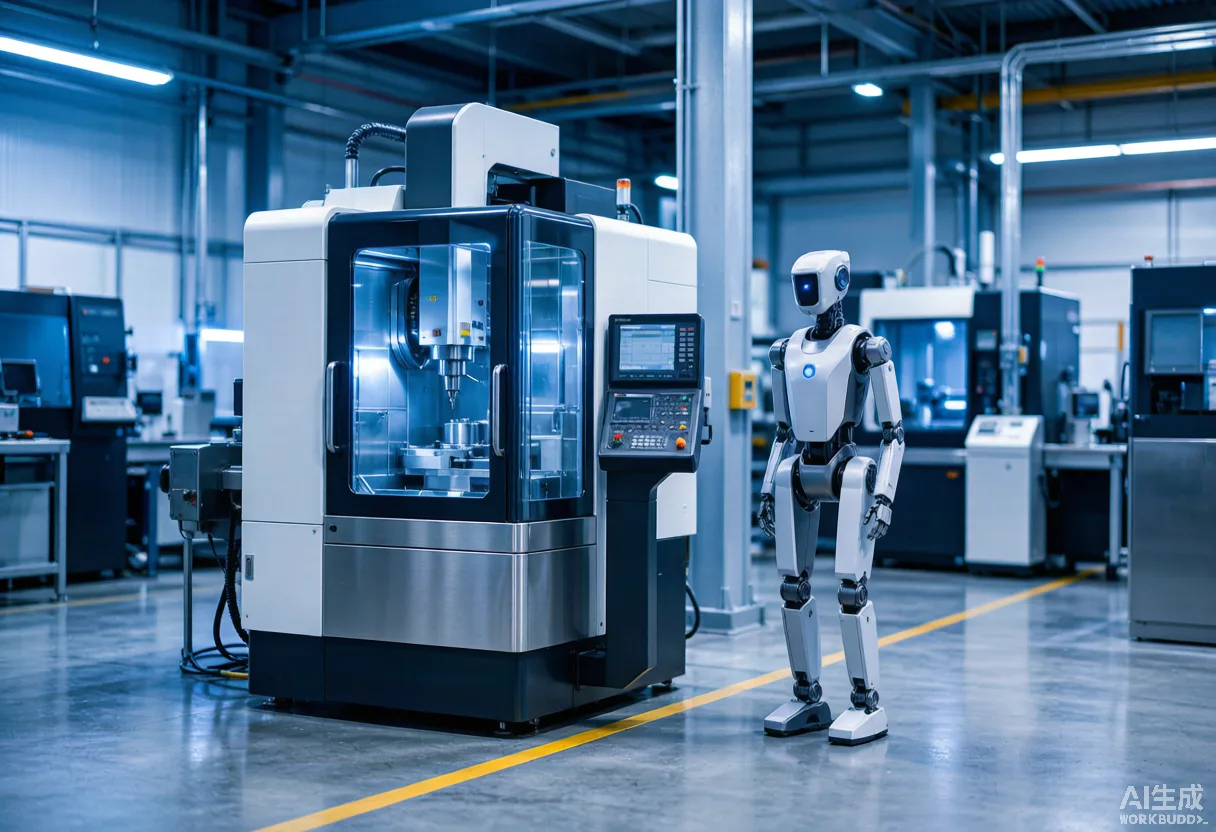
Why a CNC dealer should watch the humanoid boom
A humanoid robot is, mechanically, a stack of precision actuators: reducers, screws, servos, sensors and grippers. Those are the same component families that determine how accurately and reliably a CNC machining center cuts metal. When an entire component tier scales up, two things happen for machine-tool buyers:
- Supply More domestic capacity → more stable sourcing and lower cost for the precision parts inside a five-axis center.
- Demand Robotics and new-energy-vehicle (NEV) production are the fastest-growing users of five-axis machining — a multi-year pull on machine-tool orders.
So the humanoid story is not a side-show for a CNC dealer; it is a leading indicator of both the cost structure and the order book of the machines you sell.
The core-component supply chain — the real story
We tracked the most-cited components across Chinese robotics industry media (高工机器人 / GGII, 甲子光年, 机器之心). The picture is a fast-closing localisation gap, with one exception.
+247%
Forecast 2026 China humanoid shipments (62.5k units)
+105%
Harmonic-reducer market growth 2025→2026
~70%
Servo-motor localisation (2026, from ~23% in 2023)
+265%
Dexterous-hand volume 2025→2026
Harmonic reducers — the breakout
One leading domestic reducer maker reported Q1 2026 new orders up +320% year-on-year, with a backlog exceeding ¥4.8 billion and monthly capacity climbing from 50k toward 100k units. A single humanoid uses 14–26 harmonic reducers. For CNC buyers the takeaway is simple: the precision-transmission tier that feeds machine tools is now capacity-rich and price-competitive.
Dexterous hands & six-axis force sensors
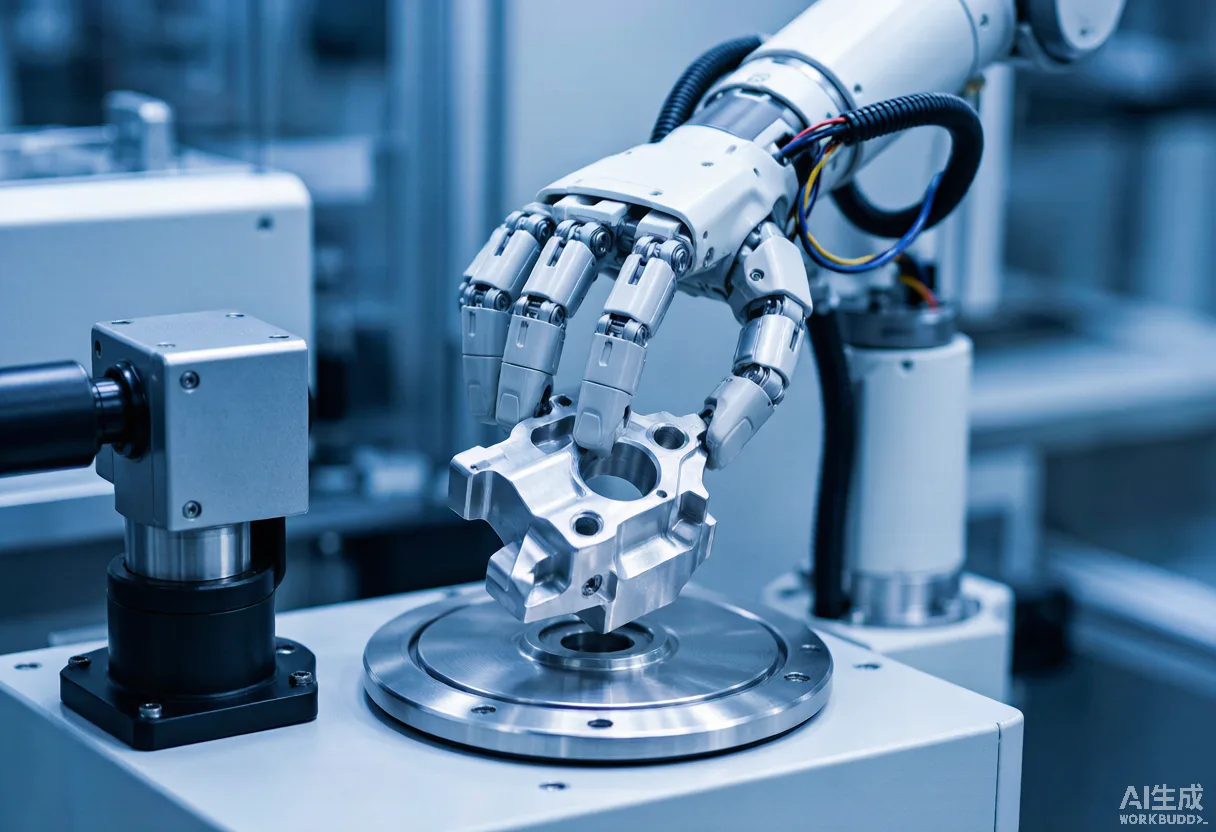
Dexterous-hand (灵巧手) volume is forecast to jump from 19k units (2025) to 70k (2026), reaching 430k by 2030. Six-axis force/torque sensors — the "feel" behind precise force control — moved from under 10% localisation to volume supply in 2026, with reported gross margins above 50%. Both are the same sensing/actuation DNA used in machine-tool probing and constant-force machining.
Servo motors — nearly closed
Servo localisation rose from ~23% (2023) to ~70% (2026). Servos drive both robot joints and CNC feed/spindle axes, so this is the most directly transferable win for machine-tool cost and lead time.
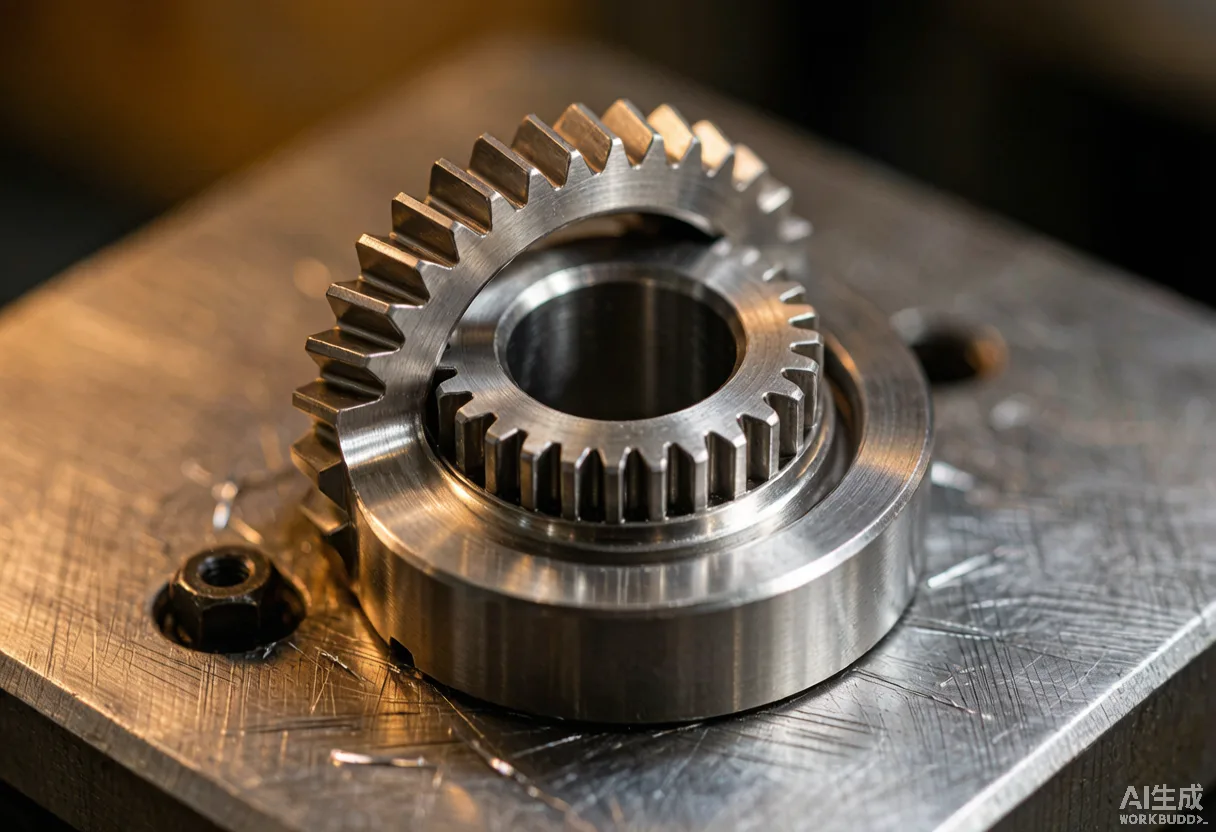
One honest gap. Planetary roller screws — the linear-transmission core for both robots and machine axes — still show a domestic yield of about 60% versus 85%+ at global leaders. It is not a failure; it is the last tier where "verify the component brand at acceptance" still applies. Gree itself acknowledges that ultra-precision bearings and encoders are still partly imported — see the credibility note below.
Embodied AI is a data problem, not just a hardware one
The robotics media (机器之心) repeatedly lands on the same bottleneck: high-quality real-world interaction data is the scarce asset. Leading labs train on tens of thousands of hours of human/teleoperation data, and "world models" (世界模型, simulators that predict what happens next) are the current fix for the data-scarcity problem.
Why a CNC buyer should care: the same logic applies to machine tools. A supplier's real edge is process know-how — proven cutting data, not demo videos. When evaluating any "smart / autonomous" machining claim, ask where the data comes from and request a paid trial part before committing volume.
The policy tailwind behind smart manufacturing
China's 15th Five-Year Plan frames embodied AI and 6G as new growth poles, and the smart-manufacturing base is already large (sources: 智能制造IMS / MIIT):
- Factories 7,000+ advanced-level and 500+ excellence-level smart factories; 8,000+ 5G factories.
- Impact A sample of 100 5G factories reported average operating-cost reduction of 19%.
- Scale Industrial-internet core industry reached ¥1.6 trillion in 2025,拉动 (driving) a ¥2.5 trillion broader effect.
A policy-backed, digitised manufacturing base is a long-term floor under machine-tool demand — and a reason overseas buyers can expect continued supplier investment in capability, not just price.
What this means for overseas buyers & dealers
- Lead with the supply-chain story. "China's precision-component tier is now capacity-rich and price-competitive" is a credible confidence point for customers worried about delivery and cost — backed by the harmonic-reducer and servo data above.
- Position five-axis for robotics & NEV. Gree's scenario-fit models map cleanly onto the booming segments: GA-FA320 (robot joints / precision parts), GA-UHD500 (EV parts, 1.5 s tool change, 0.002 mm repeatability), GA-FMB3020D gantry (large complex parts, +25% efficiency vs a single five-axis setup, 2025 Geneva gold).
- Run a local service model, not just trade. China's outbound playbook is shifting from "sell and ship" to local entities, local teams and lifecycle/used-equipment economics — the same model our Malaysia service point is built on.
- Keep the diligence checklist. Verify controller origin, precision-transmission brands and real process data on a paid trial part. Treat any "fully self-developed / fully autonomous" claim with the credibility rating it deserves.
Data credibility rating
| Claim | Source | Rating |
|---|---|---|
| Embodied-AI financing ¥93.5B in H1 2026 (vs ¥45B FY2025) | 甲子光年 industry report | Medium third-party report, search-summary sourced |
| Harmonic-reducer market +105%; localisation 27%→48% | GGII / 高工产业研究 (forecast) | Medium forecast, labelled as such |
| Leading reducer maker Q1 orders +320%, backlog ¥4.8B | Corporate disclosure via GGII | High specific, attributable |
| Servo localisation ~23% (2023) → ~70% (2026) | Industry statistics | High consistent cross-source |
| Six-axis F/T sensor <10% → 2026 volume supply | 高工 frontline research | High |
| Planetary roller-screw domestic yield ~60% vs 85% global | 高工 frontline research | High gap openly reported |
| Smart factories 7,000+ / 5G factories 8,000+ / cost −19% | MIIT / 智能制造IMS | High official policy data |
| "Gree controller fully self-developed" | — | Low not claimed here; controller is partner-led (partial) |
Which Gree model fits the robotics / NEV wave?
- Robot joints / precision parts → GA-FA320 (direct-drive rotary table, zero-backlash).
- EV production-scale parts → GA-UHD500 (fast tool change, 0.002 mm repeatability).
- Large, complex, low-volume parts → GA-FMB3020D gantry (+25% efficiency, 6-face machining).
- 3C mirror-finish → GA-VT540.
Bottom line. China's robotics boom is a supply-chain and demand tailwind for CNC, not a threat. Use the component data to build buyer confidence, keep the diligence checklist honest, and let the +25% gantry efficiency and scenario-fit lineup carry the pitch.
Frequently asked questions
Why should a CNC buyer care about humanoid robots and embodied AI?
Because the same precision-manufacturing ecosystem that builds humanoid components — harmonic reducers, roller screws, servo motors, six-axis force sensors, dexterous hands — is the upstream of CNC machine tools. A fast-scaling domestic component base means more stable supply and lower cost for the precision parts inside a machining center, and a stronger long-term demand pull from robotics and NEV production.
Which core components are now mostly localised in China, and which still lag?
Localisation has jumped fast for servo motors (about 23% in 2023 to roughly 70% in 2026) and harmonic reducers (about 27% to 48% of the humanoid segment). Six-axis force sensors moved from under 10% to volume supply in 2026. The remaining gap is in ultra-precision transmission parts such as planetary roller screws, where domestic yield still trails global leaders — verify component brands during machine acceptance.
Does this mean Gree's CNC controller is fully self-developed?
No. Gree's self-development is strongest on the motion-execution chain — spindle, linear motor, direct-drive rotary table and servo. The CNC 'brain' (controller) is partner-led, in line with the rest of the Chinese machine-tool industry. We rate Gree's controller as partial / not fully claimed, and recommend validating controls on a paid trial part.
What is the single biggest risk the robotics boom hides for buyers?
Hype. Embodied-AI training is a 'data-scarce' problem: real-world interaction data, not marketing slides, decides whether an automation line actually works. Translate that to CNC buying — ask where the process know-how comes from, request a paid trial part, and treat any 'fully autonomous / fully self-developed' claim with the credibility rating it deserves.
Related reading
Building a robotics or NEV parts line?
Send your part drawing, material, tolerance and target volume — our application engineers will recommend the best Gree model, run a cycle-time estimate and return a quotation within one business day.