The company-level companion to this market-structure piece: the twin five-axis gantry, in-house motion components and the honest control-layer note.
Issue #17 · Market Structure
China's Machine-Tool Replacement Cycle: Why 2026–2027 Is a Buyer's Window
How a domestic renewal programme reshapes lead times, export pricing and diligence · 2026-08-17 · For overseas CNC buyers and distribution partners. ← Back to GREE CNC · China CNC Daily Insights →
Contents
Executive Summary
- The base is old. Of roughly 8 million metal-cutting machine tools in service in China, about 3 million (40%) have been running more than ten years. The 2024–2027 renewal wave is sized at close to 1 million machines a year, a pool worth over ¥300 billion (≈US$42 billion) annually.
- The swap is subsidised. The 2026 industrial mother-machine upgrade rules grant up to ¥300 million per project, backed by ¥50 billion+ of central and local funding and a ¥1.5 trillion ultra-long special treasury bond earmarked for equipment renewal.
- For an overseas buyer this is indirect good news. Domestic volume keeps lines warm, compressing five-axis delivery windows to a frequently quoted 2–4 months, and pressures export pricing.
- But variance widens with volume. When makers chase throughput, verification discipline differs between suppliers. The cycle is a reason to look harder, not to skip diligence.
- Price on total cost of ownership. Landed cost, witnessed acceptance, control-layer risk, spares lead time and training belong in the business case — not in a footnote.
1 · Snapshot: the replacement math
China operates one of the world's largest installed bases of metal-cutting machines. Industry estimates place the stock at roughly 8 million units, of which about 3 million are more than ten years old. The national renewal programme running to 2027 targets close to 1 million replacements per year.
~8 M
Metal-cutting machines installed in China (estimate)
~40%
Of that base is more than 10 years old
~1 M/yr
Replacement pace targeted to 2027
¥300 B+
Annual value of the refresh pool
Two forces push that number up, and only one of them is political:
- Wear-out. Machines past a decade show rising scrap rates and drifting repeatability. For precision work the case for replacement is mechanical.
- Capability gap. The parts being ordered now — NEV (new-energy-vehicle) battery trays, humanoid-robot joints, 3C (computer, communications and consumer-electronics) housings — need five-axis dynamics and structural rigidity that a 2008-era VMC (vertical machining center) simply does not have.
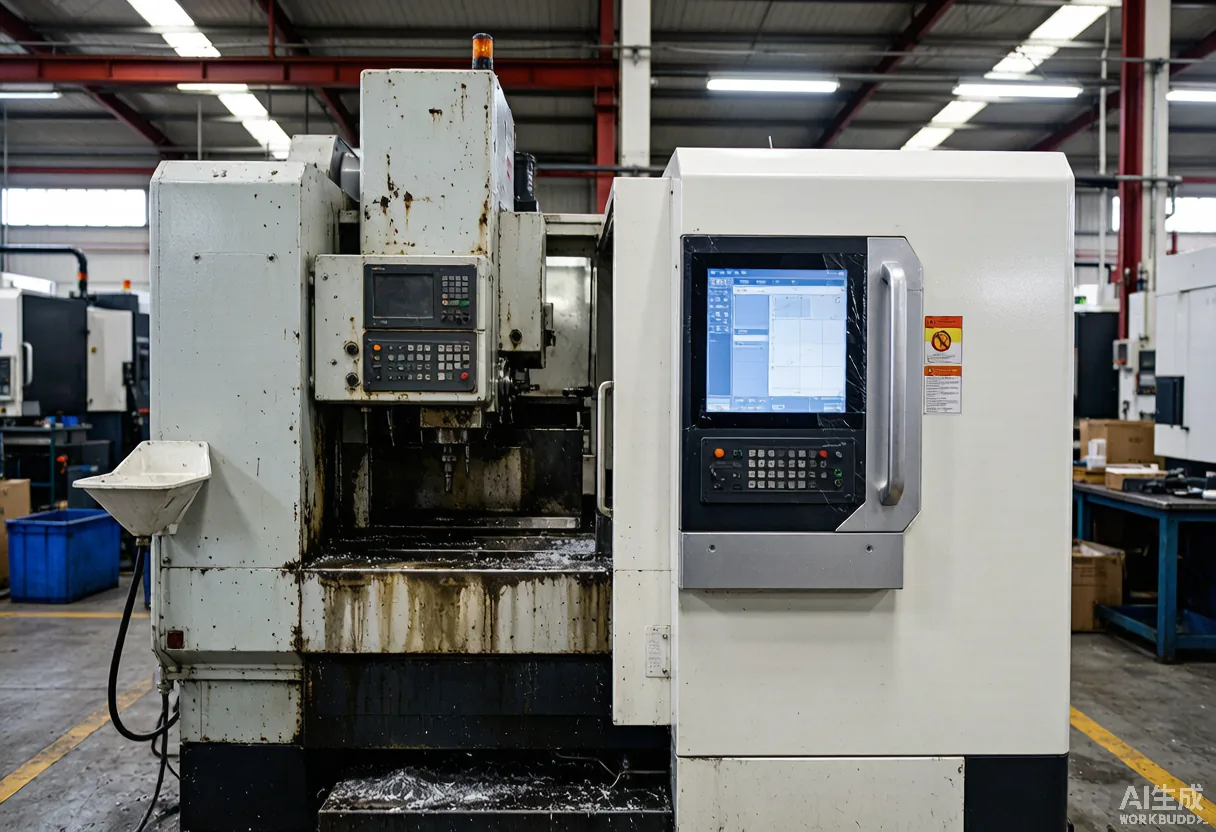
The demand side is visible in output data rather than forecasts. In the first half of 2026, Chinese output of horizontal lathes and vertical machining centers rose +45.8% and +32.0% year on year respectively. The five-axis segment, valued at about ¥12.8 billion in 2025, is projected to compound at roughly 22% a year through 2030. Both figures come from market-research and trade sources, so we grade them Medium rather than High — see the credibility table below.
2 · What the cycle gives a buyer
A domestic renewal programme is not a discount coupon for foreign buyers. Its benefits arrive through the supply chain, in three specific levers:
| Lever | What the cycle does | What a procurement lead sees |
|---|---|---|
| Lead time | Domestic volume keeps assembly and machining lines warm year-round | Five-axis deliveries commonly quoted at 2–4 months versus 6–12 months for some Western equivalents (configuration dependent) |
| Price | R&D amortised over larger runs; subsidy-driven domestic competition | Aggressive export pricing; total cost of ownership frequently favourable once freight and duty are included |
| Iteration speed | Fast model turnover in the home market | Newer kinematics, spindles and control packages reach the export catalogue sooner |
| Component depth | Volume funds in-house rotary tables, swing heads, spindles and linear motors | Fewer single-source subsystem dependencies in the quoted machine |
The fourth lever is the one most buyers underrate. Motion-chain components — rotary tables, swing heads, electric spindles, linear motors and linear encoders — used to be the reason a Chinese five-axis quote carried hidden import exposure. Volume from the renewal cycle is what pays for developing them in-house, which is why component localisation has moved faster in the last three years than the finished-machine headlines suggest.
3 · What the cycle does not give you
This is the part a serious buyer should read twice. Volume improves availability and price. It does not automatically improve verification.
Three things you still have to establish yourself
- Accuracy on paper is not accuracy on your part. Brochure repeatability figures are vendor-stated. Ask for written positioning and repeatability values tied to a named standard, and a witnessed cut on geometry resembling your part.
- The control layer deserves its own line in the business case. High-end CNC controls remain the segment where the international top tier is strongest. Where a machine uses a domestic or partner-supplied control, price the productivity and training implications explicitly rather than assuming parity.
- Acceptance testing is a budget item. A witnessed factory acceptance test with an S test piece (ISO 10791-7) and written ISO 230-2 figures costs time and money. Buyers who treat it as optional discover the cost later, in scrap.
None of this is unique to Chinese equipment; it is standard capital-goods diligence. The difference is that a fast-scaling supplier base has a wider spread between its best and its median, so the value of doing diligence properly is simply higher.
4 · Competitive positioning
Simplified, the market a buyer is choosing from now looks like this:
| Tier | Typical proposition | Where it wins | Where to probe |
|---|---|---|---|
| International top tier | Mature control, documented acceptance, global service | Long-cycle aerospace and medical work; accuracy retention over years | Lead time, landed price, licence exposure on certain configurations |
| Chinese leading builders | Strong structure and dynamics, increasingly in-house motion chain, fast delivery | NEV, 3C, general precision, high-cadence production | Control maturity, third-party acceptance documentation, spares network |
| Chinese volume builders | Lowest sticker price, standard configurations | Simple three-axis work with modest tolerance bands | Structural rigidity, thermal behaviour, accuracy retention |
Where Gree Intelligent Equipment sits
Gree Intelligent Equipment, the Gree Electric subsidiary behind the machines we distribute, is a useful worked example of a builder scaling inside this cycle. Its intelligent-equipment segment reported roughly ¥681 million of revenue in 2025 and was the group's fastest-growing business line that year, per an exchange investor-relations disclosure — the most authoritative scale figure available, and one of the few we grade High. Its Zhuhai and Changsha bases are running at capacity.
More relevant than revenue is what the volume has funded. Gree develops its own precision rotary tables, direct-drive swing heads, electric spindles and third-generation linear motors, which is why models in the current catalogue read the way they do:
| Model | Defining characteristic (vendor-stated) | Typical fit |
|---|---|---|
| GA-FA320 | Full direct-drive cradle trunnion; repeatability 0.006 mm; 2.5 s tool change | Five-axis VMC work: aluminium structures, valve bodies |
| GA-UHD500 | Positioning 0.004 mm, repeatability 0.002 mm; rapid traverse 60 m/min; 1.5 s tool change; 0.001° table indexing | Combined roughing and finishing on one setup |
| GA-FMB3020D | Twin five-axis gantry; +25% efficiency; gold medal, 50th Geneva Inventions Exhibition | Large NEV die-cast parts and aerospace panels |
| GA-DV750 | Three-axis linear direct drive; 1 G acceleration | High-cadence precision milling |
| GA-UV1050 | 300 Nm spindle; bed rigidity ≥265 N/µm | Heavy-torque cutting |
| GF-series (GA-GF2755 / GF3755) | 20,000 rpm; X rapid traverse 80 m/min; mineral-cast bed for long parts | Battery trays, body rails, cold plates |
Two honest notes. First, model designations differ between the domestic and export catalogues, so confirm the exact suffix against the quotation rather than against an article. Second, we do not claim a fully proprietary high-end control system: the control layer leverages domestic CNC partners, and the +25% efficiency figure for the twin-gantry platform is our standing export-facing standard, deliberately more conservative than higher domestic marketing numbers, so that a customer re-test does not embarrass anyone.
5 · Overseas reality: lead time, licensing, service
Three practical items shape whether the window is actually usable from outside China.
Lead time is real but configuration-sensitive
The 2–4 month figure holds for catalogue configurations. Custom fixturing, non-standard controls, automation cells or export documentation for regulated end-uses all extend it. Ask for the quoted lead time to be split into build, test and shipping, and put it in the contract.
Subsystem licensing is now a live question
Japan's revised Export Trade Control Order took effect on 16 August 2026 and moved certain five-axis machining centers, precision rotary tables, linear encoders and CNC design software into a tighter licensing category, with reported approval windows measured in months rather than weeks. Press reporting also places a large share of the high-end linear-encoder market with Japanese suppliers.
For a buyer, the takeaway is administrative rather than political. Ask any vendor — Chinese, European or Japanese — to state in writing which subsystems in your quoted configuration originate in a licence-controlled jurisdiction, and what the substitution plan is if a licence is delayed. A machine builder with a genuinely in-house motion chain has a shorter answer to that question, which is precisely why component localisation has become a commercial argument and not just an engineering one.
Service coverage decides the real cost
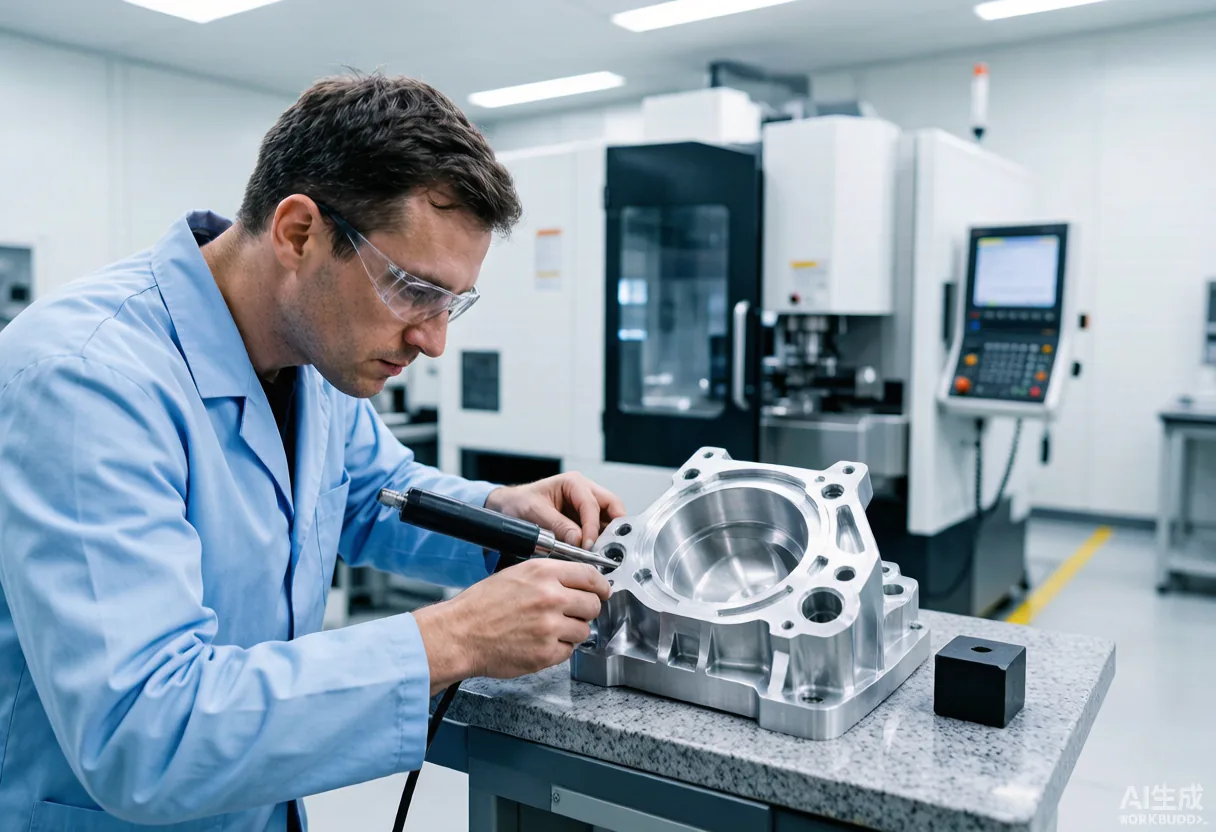
A competitive machine with a twelve-week spare-part wait is an expensive machine. Confirm before signing: spare-parts stocking location, guaranteed response window, remote-diagnostic access to the builder's engineers, and who pays travel. On our side, a dedicated Southeast-Asia service point is being established in Malaysia as the pilot for regional spares and field support, alongside coverage for North America, Europe and the Middle East.
6 · Data credibility rating
Every number in this report carries a grade. We publish the grade rather than hiding it, because a buyer's risk sits in the ungraded claims.
| Claim | Value used | Credibility |
|---|---|---|
| Gree intelligent-equipment segment revenue, 2025 | ~¥681 million; fastest-growing group segment | High (exchange investor-relations disclosure) |
| Installed base / share over 10 years old | ~8 million units; ~40% | Medium (association and trade-press estimate, not an audited census) |
| Renewal pace and pool value | ~1 million machines/yr; ¥300 B+/yr | Medium (programme targets and trade-press sizing) |
| Subsidy parameters | ¥300 M/project; ¥50 B+ funding; ¥1.5 T bond | High (published policy documents and ministry releases) |
| H1 2026 output growth | +45.8% lathes; +32.0% VMCs | Medium (market-data providers) |
| Five-axis segment size and growth | ~¥12.8 B in 2025; ~22% CAGR to 2030 | Medium (market-research forecast) |
| Japan export-control revision | Effective 2026-08-16; tighter licensing category | Medium (press reporting of the revised order) |
| Machine specifications in the table | As listed | Medium (vendor-stated; no public third-party ISO 10791-7 / ISO 230-2 report) |
| Quoted delivery windows | 2–4 months typical | Indicative (configuration dependent; confirm per quotation) |
7 · Guidance by use case
If you are a job shop adding five-axis capacity
The window is genuinely favourable: shorter delivery and competitive pricing let you add capability without a twelve-month wait. Spend the savings on acceptance. Insist on a witnessed cut of a part representative of your worst tolerance, and budget post-processor and RTCP (rotary tool centre point) commissioning as part of the purchase, not as an afterthought.
If you are a tier-1 automotive or NEV supplier
Volume and cadence matter more than headline accuracy. Prioritise rapid-traverse speed, tool-change time, thermal stability over a full shift, and automation interfaces. Ask for a documented eight-hour drift test — not a cold-machine number — and confirm spares stocking in your region before committing to a line.
If you are in aerospace, medical or metrology-critical work
Be the most demanding buyer in the room. Require third-party acceptance documentation against a named standard, ask directly about accuracy retention over 24–36 months, and treat control maturity as a first-order selection criterion. If a vendor cannot produce the documentation, that is your answer, regardless of origin.
If you are a distribution partner
The strongest material you have this year is not price — it is availability plus a credible verification story. Lead with delivery certainty, in-house motion-chain depth and a documented acceptance protocol. Keep the conservative +25% efficiency framing and the honest control-layer note; buyers who catch an overstated claim discount everything else you say.
Five-point checklist before you sign
- Written accuracy and repeatability figures tied to a named standard, on the quotation.
- Witnessed acceptance cut on geometry resembling your worst part, with measurement report.
- Control-layer implications priced explicitly in the business case.
- Spare-parts stocking location, response window and travel-cost responsibility in writing.
- Lead time split into build, test and shipping, with the subsystem-licence question answered.
FAQ
How big is China's machine-tool replacement cycle?
Industry estimates put the installed base at roughly 8 million metal-cutting machines, with about 3 million (40%) in service more than ten years. The 2024–2027 renewal programme is sized at close to 1 million replacements a year, a pool worth over ¥300 billion (≈US$42 billion) annually. Treat the stock figure as Medium credibility: it is an association and trade-press estimate, not an audited census.
Why does a Chinese domestic renewal programme matter to an overseas buyer?
Indirectly, through three levers. Domestic volume keeps production lines warm, so five-axis delivery windows are frequently quoted at 2–4 months rather than 6–12; amortised R&D and subsidy-driven competition push export pricing down; and fast model turnover at home means newer geometries and control packages reach the export catalogue sooner. The trade-off is wider quality variance between suppliers, so diligence matters more, not less.
How should I price a Chinese five-axis machining center properly?
Use total cost of ownership rather than sticker price. Budget five items: landed acquisition cost including freight and duty; a witnessed factory acceptance test with a written S test piece and ISO 230-2 figures; the control-layer question priced explicitly; spare-parts lead time and local service coverage; and post-processor, RTCP tuning and operator training. A low ex-works price with a twelve-week spare-part wait is not a saving.
Does Japan's revised export-control order affect buying a Chinese machine?
It affects subsystem sourcing rather than the finished machine. The revised order took effect on 16 August 2026 and moved certain five-axis machining centers, precision rotary tables, linear encoders and CNC design software into a tighter licensing category, with reported approval windows measured in months. The practical action is administrative, not political: ask the vendor to state in writing which subsystems in your configuration originate in a licence-controlled jurisdiction, and what the substitution plan is.
Sources & references
- China machine-tool installed base, ageing share and 2024–2027 renewal sizing — Chinese industry-association and trade-press reporting, 2026.
- 2026 industrial mother-machine upgrade subsidy rules (per-project cap, combined funding, ultra-long special treasury bond, fixed-asset grant rate) — ministry releases and policy summaries, 2026.
- H1 2026 output growth for horizontal lathes and vertical machining centers — Chinese market-data providers, 2026.
- Five-axis segment sizing and growth outlook to 2030 — market-research reports, 2026.
- Gree Electric intelligent-equipment segment scale and growth ranking, 2025 — Shenzhen Stock Exchange investor-relations reply, July 2026.
- Gree Intelligent Equipment component development (rotary tables, direct-drive swing heads, electric spindles, third-generation linear motors) and model specifications — official product materials and Chinese industry coverage, 2025–2026.
- Japan's revised Export Trade Control Order, effective 16 August 2026 — press reporting of the revision, August 2026.
- Companion report: Gree CNC in China's Mother-Machine Era — GREE CNC Insights, 2026-08-15.
- Standing convention: overseas efficiency claim for the twin-gantry platform standardised to +25%; no OEM customer named without written consent.
Related reading
Talk to our application engineers
Send your part material, tolerance and volume — we return a recommended model, spec sheet and quote within one business day.
Request a Quote →