The digital-factory base — 5G private networks, agentic AI, robot-component localization — that underpins five-axis demand.
WeChat Intel · Issue #22
NEV & 3C Automation: The Demand Pull Behind China's Five-Axis Boom
Credibility-rated intelligence from Chinese industry media · ← All insights · ← GREE CNC
Executive summary — read this first.
- China's new-energy-vehicle (NEV), battery and 3C electronics automation is the single strongest demand driver for five-axis and machining-center capacity right now. NEV-sector industrial-robot procurement rose about 65% year-on-year in 2025, and welding-line robot installations are forecast to reach roughly 42,000 units in 2026 — both are direct proxies for machining-capacity expansion.
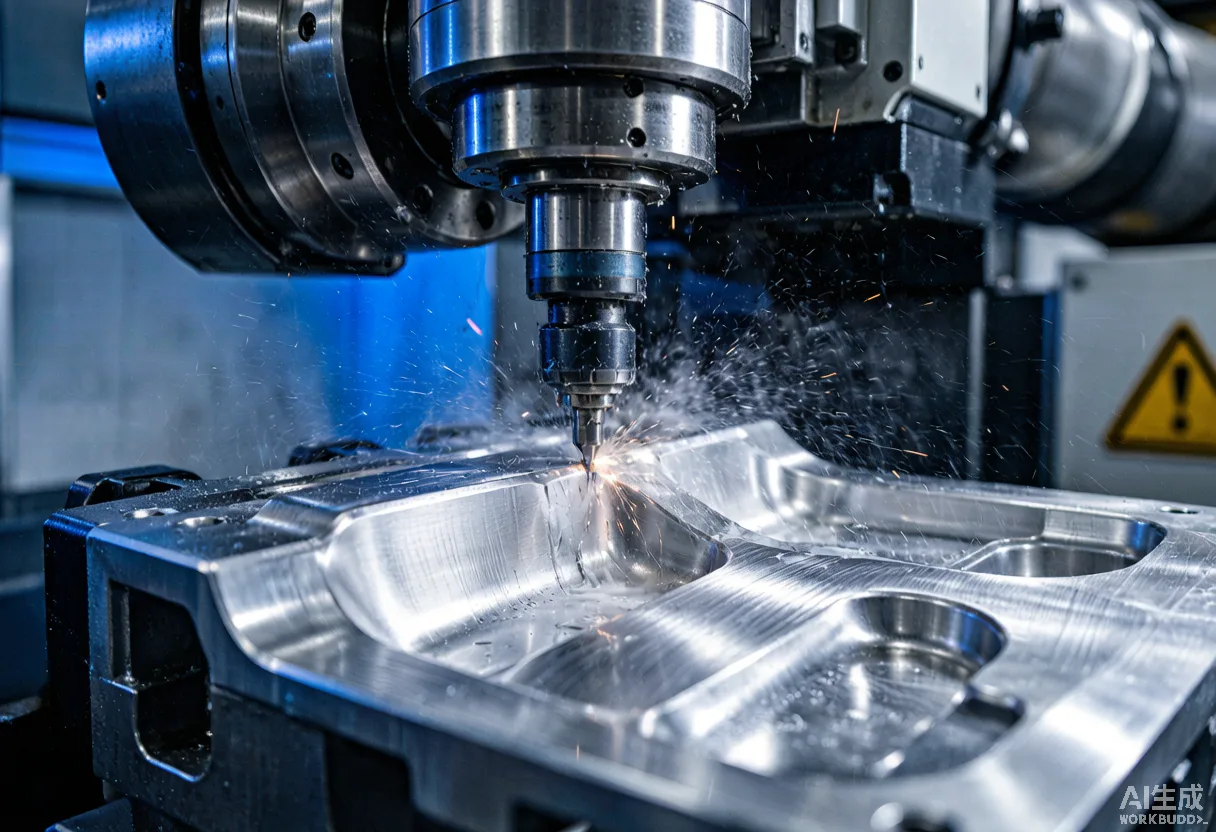
- The parts being machined — battery trays (PACK), motor/reducer housings, integrated die-cast nodes, robot joints, 3C enclosures — are exactly the high-mix, high-precision parts where single-setup five-axis wins on accuracy and cycle time.
- For overseas buyers, the upside is maturity: a domestic market that has been stress-tested by the world's most demanding high-mix, fast-changeover production has pushed China's machine-tool supply chain toward faster lead times, lower cost and better automation-readiness.
- Apply a buyer verification checklist before committing: validate specs on a paid trial part, confirm the CNC controller is partner-led (not "fully self-developed GNC"), and check data interfaces and regional service.
- All figures below are credibility-rated against named Chinese sources; vendor-stated numbers are flagged as Medium unless independently confirmed.
Why this is the demand signal to watch
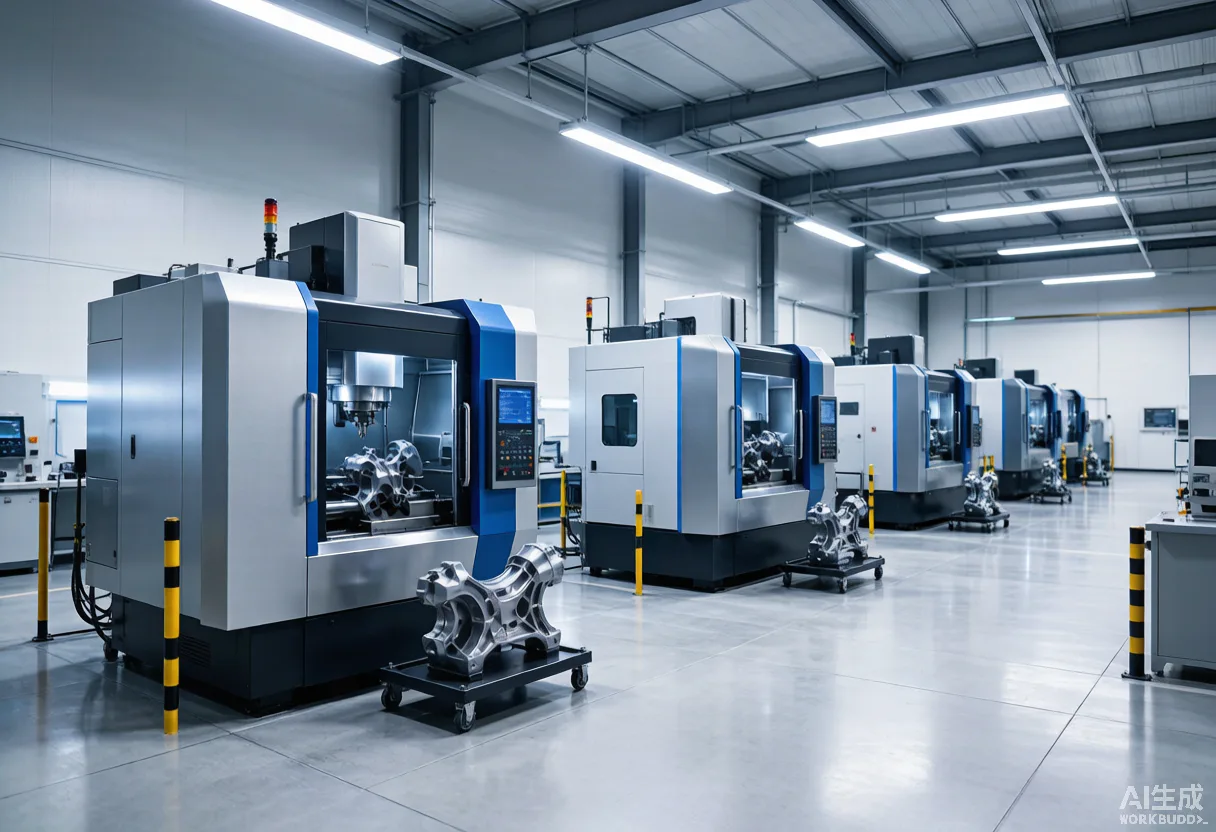
For two decades, China's machine-tool demand track ed the broader manufacturing cycle. What changed in 2025–2026 is the composition of that demand. Three sectors — NEV (New Energy Vehicle), batteries and 3C (Computer, Communication, Consumer-electronics) — now dominate capacity-expansion plans, and all three are unusually machine-tool-intensive.
Unlike traditional automotive, where a model runs for years, an NEV platform refreshes roughly every 1.3 years (about three times faster than legacy carmakers, per a 2026 industry think-tank report). That compresses tooling and fixture lifecycles and forces continuous machining-capacity churn — a structural tailwind for five-axis and flexible machining centers.
156K
Industrial robots, China auto & parts, 2026e (GGII)
+65%
NEV-sector robot procurement YoY, 2025
42K
Welding-line robots, 2026e (from 28K in 2023)
1.3 yr
NEV model refresh cycle (≈3× legacy)
What is actually being machined
The automation surge is not abstract — it translates into a concrete, recurring set of five-axis part families:
| Sector | Typical five-axis parts | Why five-axis |
|---|---|---|
| NEV | Battery trays (PACK), motor & reducer housings, integrated die-cast structural nodes | Large thin-wall aluminum, tight flatness, single-setup 6-face machining |
| Battery | Module/cell fixtures, cooling plates, end-plates | High-volume, high-precision, fast changeover between formats |
| 3C | Phone middle frames, camera brackets, mirror-finish enclosures | Mirror-grade surface, micro-tolerances, fast iteration |
| Robotics | Joint housings, dexterous-hand frames, reducer parts | Complex curved surfaces, low volume, high mix |
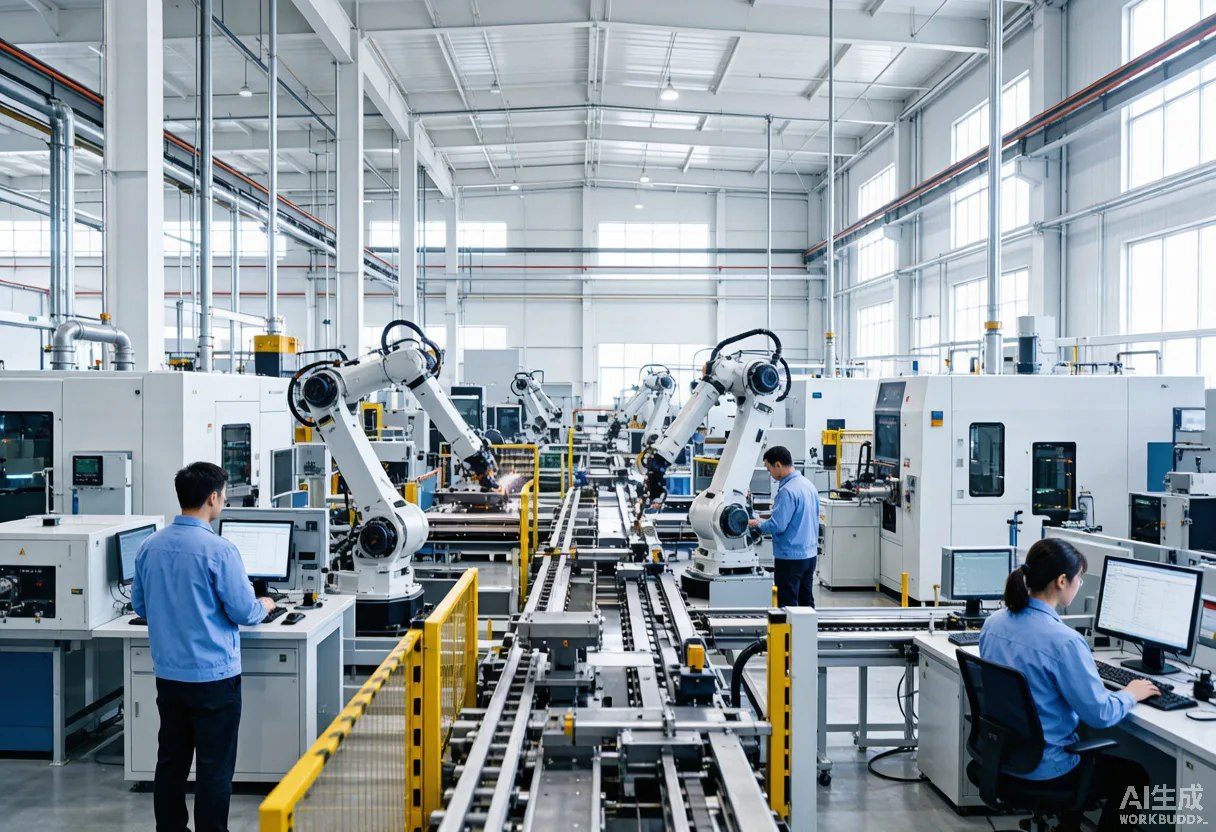
GGII data puts lithium-battery industry industrial-robot sales above 35,000 units in 2023 (about 70% in loading/unloading and handling), and NEV welding-line robot installs growing from ~28,000 (2023) toward ~42,000 (2026, ~14% CAGR). Each of those lines also needs the upstream machining that makes the fixtures, trays and housings — the demand that lands on five-axis shops.
What this means for overseas buyers
The same forces reshaping China's domestic market create three concrete advantages for an overseas distributor or end-buyer evaluating Chinese five-axis machines:
- Maturity Battle-tested supply chain. High-mix, fast-changeover domestic demand has matured China's core-component base. Localization of six-/seven-axis robot core parts is reported above 72%, and torque-sensor localization above 40% — the same motion-chain ecosystem that feeds machine-tool spindles, drives and tables.
- Cost & lead time Faster, cheaper capacity. Volume manufacturing at home translates into shorter lead times and lower price than European/Japanese imports for comparable envelope and accuracy.
- Automation-ready Factory-digitalization pull. National policy (eight-ministry "High-Quality Industrial Internet" plan) targets 50,000 industrial 5G private networks by 2030 and 207 industrial-category coverage. Machines that expose data interfaces and support remote diagnostics are increasingly the default expectation — a useful filter when you specify equipment.
Controller honesty (red line). A Chinese CNC "brain" is generally partner-led — most makers, including Gree, work with domestic controller specialists such as Huazhong CNC (华中数控). We rate full in-house GNC as Partial / Not claimed. The genuine in-house depth is on the motion-execution chain (spindle, linear motor, direct-drive rotary table, servo) — not on the controller firmware alone. Buyers should verify controller origin and the post-sale support path, not assume a fully proprietary stack.
Buyer verification checklist
- 1. Trial part. Validate published repeatability/positioning on a paid part in your own material and tolerance band.
- 2. Controller origin. Confirm who supplies the CNC controller and what the upgrade/support path looks like over the machine's life.
- 3. Automation-readiness. Check data interfaces (MTConnect/OPC-UA-style), remote diagnostics and compatibility with your MES/ERP.
- 4. Service footprint. Confirm spare-parts lead time and a local or regional service point — Gree's first overseas service hub is in Malaysia, with factory remote-diagnosis linkage.
- 5. Reference install. Ask for a live reference in your industry and region before volume commitment.
Data credibility rating
| Claim | Source | Rating |
|---|---|---|
| NEV-sector robot procurement +65% YoY (2025) | GGII / high-tech robot industry data | Medium reputable industry research, not a government primary stat |
| Auto & parts robot sales 156K (2026e); welding-line 28K→42K | GGII forecasts | Medium forecast, plausible trajectory |
| Lithium-battery robot sales >35K units (2023) | GGII / industry analysis | Medium industry estimate |
| NEV model refresh ~1.3 yr (≈3× legacy) | Jazzyear 《2026 Industrial AI Agent Report》 | Medium think-tank figure |
| 50,000 industrial 5G private networks by 2030 | MIIT et al. 《High-Quality Industrial Internet》 plan | High official policy target |
| Core-part localization 72% / torque-sensor 40%+ | Market-research aggregates | Medium range estimate, varies by segment |
Bottom line. The NEV/battery/3C automation wave is real and measurable, and it is the cleanest explanation for why Chinese five-axis capacity and capability keep climbing. For overseas buyers the takeaway is practical: the maturity is now exportable — provided you verify specs, controller origin and service on a trial basis rather than on brochures.
Frequently asked questions
Why is NEV manufacturing driving CNC machine-tool demand?
New-energy vehicles (NEVs), batteries and 3C electronics all need high-mix, high-precision metal parts — battery trays, motor housings, structural castings, phone middle frames — that are economical only on five-axis and fast machining centers. Industry data shows NEV-sector robot procurement rose ~65% in 2025 and welding-line robot installs are forecast to reach ~42,000 units in 2026, a direct proxy for machining capacity expansion.
Which parts need five-axis machining in EV, battery and 3C?
Typical five-axis parts include aluminum battery trays (PACK), motor and reducer housings, integrated die-cast structural nodes, humanoid-robot joint components, and 3C enclosures/middle frames requiring mirror-grade surfaces. These are low-volume-to-medium, high-complexity parts where single-setup five-axis beats multi-setup 3-axis on accuracy and cycle time.
Does China's automation surge mean better, cheaper five-axis for overseas buyers?
Yes, with caveats. High-volume, high-mix domestic demand has matured China's machine-tool supply chain (core-component localization, faster lead times, lower cost). Overseas buyers benefit from that maturity. Verify published specs on a paid trial part, confirm the CNC controller is partner-led (not claimed as fully self-developed GNC), and check automation-readiness (data interfaces, remote diagnostics).
Is a Chinese CNC controller fully self-developed?
Generally no. Most Chinese machine-tool makers, including Gree, use a partner-led controller approach (for example, Huazhong CNC / 华中数控 and similar domestic systems). We rate full in-house GNC as Partial / Not claimed. The motion-execution chain (spindle, linear motor, direct-drive tables) shows genuine in-house depth; the controller 'brain' is shared with domestic specialists.
What should overseas buyers verify before buying a Chinese five-axis?
1) Validate repeatability/positioning on a paid trial part. 2) Confirm controller origin and post-sale support path. 3) Check automation-readiness (MTConnect/OPC-UA style data interfaces, remote diagnostics). 4) Confirm spare-parts lead time and a local or regional service point. 5) Ask for a reference installation in your industry and region.
Related reading
Evaluating a five-axis line for EV, battery or 3C parts?
Send your part drawing, material, tolerance and target volume — our application engineers will recommend the right Gree model, run a cycle-time estimate and return a quotation within one business day.