The hardware side of the same story — reducers, screws, dexterous hands and where the bottlenecks sit.
Gree CNC · Industry Intelligence · Issue #31
The AI-Native Factory: What It Changes About Buying a CNC Machine
Executive summary — read this first.
- The evaluation lens is moving. China's industrial-AI and smart-manufacturing push is quietly shifting what "a good CNC" means. For an AI-native plant, data readiness and MES/ICS interfaces now matter as much as spindle speed and repeatability.
- Industrial AI agents are real, not vapor. 甲子光年's 2026 report models a ¥361.9B AI-augmented industrial-software market by 2030; demonstration cases cut single-part setup from 20→5 min and lifted scheduling attainment from 50%→90%.
- Policy sets a high baseline. Eight ministries target a ¥2.5T smart-manufacturing core industry by 2030, 50,000 5G private networks, and China already runs 8,000+ 5G factories (operations cost −19% at benchmark plants).
- Robotics keeps CNC demand durable. GGII forecasts ~62,500 humanoid units in China for 2026 (+240% YoY); the planetary-roller-screw localization gap (15%) is a long runway for high-precision machining.
- What this means for you: before you buy, ask vendors about open data interfaces, OPC UA / MTConnect and remote monitoring — and verify Gree's integration maturity honestly rather than assuming.
1. Factory-native AI agents are leaving the lab
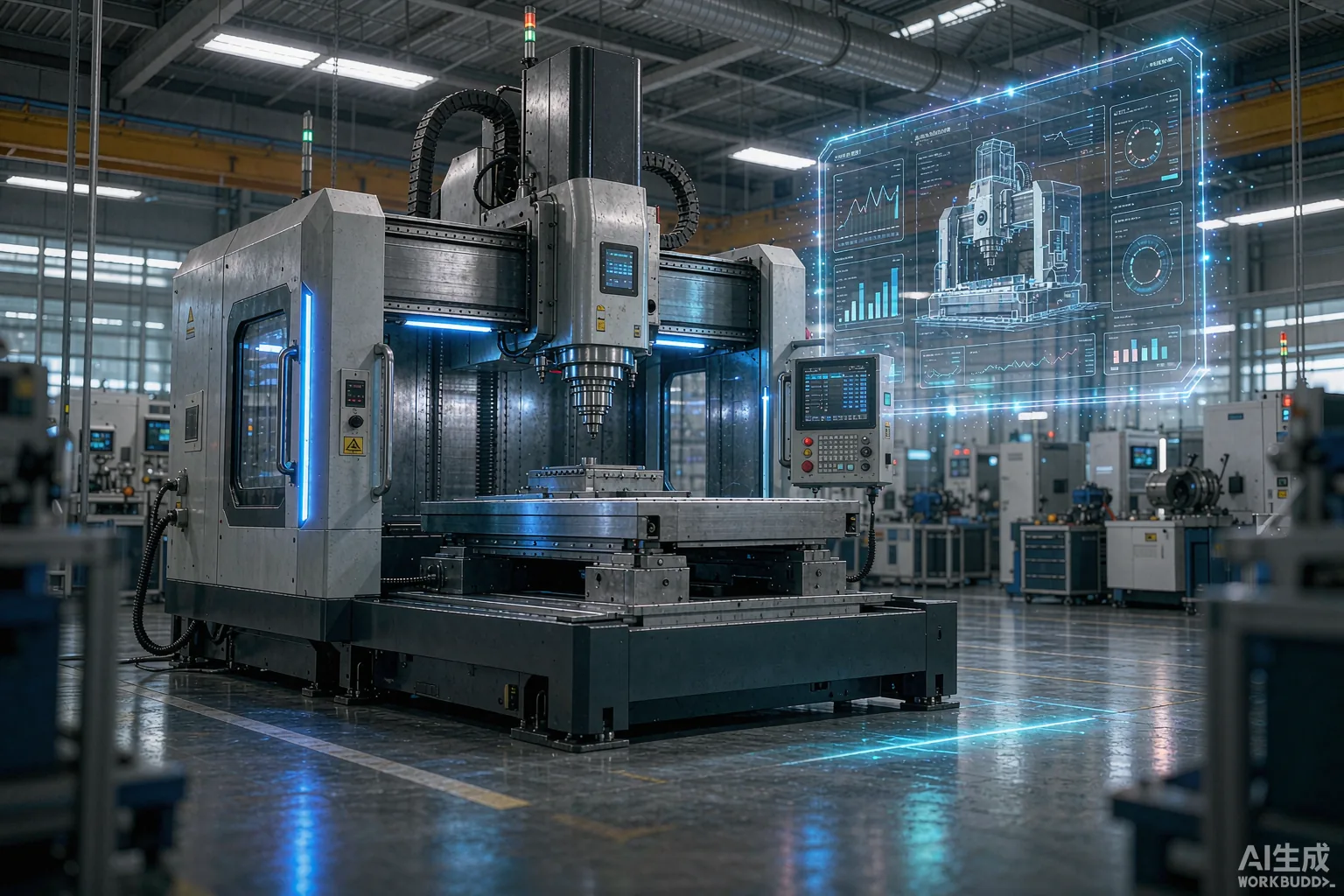
According to 甲子光年's 2026 Industrial AI Agent Research Report (published 2026-09-07), the next step in manufacturing digitalization is not a bigger MES but factory-native AI agents — small, task-specific models that sit on top of production data and act: a process agent, a scheduling agent, a monitoring agent. The report models the AI-augmented industrial-software market at ¥361.9B by 2030 (on a ¥657.5B base, a 55% enablement rate).
The concrete numbers come from demonstration cases at automotive precision-parts suppliers (reported as partners of SAIC Volkswagen and a Huawei supply chain): wiring process + scheduling + monitoring agents together cut single-part preparation 20→5 min, raised scheduling attainment 50%→90%, and shrank plan-adjustment time 2 hr→5 min. The report notes scheduling agents drew the strongest willingness to pay.
Read it as a direction, not a guarantee. These are vendor-cooperative demonstration cases on specific lines; the 2030 market figure is a modeled forecast. They prove the pattern is commercializing, not that every plant sees those numbers.
2. Smart manufacturing is now national infrastructure
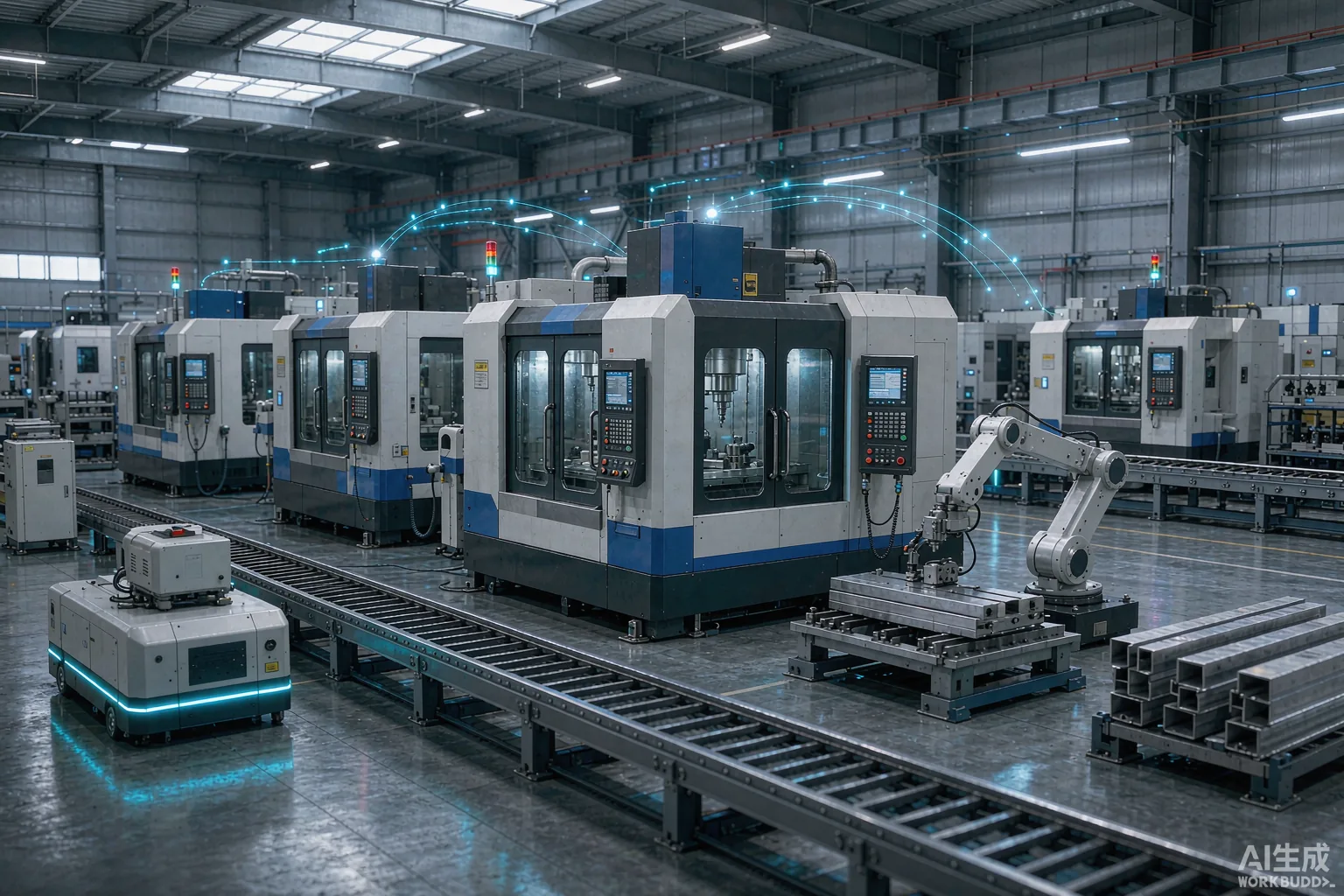
On 2026-06-30, eight Chinese ministries issued an Implementation Opinion targeting a smart-manufacturing core-industry added value of over ¥2.5T by 2030, 50,000 5G private networks, and coverage of all 207 industrial sub-categories. The Ministry of Industry and Information Technology reports 7,000+ advanced and 500+ excellence-level smart factories, full coverage of 41 industrial categories by industrial internet, and 8,000+ 5G factories; benchmark 5G factories cut operating cost by 19%.
Single-plant cases underline the payoff: a Yancheng textile lighthouse plant dropped workers per 10k spindles 50→15, efficiency +30%, cost −26%; a Jiangsu valve plant's 5G+smart line runs 80% robot welding, 5× efficiency, and defect rate 5%→0.01%.
3. Embodied intelligence keeps lowering the robotics bar
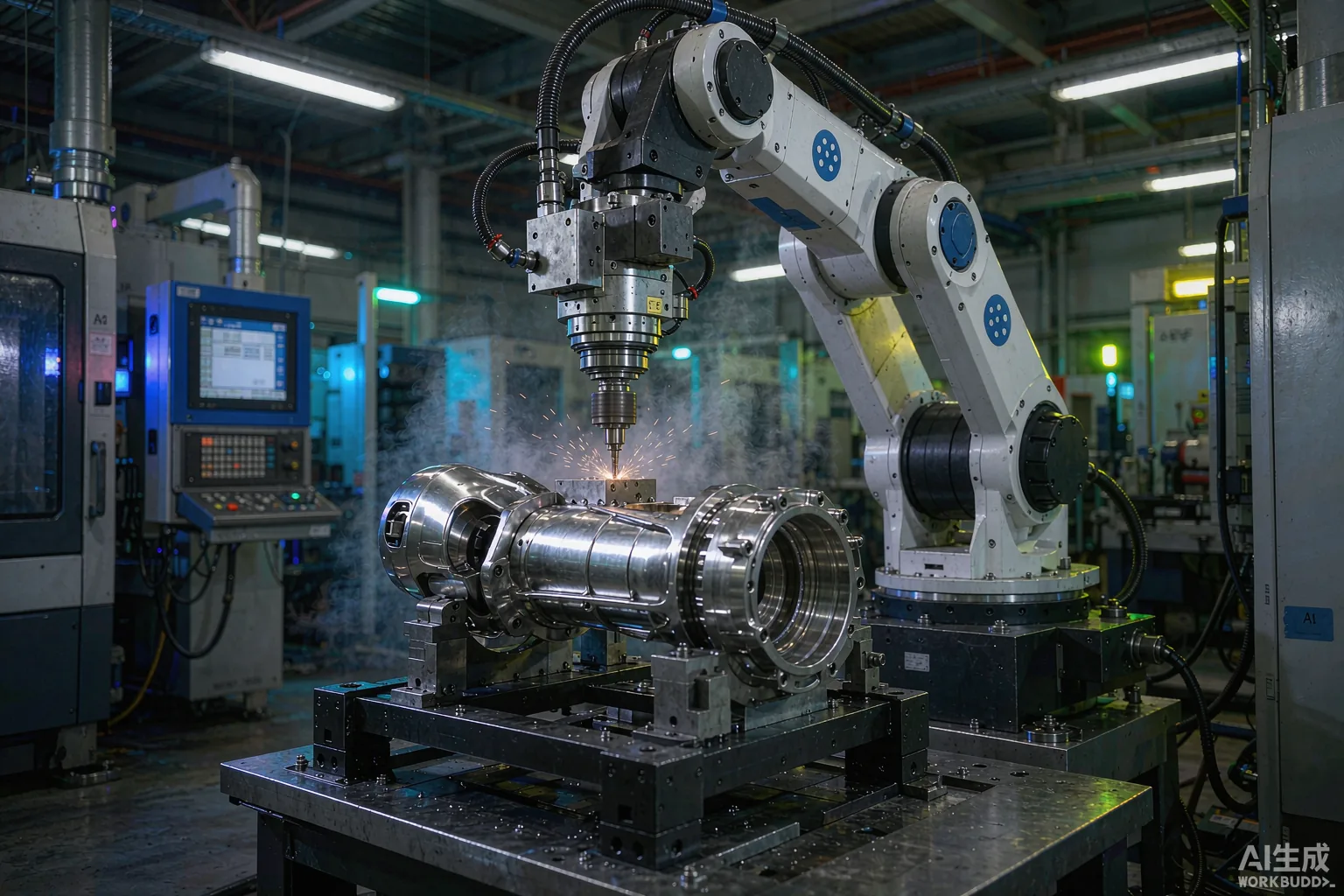
On the technical front, 机器之心 reports a clear pivot at the 2026 World Robot Conference: VLA (vision-language-action) models cooling, world models heating up. Benchmarks like GigaBrain-0.5M* (world-model-conditioned VLA, reported zero-failure on real tasks) and Goal-VLA (NUS, ICRA 2026; RLBench 59.9% vs MOKA 26%, real-world 60%, reflection loop 40%→83.8%) point to robots that need far less real-world data to deploy.
Why a CNC buyer should care: cheaper, more capable robots mean more automated lines, which means more precision parts to machine — a durable demand pull, not a one-quarter spike. This is the same thread as our humanoid-component supply chain report (#29), seen from the software side.
4. The component crunch is the CNC opportunity
GGII data underscores the hardware side: global harmonic-reducer capacity reached 4.897M units in 2024 (+10.4%), heading to ~6M in 2025 and >10M by 2030, with the Yangtze Delta over 70%. For humanoids, the BOM share of high-precision sensors + precision screws is about 42%; GGII forecasts ~62,500 China units in 2026 (market >¥9B, +240%), with core components over 65% of that. Each humanoid uses 14–28 harmonic reducers and 28–56 precision screws; at a 500k–1M global unit run, reducer demand alone hits 14–28M units.
The bottleneck is the opening: planetary-roller-screw localization is under 15%, high-end RV reducers are still dominated by Nabtesco, and high-end six-axis force sensors remain import-dependent. That gap is exactly where high-precision CNC (repeatability in the 0.002–0.006 mm class, as Gree's five-axis line publishes) has a long, defensible runway.
5. What to verify before you buy
The throughline for an overseas buyer: the question is shifting from "how fast is the spindle" to "can this machine talk to my plant brain."
- Open data interface. Ask for OPC UA / MTConnect support and a documented data dictionary. A closed protocol is a tax you pay later.
- Remote monitoring. Can you read spindle load, thermal drift and alarm history from outside the plant? This is table stakes for lights-out.
- Scenario fit. Gree positions machines as a one-stop solution — machine + automation + thermal control — which aligns with an AI-native plant in principle.
- Honest limit. Gree's own MES/software layer is younger than Siemens or DMG MORI's; verify the specific interface and integration maturity for your plant, and treat controller substitution as partner-led, not fully in-house.
¥361.9B
2030 AI-augmented industrial software (predicted)
¥2.5T
2030 smart-manufacturing core target (policy)
8,000+
5G factories in China (2025)
50→15
workers / 10k spindles, lighthouse case
<15%
planetary-roller-screw localization (gap)
62,500
China humanoid units forecast 2026 (GGII)
Data credibility rating
We rate every figure so you can weight it. "High" = official policy or first-hand disclosure; "Medium-High" = reputable think-tank / industry-research estimate; "Medium" = commentary on public stats.
| Source | Claim used | Credibility | Note |
|---|---|---|---|
| 八部门 / MIIT (policy) | ¥2.5T by 2030, 50k 5G nets, 8,000+ 5G factories, cost −19% | High | Official policy & ministry disclosure |
| 甲子光年 (think tank) | ¥361.9B by 2030; setup 20→5 min; scheduling 50→90% | Medium-High | Modeled forecast + cooperative demo cases |
| GGII (industry research) | Reducer capacity; 62.5k humanoids; screw <15% | Medium-High | Capacity / forecast, not sales |
| 机器之心 (tech media) | VLA/world-model benchmarks | Medium-High | Academic benchmarks; factory scaling unproven |
| 秦朔朋友圈 (commentary) | Machinery export 42%→62% of total | Medium | Opinion on public trade stats |
Implications & honest limitations
What holds up
- The direction is unambiguous: plants expect machines to be data nodes, not islands. That favors suppliers who ship open interfaces and integration support.
- Robotics scale-up is a structural, multi-year demand pull for precision machining — useful context when you budget capacity.
- China's cost-effective, scenario-bundled CNC solutions fit AI-native plants that prioritize total solution over the last micron.
Where to stay careful
- Don't extrapolate demo numbers. The 20→5 min / 50→90% figures are single cooperative cases, not a universal promise. Lighthouse efficiency (+30% / −26%) is a specific enterprise result — not a Gree general spec. Gree's own published efficiency claim stays at the brand-owned +25% (GA-FMB3020D vs a single five-axis setup).
- Software maturity gap is real. Chinese CNC makers lead on hardware integration; the deepest process libraries and MES ecosystems still sit with German/Japanese premium brands. Validate on a paid trial part.
- No competitor disparagement. We state data; we don't crown winners. "Better" depends on your part, volume, tolerance and data needs.
- No negative news on this site. Per editorial policy, litigation/penalty/scandal is excluded; this is a forward-looking buyer guide.
Frequently asked questions
What does an "AI-native factory" mean for a CNC buyer?
It means the machines are expected to feed data into a plant-level brain — scheduling, quality and predictive-maintenance agents — not sit as isolated islands. For a buyer, the practical question shifts from "how fast is the spindle" to "can this machine talk to my MES, and can I read its health remotely."
Should I require MES/ICS connectivity when buying a CNC?
If your plant is moving toward lights-out or data-driven production, yes. Ask any vendor for OPC UA / MTConnect support, an open data interface, and remote-monitoring before you sign. If you run a single standalone machine today, it is optional — but a machine with a closed protocol will cost you later when you scale.
Does China's smart-manufacturing push mean Chinese CNC is "better"?
Not automatically. The policy push raises the baseline of what factories expect from equipment, and Chinese suppliers are strong on integrated, cost-effective scenario solutions. But the deepest process know-how and the most mature software ecosystems still sit with German/Japanese premium brands. Evaluate the machine on your part, your data needs and a paid trial — not on national labels.
How does humanoid-robot growth affect CNC demand?
Robotics scale-up is a durable, not a hype, demand pull for precision machining: each humanoid uses 14–28 harmonic reducers and 28–56 precision screws, and China's 2026 unit forecast is ~62,500 (+240% YoY per GGII). The screw-localization gap (under 15%) is exactly where high-precision CNC has a long runway.
Is Gree's controller and software ecosystem ready for an AI-native plant?
Gree positions machines as part of a one-stop scenario solution (machine + automation + thermal control), which fits an AI-native plant in principle. Honestly, Gree's own MES/software layer is younger than Siemens or DMG MORI's; verify the specific data interface and integration maturity for your plant before committing, and treat controller substitution as partner-led, not fully in-house.
Related reading
Want a CNC that fits your data-ready plant?
Send your part drawing, material, tolerance, target volume and your MES/interface requirements — our application engineers will recommend the right Gree model, estimate cycle time and return a quotation within one business day.