The event-level read on humanoids and CNC demand — a useful companion to this component-deep-dive.
WeChat Intel · Issue #29
China's Humanoid-Robot Component Supply Chain: The Real CNC Demand Pull
Synthesised from Chinese-language industry accounts (Jazzyear, Synced, GGII, MIIT/Industrial-Internet coverage) · ← All insights · ← GREE CNC
Executive summary — read this first.
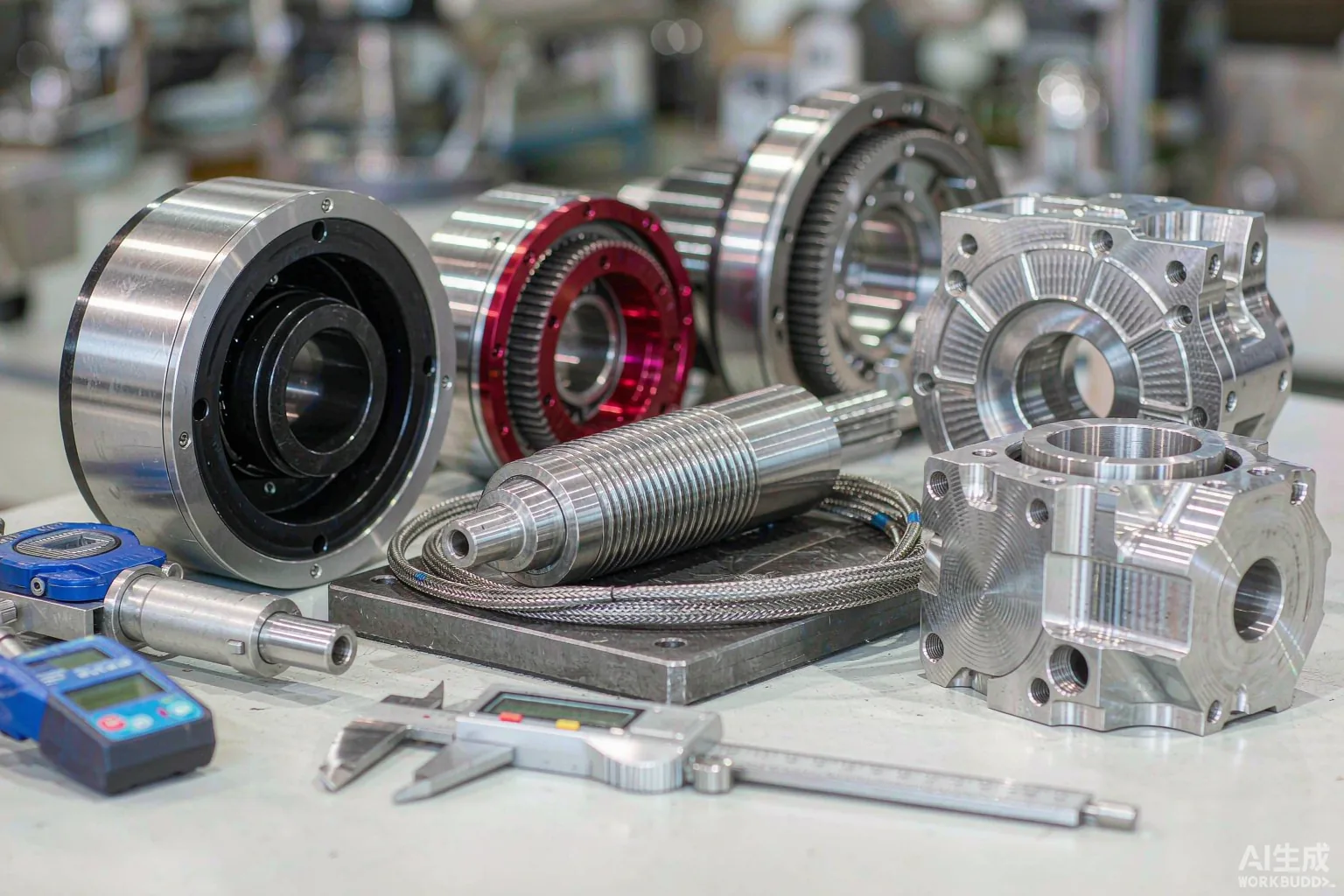
- The humanoid-robot story is loud, but the durable, machine-tool-relevant signal is in the components: harmonic and RV reducers, planetary/ball screws, dexterous hands, servo-motor rotors, six-axis force-torque sensor housings. Every one of these is a precision-machined metal part.
- Forecasts put domestic 2026 humanoid shipments around 62,500 units (+247% YoY), with harmonic-reducer localization already at ~73%. That is a capacity-build wave that must be machined — a steadier demand driver than betting on any single robot brand.
- The "sell-the-shovel" logic holds: whoever wins the robot race, component makers must expand precision-machining capacity. Reducers alone are 30–35% of a humanoid's bill of materials.
- Honest boundary: in 2026 only an estimated 3–5% of humanoid shipments serve industrial or commercial use. The larger near-term CNC pull remains NEV, 3C and aerospace. Treat robotics as a growing slice, not the whole story.
- For buyers: prioritise machines with data interfaces (e.g. OPC UA), thermal stability and tight repeatability for small, hard alloys — and validate any supplier's published specs on a paid trial part before committing volume.
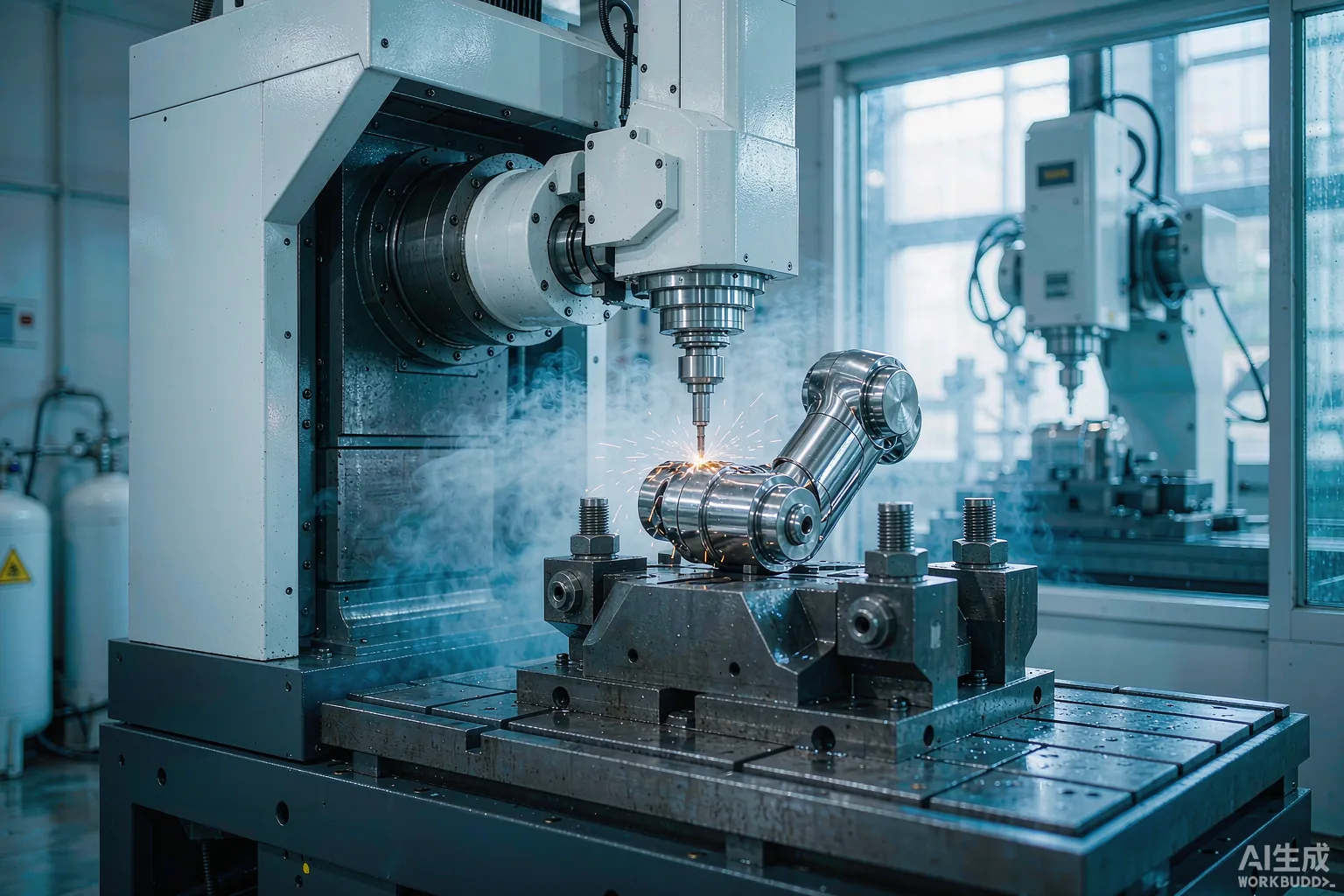
Why components, not robots, are the CNC story
Most coverage of China's humanoid-robot boom focuses on the整机 (the whole robot) — who shipped how many, whose demo looked best. For a machine-tool buyer that framing is a distraction. The useful question is simpler: what is a humanoid robot made of, and who makes those parts?
A humanoid is mostly precision-machined metal. A standard unit carries 20–40 active joints; each joint is a servo motor plus a reducer plus an encoder plus a driver, and some linear joints swap the rotary reducer for a screw. The dexterous hands, the sensor housings, the structural links — all machined. In other words, a humanoid is a concentrated bundle of CNC demand. That is why industry analysts repeatedly call reducers and screws the "shovel sellers" of the robot gold rush: the robot brands may churn, but the component makers must keep buying machining capacity.
The numbers: scale and localization
Chinese-language industry accounts this week converged on a consistent picture. The figures below are analyst/published estimates, not audited shipments — read them as directional, and check the credibility rating at the end.
~62,500
Forecast 2026 domestic humanoid shipments (GGII), +247% YoY
30–35%
Reducer share of a humanoid's bill of materials
~73%
Harmonic-reducer localization rate (2026)
~38%
RV-reducer localization rate (still import-heavy)
| Component | Role in a humanoid | Units per robot | Why it needs CNC |
|---|---|---|---|
| Harmonic reducer | Light-load joints: wrist, neck, fingers | 12–20 | Tiny, thin-walled flex-spline & rigid-spline in bearing steel; tight tooth accuracy |
| RV reducer | Heavy-load joints: hip, knee, shoulder | 2–6 | Cycloidal discs, needle bearings, high rigidity — precision grinding |
| Planetary / ball screw | Linear joints, actuators | 0–6+ | Threaded shaft & nut, surface finish & lead accuracy |
| Servo-motor rotor | Joint drive | 20–40 | Shaft, housing, lamination stacks — turn-mill & grinding |
| Dexterous hand & sensors | End-effector, force feedback | 2 hands | Miniature links, six-axis force-torque housings, tight tolerances |
One vendor cited in the coverage (Leaderdrive / 绿的谐波, a harmonic-reducer leader) is reported to have ~800k units/yr of capacity at end-2025 with a further million-unit line commissioned in mid-2026, and orders booked into 2027. Even allowing for vendor optimism, the direction is clear: component capacity is being added faster than the visible robot-demand mix would justify — a classic "build the shovels first" cycle.
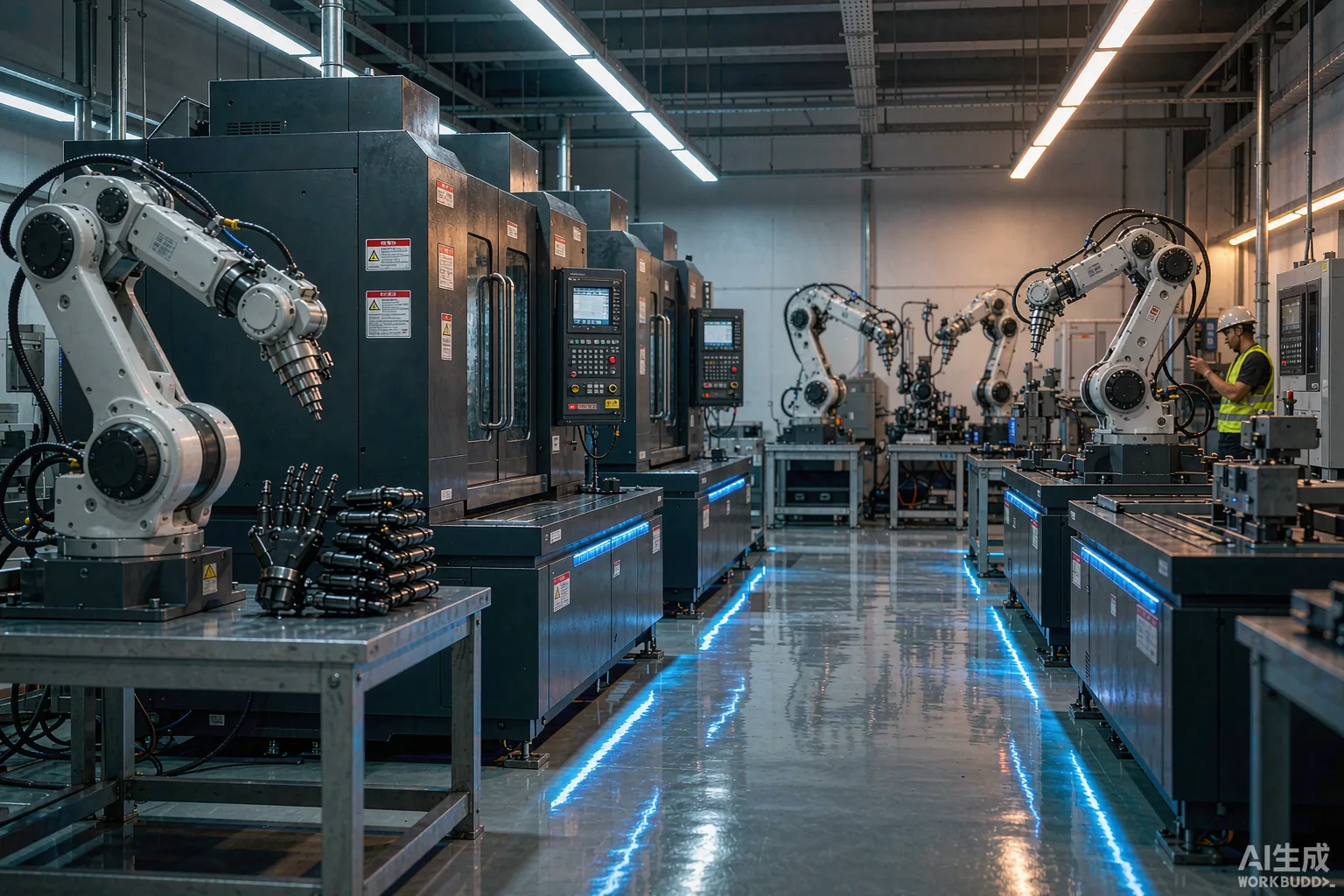
What this actually demands from a machine tool
The parts above share a manufacturing profile that favours 5-axis and turn-mill centers over simple 3-axis work:
- Small & hard Aluminum, titanium and bearing steel, often thin-walled — need rigid spindles and good chip evacuation.
- One-setup 5-axis "3+2" cuts complex curved surfaces in a single clamping, protecting the accuracy these parts need.
- Thermal Batch consistency depends on thermal stability; a machine that drifts with the shift will scrap a whole tray of joints.
- Finish Burr control and surface finish matter because many parts are hard to reach for manual deburring.
Where a Gree CNC center fits. Gree Intelligent Equipment positions the GA-FA320 (direct-drive rotary table, ~0.006 mm repeatability) for precision joint parts, and the GA-VT540 for small, mirror-finish 3C-style components — both map onto the reducer / screw / hand supply chain. As with all Chinese challenger brands, the honest caveat applies: the motion chain (spindle, linear motor, direct-drive) is strongly in-house, while the very highest-grade bearings and encoder gratings are still partly imported. Validate the full spec chain on a paid trial part.
The bottleneck map: strong, and still importing
The same coverage that celebrates ~73% harmonic-reducer localization also shows the weak spots — and they are instructive for any buyer evaluating a Chinese machine tool:
- RV reducers ~38% localized. The heavy-load joints still lean on imported (notably Japanese) supply. Capacity is being added, but the gap is real.
- Ultra-precision bearings & encoder gratings. Still partly import-dependent across the robotics chain — the exact base parts that limit the tightest machine-tool claims too.
- Price-war risk. Mid/low-end harmonic reducers are already seeing overcapacity and margin pressure. That can squeeze component-maker budgets and, indirectly, their capex for new machines.
Why this matters to a buyer. A machine-tool maker and a reducer maker face the same base-part dependency. When a supplier claims "fully in-house" precision, the credible answer is usually "in-house on the motion chain, partly imported on the measurement/transmission base." Ask for the spec chain, not the slogan.
Policy tailwind
Two policy threads reinforce the demand pull. First, the "real-scene training" (实景实训)专项行动 and the 2026 humanoid/embodied-AI standard system push towards 10,000-unit-class deployment by end-2026 — which means more component orders. Second, the eight-ministry Industrial Internet high-quality development plan (issued 2026-06) targets 50,000 industrial 5G private networks and 2.5 trillion yuan of core-industry value-add by 2030, with device-connectivity and CNC-ization rates written as hard metrics. Both point the same way: more domestic, connected, numerically-controlled production capacity.
Implications for overseas buyers & distributors
(Written under our altruistic mission: teach how to choose, disclose limitations, never disparage a competitor. We state data; you conclude.)
- Opportunity — a steadier demand narrative. If you supply component makers (reducers, screws, servo parts, hands), the robotics wave is a multi-year capacity story independent of which robot brand wins. A Chinese 5-axis center priced well below a German/Japanese import can be a rational capacity bet.
- Boundary — robotics is not the whole CNC market. With industrial/commercial humanoid use at only ~3–5% of 2026 shipments, the near-term, larger pull on Chinese machine tools remains NEV, 3C and aerospace. Size your expectations against those, not against robot-headline numbers.
- Risk — spec and supply-chain variance. Localization rates differ sharply by part (73% vs 38%). A machine that is excellent on aluminum joint links may not be the right tool for hardened RV cycloidal discs. Match the machine to the specific alloy and tolerance, and verify on a trial part.
- Risk — margin pressure upstream. If component makers face price wars, their capex discipline tightens. Lead with total cost of ownership and uptime, not just sticker price.
- What to look for. Data interfaces (OPC UA / MTConnect), thermal stability, sub-0.01 mm repeatability on small parts, and a supplier who is candid about which base parts are imported. Those traits age better than any single headline tolerance.
Data credibility rating
| Claim | Source | Rating |
|---|---|---|
| ~62,500 domestic humanoid shipments 2026 (+247% YoY) | GGII (High-tech Robot Research); cross-checked vs Goldman/IDC/Morgan Stanley/Nomura ranges | Medium analyst forecast, not audited |
| Harmonic ~73% / RV ~38% localization | GGII monthly reducer report (cited in Chinese coverage) | Medium plausible, single-source |
| Reducer = 30–35% of BOM; 20–40 joints/robot | Industry teardown coverage (Eastmoney / Toutiao aggregates) | Medium aggregate, verify per model |
| Leaderdrive capacity & 2027 order book | Vendor / equity-research cited in coverage | Low vendor-stated, not independently confirmed |
| Industrial-internet 2030 targets (5G nets, 2.5T yuan) | MIIT eight-ministry implementation opinion (official) | High government document |
Frequently asked questions
Why are humanoid-robot components a CNC demand signal?
A humanoid robot is mostly precision-machined metal: harmonic and RV reducers, planetary/ball screws, servo-motor rotors, dexterous-hand frames and six-axis force-torque sensor housings. Every unit of output requires machine-tool capacity. So the steadier demand driver is the component makers' capacity build-out, not the fortunes of any single robot brand.
What machining capabilities do these parts actually need?
Small, hard, thin-walled parts in aluminum, titanium and bearing steel — often 5-axis or turn-mill in one setup, with tight repeatability (sub-0.01 mm on joints) and good thermal stability for batch consistency. Surface finish and burr control matter because many parts are hard to reach for manual finishing.
Where is China still importing, and why does it matter to a buyer?
Harmonic reducers are ~73% localized, but RV reducers only ~38%, and the highest-grade bearings and encoder gratings are still partly imported. For a machine-tool buyer this is a useful honesty check: even leading Chinese CNC makers rely on some imported measurement/transmission base parts, so validate the full spec chain, not just the headline tolerance.
Should I buy a machine today because of the humanoid-robot boom?
Treat robotics as a growing slice, not the whole story. In 2026 only an estimated 3-5% of humanoid shipments serve industrial or commercial use; the larger near-term CNC pull remains NEV, 3C and aerospace. Buy for your real part mix and validate any supplier's published specs on a paid trial part before committing volume.
Related reading
Machining humanoid-robot components?
Send your part drawing, material, tolerance and target volume — our application engineers will recommend the right Gree model, run a cycle-time estimate and return a quotation within one business day.