The full buyer-grade guide to Gree's five-axis lineup, in-house motion components and honest limitations.
Gree CNC · Market Intelligence
From Showmanship to Shipments: What the 2026 World Robot Conference Means for CNC Buyers
Executive summary — read this first.
- The 2026 World Robot Conference (WRC, Beijing, 19–22 August) signalled a clear shift: humanoid and industrial robots are moving from demos to real production. A major local robot maker reported over 80% of its 2025 full-size humanoid sales went into industrial scenarios, and a 10,000-unit-capacity JV plant with a global automation vendor is already in production.
- That is a durable, multi-year demand driver for precision machining. Every robot is built from dozens of machined parts — reducer housings, roller-screw shafts, joint housings, dexterous-hand frames, force-sensor brackets — and volume production pulls exactly the kind of work a 5-axis or machining center does.
- The bottleneck has moved to the component level: leading harmonic-reducer suppliers report order books stretching into 2027 and capacity utilisation above 130%. Some high-end specialty steel and rare-earth magnet grades are still partly imported.
- Policy tailwinds are real: China's "15th Five-Year Plan" lists industrial mother machines as a super-priority, and the leading 5G-smart-factories benchmark at +25% capacity, +21% quality, −19% cost — a third-party signal that data-connected, automation-ready manufacturing is becoming the default.
- Honest caveat: "mass production" of humanoids is still early (low absolute base), and the component crunch can lengthen lead times on some imported sub-parts. Validate delivery dates and lock spares before committing volume — the same advice we give for any brand.
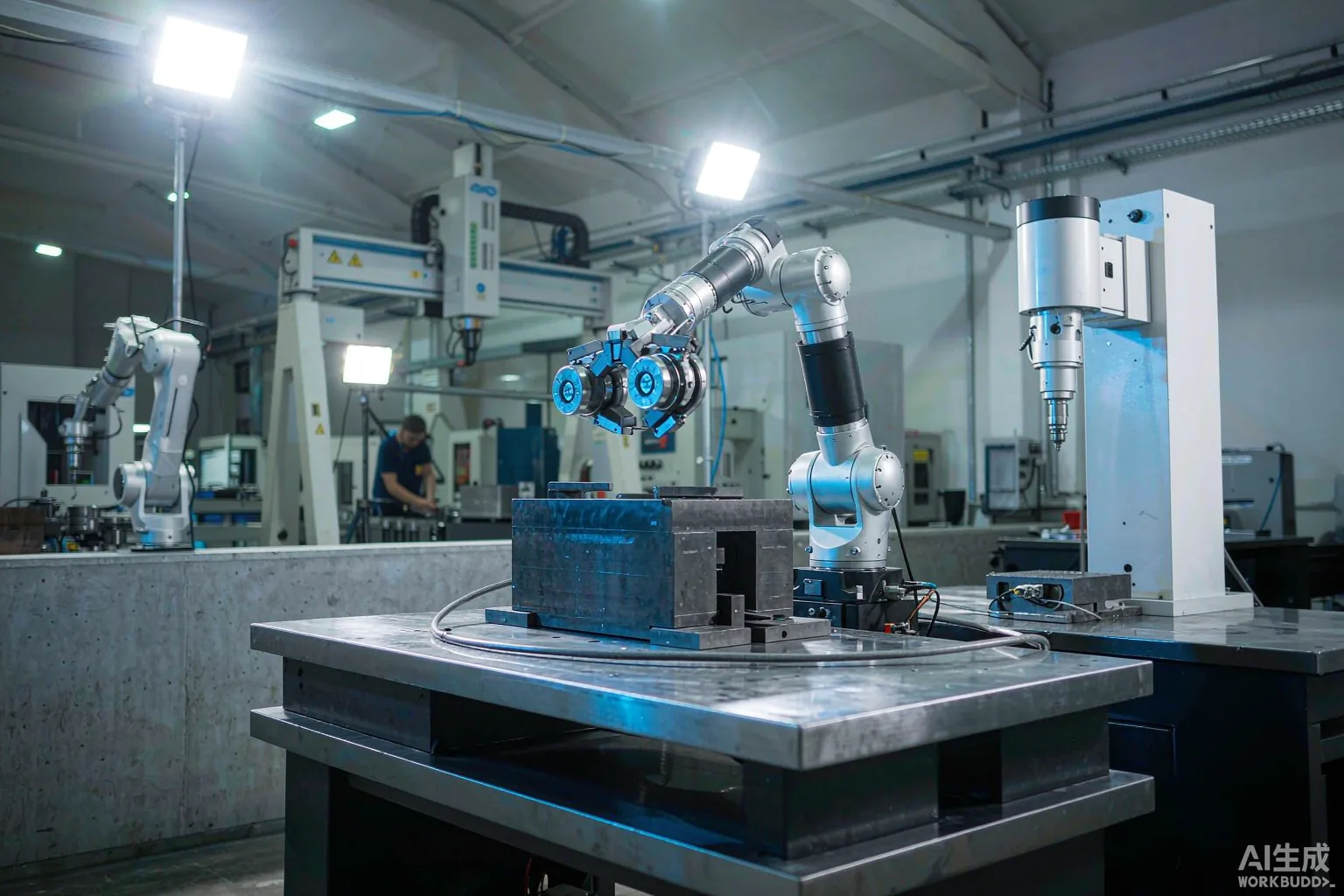
The signal from WRC 2026: from "showmanship" to "shipments"
At the 2026 World Robot Conference in Beijing, an industry-media roundup distilled five trends: verification is shifting from technology to product; world models (World Model / VLA) are a focal point but not yet the headline funding story; touch sensing has become the new focus for dexterous hands; exoskeletons are emerging (online retail of one category rose sharply in the first four months); and joints have become the new battleground for component suppliers (the core joint of one leading humanoid brand is estimated at around RMB 27,500).
The deeper message was cultural: after years of robots dancing and playing piano, exhibitors in 2026 bent their demos toward real environments — airport baggage handling, warehouse picking, café service, pharmaceutical picking. One major local robot maker reframed its booth from "walking" to "working": its units now handle inbound parts, loading/unloading and palletising inside factories, with single-arm payloads around 10 kg and positioning error kept under 1 mm.
Why this pulls CNC demand
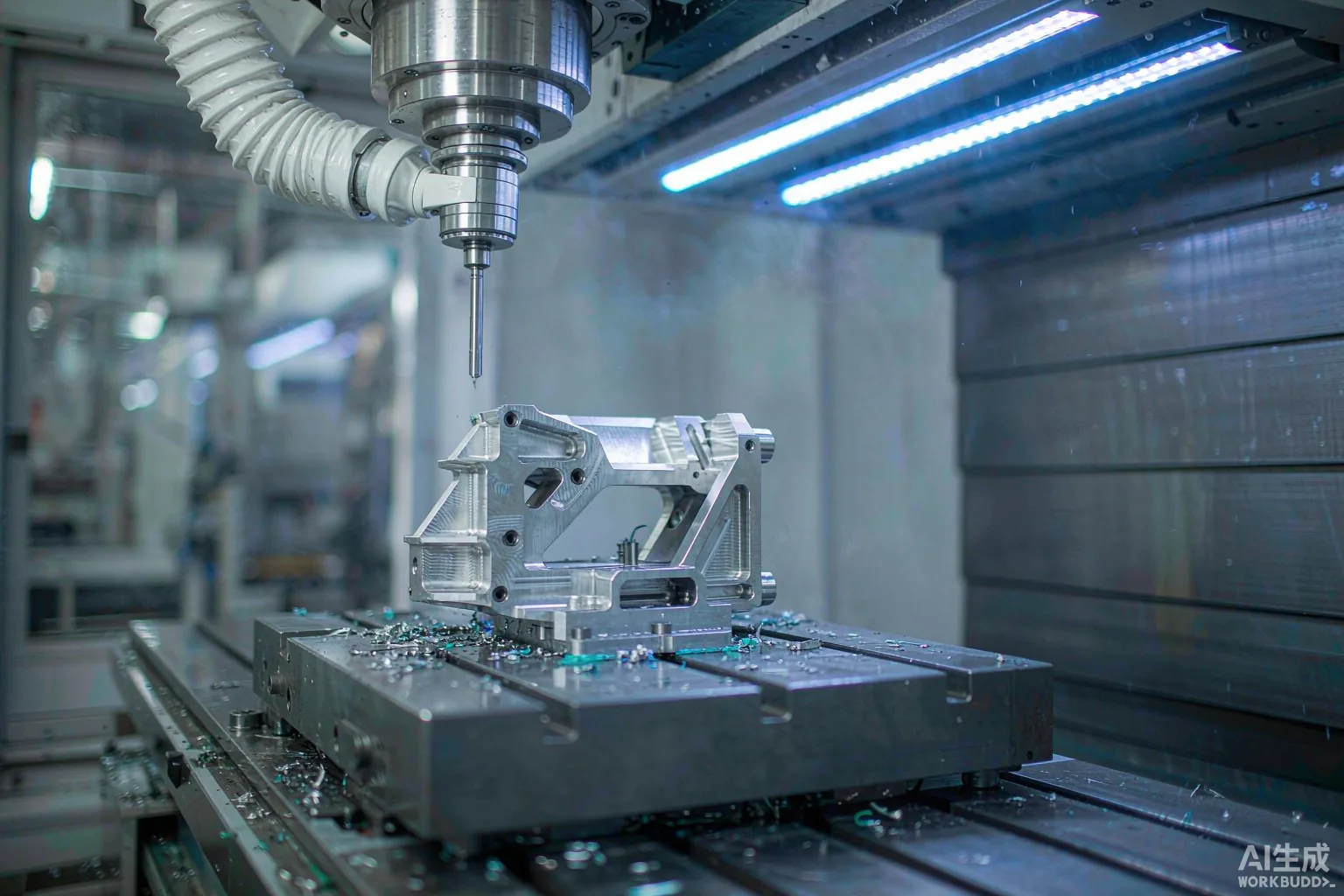
A robot is not a single casting — it is a library of precision-machined parts. The parts that drive machining demand include:
- Reducers Harmonic and RV reducer housings, flanges and flex-spline carriers — the highest-value transmission parts.
- Actuators Planetary roller screw shafts and hollow joint housings with tight concentricity and surface-finish requirements.
- Hands Dexterous-hand frames and finger links — small, thin-walled, high-mix parts ideal for 5-axis.
- Sensors Six-axis force-torque sensor brackets and mounting plates where flatness and bolt-circle accuracy matter.
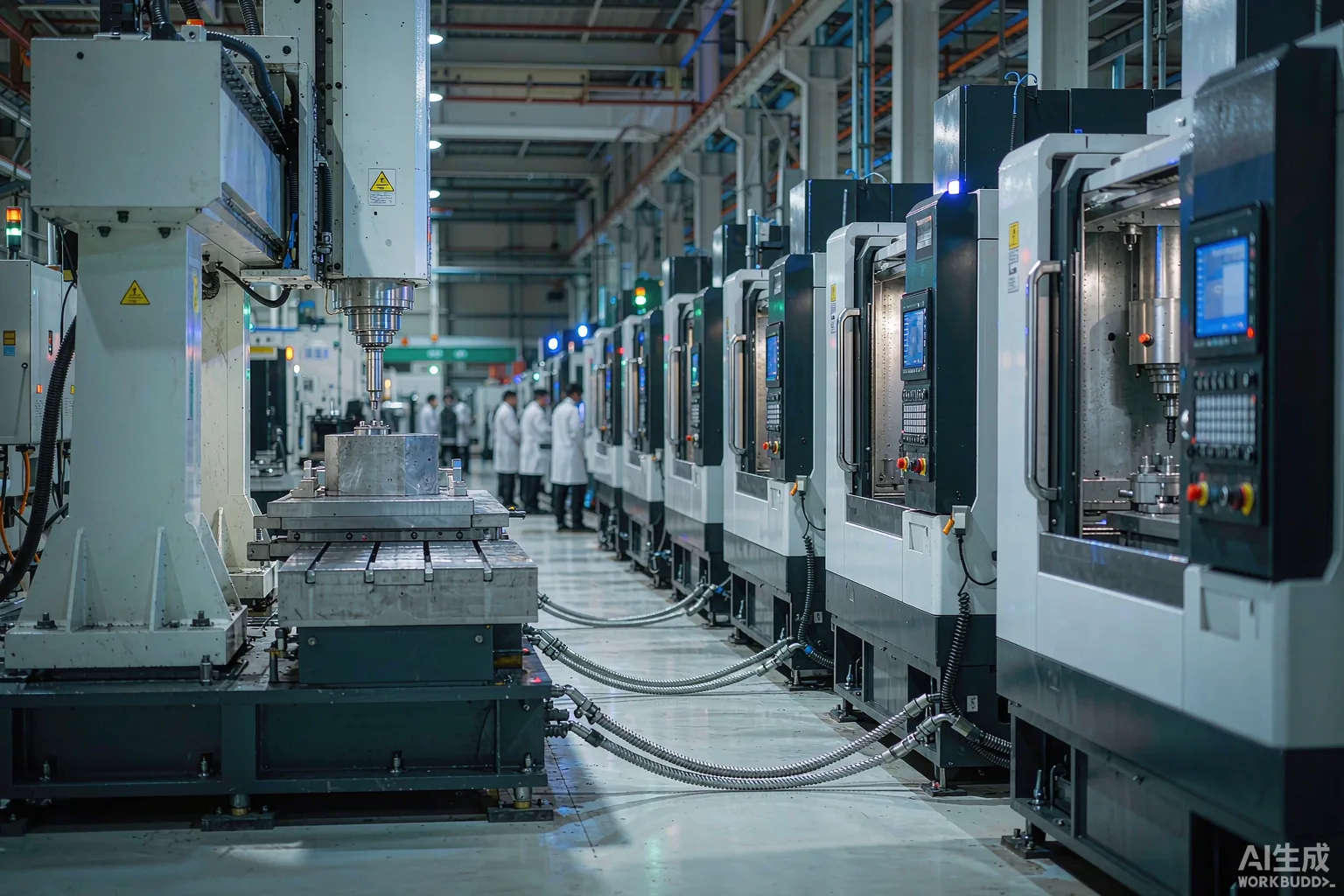
When a robot maker scales from hundreds to tens of thousands of units, these parts stop being prototypes and become steady production runs. That is precisely the workload a 5-axis machining center or a turn-mill center is built for — multi-face, tight-tolerance, repeatable. The robotics boom is, underneath, a machining boom.
The numbers worth a buyer's attention
300+
Exhibitors at WRC 2026 (Beijing)
+247%
Projected 2026 humanoid shipments vs 2025 (industry institute)
+320%
YoY new orders at a leading harmonic-reducer maker (2026 Q1)
+25%
Capacity at China's leading 5G-smart-factories (official benchmark)
A leading Chinese harmonic-reducer supplier reported 2026 Q1 new orders above 800,000 units (over +320% year-on-year), lifted monthly capacity toward 100,000 units, and an order book stretching into the third quarter of 2027. Industry-institute (GGII) projections put 2026 domestic humanoid shipments around 62,500 units — up roughly 247% on 2025. One leading humanoid brand is estimated to use 14–20 harmonic reducers per unit; at volume, that alone means hundreds of thousands of precision reducers a year, on top of existing industrial and collaborative-robot demand.
The honesty check: supply concentration is a two-way street
What the crunch means for a CNC buyer. The same capacity that makes Chinese machine tools attractive — fast iteration, competitive pricing, short lead time versus European/Japanese imports — is now shared with a robotics sector booking components into 2027. Reported capacity utilisation above 130% at reducer makers, and the fact that some high-end specialty steel and rare-earth magnet grades are still partly imported, mean that some imported sub-components inside a CNC machine can also take longer to source.
This is not a reason to avoid Chinese CNC — it is a reason to buy with eyes open. Practical steps for an overseas buyer or distributor:
- Validate delivery dates in writing and treat published lead times as planning figures, not guarantees.
- Lock critical spares (bearings, gratings, specialty steel parts) on a scheduled basis, especially for a first overseas service point.
- Prefer suppliers who are transparent about component sourcing and who run a local or regional service partner.
Policy tailwind: industrial mother machines and the IIoT base
China's "15th Five-Year Plan" lists industrial mother machines (machine tools) as a super-priority for decisive breakthrough, with a stated medium-term goal of raising home-grown rate from ~20% toward 60%, a 120% pre-tax super-deduction for qualified R&D, and a 2025 domestic machine-tool revenue above ¥1.6 trillion (about one-third of global consumption). Separately, eight ministries issued an implementation opinion (June 2026) targeting 50,000 industrial 5G private networks and a core-industry added value above ¥2.5 trillion by 2030, explicitly promoting industrial agents and AI–IIoT fusion.
For a buyer, the takeaway is concrete: the leading 5G-smart-factories benchmark at +25% capacity, +21% quality and −19% operating cost. That is a third-party data point showing Chinese manufacturing is converging on data-connected, automation-ready plants. The smart move in 2026 is to spec a machine that integrates with MES/IIoT and exposes process data — not a standalone island.
Data credibility rating
| Claim | Source | Rating |
|---|---|---|
| WRC 2026 scale (300+ exhibitors, ~3,000 exhibits); five trend observations | Industry media (Jazzy/APlus) event roundup; attendance public | Medium reputable media, trend figures are their own estimates |
| A leading humanoid maker: >80% of 2025 sales into industrial scenarios; 10k-unit JV plant in production | Vendor disclosure via 21st Century Business Herald | Medium vendor-stated, not independently verified |
| 2026 humanoid shipments ~62.5k (+247% YoY); reducer maker Q1 orders >800k (+320% YoY), booked to 2027, utilisation >130% | GGII (industry institute) + public reporting | High institute data, cross-reported |
| Leading 5G-smart-factories: +25% capacity, +21% quality, −19% cost | MIIT-selected benchmark program (official) | High official program data |
| Industrial mother machine policy: 15th FYP super-priority; home-grown rate target 20%→60%; ¥1.6tn 2025 revenue | MIIT / state media | High official policy |
| Pixel-level world model (WMPO) lifts VLA sample efficiency +9.8% to +15.2% | HKUST + ByteDance Seed, ICLR 2026 (peer-reviewed) | High academic, reproducible |
| World-model VLA vendor claims "hours of zero-failure" in real tasks | Vendor release | Medium vendor-stated, unverified |
What this means for overseas buyers & distributors
- Treat robotics as a demand engine, not a sideshow. The robotics supply chain is one of the strongest structural pulls on precision machining through the late 2020s. If your customers are in automation, EV, 3C or medical devices, the same 5-axis capability serving robots also serves them.
- Buy automation-ready. With IIoT and industrial agents becoming policy-backed defaults, a machine that reports data and slots into MES reduces your customer's integration cost and future-proofs the purchase.
- Discount the hype, keep the trend. Humanoid "mass production" is still a low-base story; plan for steady, not explosive, near-term volumes. Gree's positioning — application-focused 5-axis and gantry centers, partner-led controller, scenario solutions — fits buyers prioritising total solution and lead time. If your work needs certified micron-level tolerances and deep aerospace-grade process know-how, a century-old German or Japanese house is the more proven fit; treat Gree as the value-and-lead-time option, and validate it on a paid trial part first.
- Local service is the differentiator overseas. The component crunch is a reason to value a distributor with a real local service point and transparent spare-parts policy — exactly the model Gree is building via its Southeast-Asia service lighthouse.
- Validate, then commit. Run a paid trial part against published specs before volume. This is our standing advice for any brand, including ours.
Bottom line. The 2026 robotics signal is good news for CNC buyers indirectly: deeper domestic demand pushes Chinese machine-tool makers to mature faster and price more competitively. The matching obligation is honesty — lead times on some imported sub-parts can stretch, so verify and lock spares. Gree's gantry centers cite a +25% efficiency gain versus a conventional single five-axis setup; the CNC controller remains partner-led and is rated partial, not claimed.
Frequently asked questions
Why should a CNC buyer care about humanoid robots?
Every humanoid or industrial robot is built from dozens of precision-machined parts — reducer housings, planetary roller screw shafts, joint housings, dexterous-hand frames and six-axis force-torque sensor brackets. When robot makers move from demos to volume production, they pull years of durable demand for the machine tools that make those parts. That demand is what keeps Chinese CNC makers' order books full and their technology iterating fast.
Is the precision-component boom a risk as well as an opportunity?
Yes. The bottleneck has shifted to the component level: leading harmonic-reducer makers report order books stretching into 2027 and capacity utilisation above 130 percent, and some high-end specialty steel and rare-earth magnet grades are still partly imported. For a CNC buyer this means lead times on some imported sub-components can lengthen. Validate delivery dates, lock critical spares early, and prefer suppliers with transparent component sourcing.
What should I spec when buying a CNC machine in 2026?
China's industrial-internet policy is making data-connected, IIoT-ready factories the default. Spec a machine that integrates with MES/IIoT and exposes process data, not a standalone island. This is also where a supplier offering a turnkey scenario solution — machine plus automation plus thermal control — earns its keep.
Does Gree claim a 100% in-house CNC controller?
No. Gree's self-development is genuinely high on the motion chain (spindle, linear motor, direct-drive rotary table, servo), but the CNC controller is partner-led and the grade is best described as partial, not claimed. Validate published specs on a paid trial part before committing volume — the same advice applies to any brand.
Related reading
Not sure which model fits your robotic or automation parts?
Send your part drawing, material, tolerance and target volume — our application engineers will recommend the best Gree model, run a cycle-time estimate and return a quotation within one business day.