The overview this piece builds on — policy, supply chain and full-stack globalisation as the three forces behind Chinese CNC.
China CNC Daily Insight · Issue #36
Factory of Factories: What China's Full-Stack Manufacturing Export Model Means for CNC Buyers
Executive summary — read this first.
- Chinese manufacturers are no longer only shipping products — increasingly they ship the factory itself. In 2025 China's electromechanical exports reached US$2.30 trillion (+8.4% YoY) and made up 61% of total goods exports (up from 59.4% in 2024), a share that has climbed from roughly 42% as far back as 2000.
- For a CNC buyer the practical shift is: the question moves from "which machine should I buy?" to "how much of the production system should I buy — and what am I taking on?"
- There are three ways to buy — single machine, cell/line integration, turnkey plant — and each hands you a different slice of capability and a different slice of risk. Most buyers over-estimate what turnkey removes and under-estimate what it adds.
- We are a machine-tool distributor, not an EPC contractor: we would rather you price the whole transfer — site, compliance, commissioning, spares, service — than discover a six-figure surprise after commissioning.
Three ways to buy, and what each demands
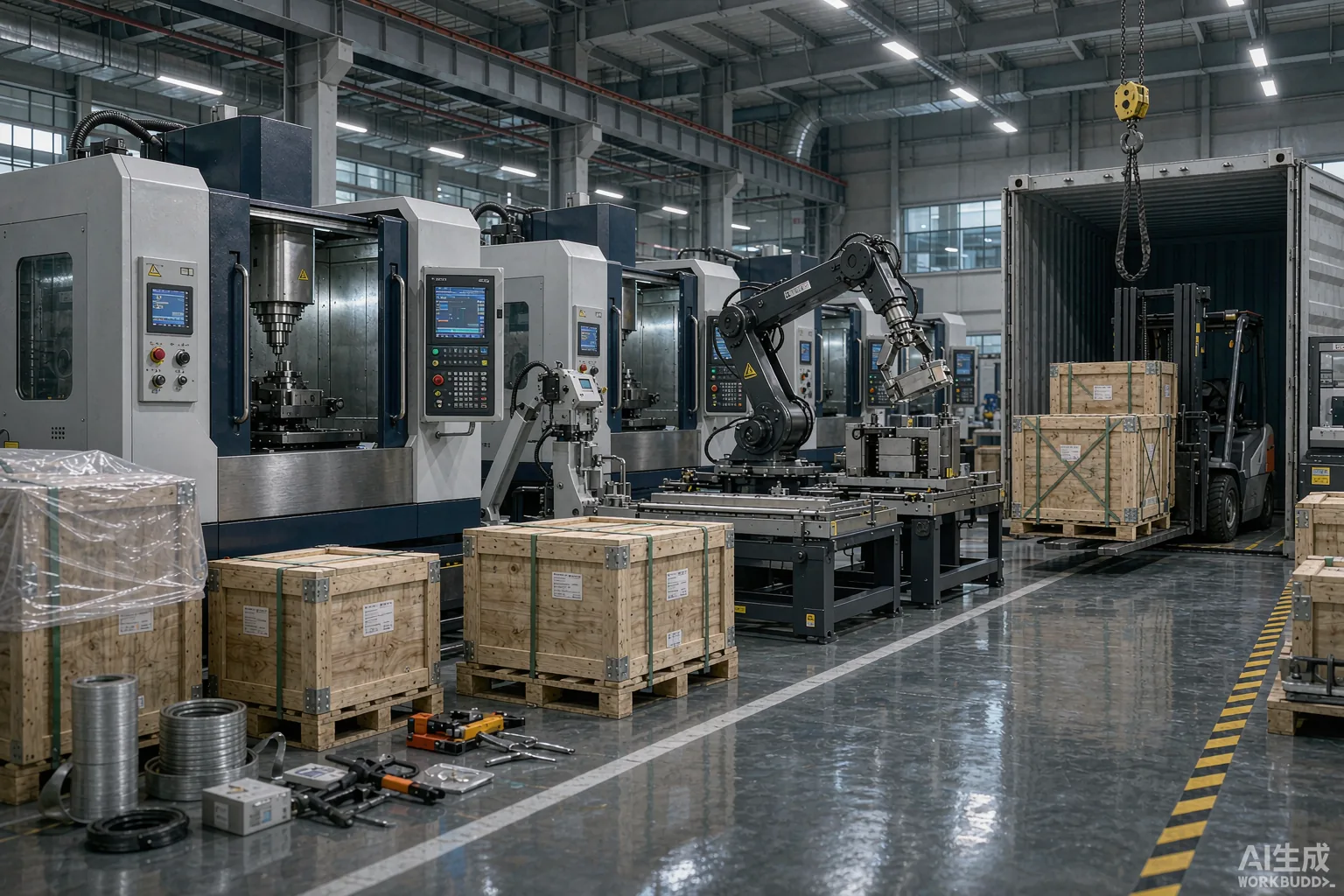
Chinese suppliers can now deliver anything from one spindle to a running plant. The model you choose changes who owns the risk:
| Mode | What you get | What it demands of you | Main risk |
|---|---|---|---|
| 1. Single machine | One CNC, delivered and commissioned | Your own process engineering | Integration becomes your problem |
| 2. Cell / line integration | Machines + fixtures + automation + commissioning | Some process and controls capability | Interface-responsibility gaps |
| 3. Turnkey plant (工厂的工厂) | Process design, equipment, install, training, ramp-up | Project management + long-term ops ownership | Hidden scope, hidden cost |
The trap. Buyers consistently over-estimate what mode 3 removes (you still own foundations, power, air, tooling, coolant, training, compliance) and under-estimate what it adds (a multi-year operating relationship you must manage). Turnkey concentrates risk as much as it concentrates convenience.
The macro backdrop (why this is happening now)
US$2.30T
2025 electromechanical exports (+8.4% YoY)
61%
share of China's goods exports (59.4% in 2024)
~42%
same share back in 2000 — a two-decade climb
- Electromechanical exports reached US$2.30 trillion in 2025, +8.4% YoY; their share of China's goods exports rose to 61% (59.4% in 2024) and has roughly trended from ~42% in 2000 — a long-run move toward higher-value equipment, not a single-year spike (source: China Customs / SAFE 2025 Balance of Payments report).
- Complex-equipment capability is visible beyond machine tools. China's Yangtze River Delta delivered the large cruise ship Adora Flora City (爱达·花城号) — evidence it can deliver large integrated systems, not just components. That is the capability turnkey line exports draw on.
- Mature Chinese consumer brands already earn a large share overseas — Haier ~53%, Midea ~41.9%, Hisense ~42.5%, TCL ~46%. Caveat: these are consumer brands; B2B machine tools sit at a much earlier point on the same arc. The analogy is directional, not equivalent.
What this means for a CNC buyer
- You can now source a production line, not just a spindle. That compresses your vendor count — and concentrates your risk onto one supplier relationship.
- Service radius becomes the deal variable. A turnkey line with no local service is a liability. This is precisely why a regional service point — such as our Malaysia hub for Southeast Asia — matters more than the machine's sticker price. Ask for a written local response time before you sign.
- Data and interfaces must be specified up front. Require OPC UA / MTConnect and a written remote-service agreement, or you inherit a closed system you cannot optimise or support.
Honest limitations (read before you quote any figure)
- "Factory of factories" is an analytical frame, not an official statistic. Treat it as interpretation of export structure, not a number from a ministry.
- Turnkey does not mean risk-free. Foundations, power, compressed air, tooling, coolant and operator training are frequently out of scope. The equipment quote never lists them.
- Compliance ownership must be written down — CE / UKCA / UL / local electrical and safety standards — before contract, not after install. A machine built for the domestic market is not automatically compliant at your door.
- Consumer-brand overseas success does not transfer automatically to B2B machine tools. We flag the difference rather than lean on it. Machine tools carry longer duty cycles, stricter precision retention demands and a thinner local-service network.
When NOT to choose a Chinese turnkey line
Honesty cuts both ways. A turnkey Chinese line is the wrong default if:
- You have no project-management capacity to own a multi-month install and ramp-up — integration risk lands on you regardless of who supplied the iron.
- You cannot specify local compliance and a written service agreement before signature. If your end-use requires certified local standards you cannot name up front, the risk is yours, not the exporter's.
- Your parts demand proven long-duty-cycle precision retention and you have no plan to verify it on your own workpieces. Short-term accuracy and long-term retention are different things (see our accuracy-retention piece).
In those cases, single machines or line integration with a strong local partner are the lower-risk choices. Turnkey concentrates both capability and risk; only choose it when you can absorb both.
A simple decision test
- Choose single machines if you have strong in-house process engineering and want vendor diversity.
- Choose line integration if you have controls capability but limited process bandwidth.
- Choose turnkey only if you have project-management capacity and a written service agreement with local response times.
Data credibility rating
| Claim | Source | Rating |
|---|---|---|
| 2025 electromechanical exports US$2.30T, +8.4% YoY; 61% of goods exports (59.4% in 2024) | China Customs / SAFE 2025 Balance of Payments report (1st-hand, corroborated) | High first-hand customs data |
| Export share ~42% in 2000 → 61% in 2025 (two-decade structural shift) | China Customs long-run series (same source family) | High first-hand |
| Consumer brands overseas share (Haier 53% / Midea 41.9% / Hisense 42.5% / TCL 46%) | Company annual reports / Qinshuo 朋友圈 compilation | Medium consumer brands; B2B analogy directional only |
| "Factory of factories" as a framing of China's export model | Commentary (远川研究所 et al.) — an analytical frame, not an official statistic | Interpretation not a hard number |
Guidance for buyers
- Price the whole transfer, not the machine. Demand a boundary-of-supply matrix (whose concrete, whose power, whose air, whose compliance) before contract.
- Acceptance = KPI run-off on your parts. Define cycle time, first-pass yield and Cpk for critical dimensions, with target values, sample size and run duration, in a signed run-off protocol — not an equipment checklist.
- Get service in writing. A recommended spares package with prices, a written local response time, and remote diagnostics (OPC UA / MTConnect) protect you after the engineers leave.
- Use the macro story as context, not a guarantee. China's export structure tells you the ecosystem can deliver integrated systems; it does not certify the specific line on your quote.
Bottom line. "Factory of factories" is real, but it is a shift in what you can buy, not a reduction in what you must own. The disciplined buyer treats a Chinese turnkey offer as a capability transfer to be scoped and verified — not a problem removed. That is how you capture the value without inheriting the surprise.
Frequently asked questions
Is buying a whole line from China actually cheaper?
Usually cheaper on capital cost — not automatically on Total Cost of Ownership. Model service, downtime, training, compliance and spares before you compare. A cheap line with a three-week spares wait is an expensive line.
Who handles CE / UKCA compliance in a turnkey deal?
It must be named in the contract before signature. Ambiguity over who certifies, documents and reworks to local standards is the single most common turnkey dispute. Write it down.
Does Gree CNC sell turnkey plants?
We supply machine tools, cells and project support; full-plant EPC scope is project-specific and stated honestly up front. We would rather define scope clearly than promise a single throat to choke we cannot actually be.
When should I NOT choose a Chinese turnkey line?
If you lack project-management capacity, have no written local service agreement, or your end-use demands certified local compliance you cannot specify up front — single machines or line integration with a strong local partner are the lower-risk choices. Turnkey concentrates both capability and risk.
Related reading
Want the three-way sourcing model applied to your parts?
Send your part drawing, material, tolerance and target volume — our application engineers will recommend the right machine family, estimate cycle time and scope the integration or turnkey support you actually need, with a clear boundary-of-supply matrix.