A practical breakdown of what 5-axis machines actually cost in 2026 — from entry-level 3+2 to full simultaneous 5-axis — and which tier fits your work.
White Paper · 5-Axis · Value & TCO
Chinese vs European 5-Axis CNC: An Honest Value and TCO White Paper
Updated 20 September 2026 · ~12 min read. We sell Chinese machines, so this paper is written to be trusted rather than flattering: the real price gap, a 10-year total-cost-of-ownership model, where European iron earns every euro, and where Chinese 5-axis is the disciplined choice. ← Back to GREE CNC
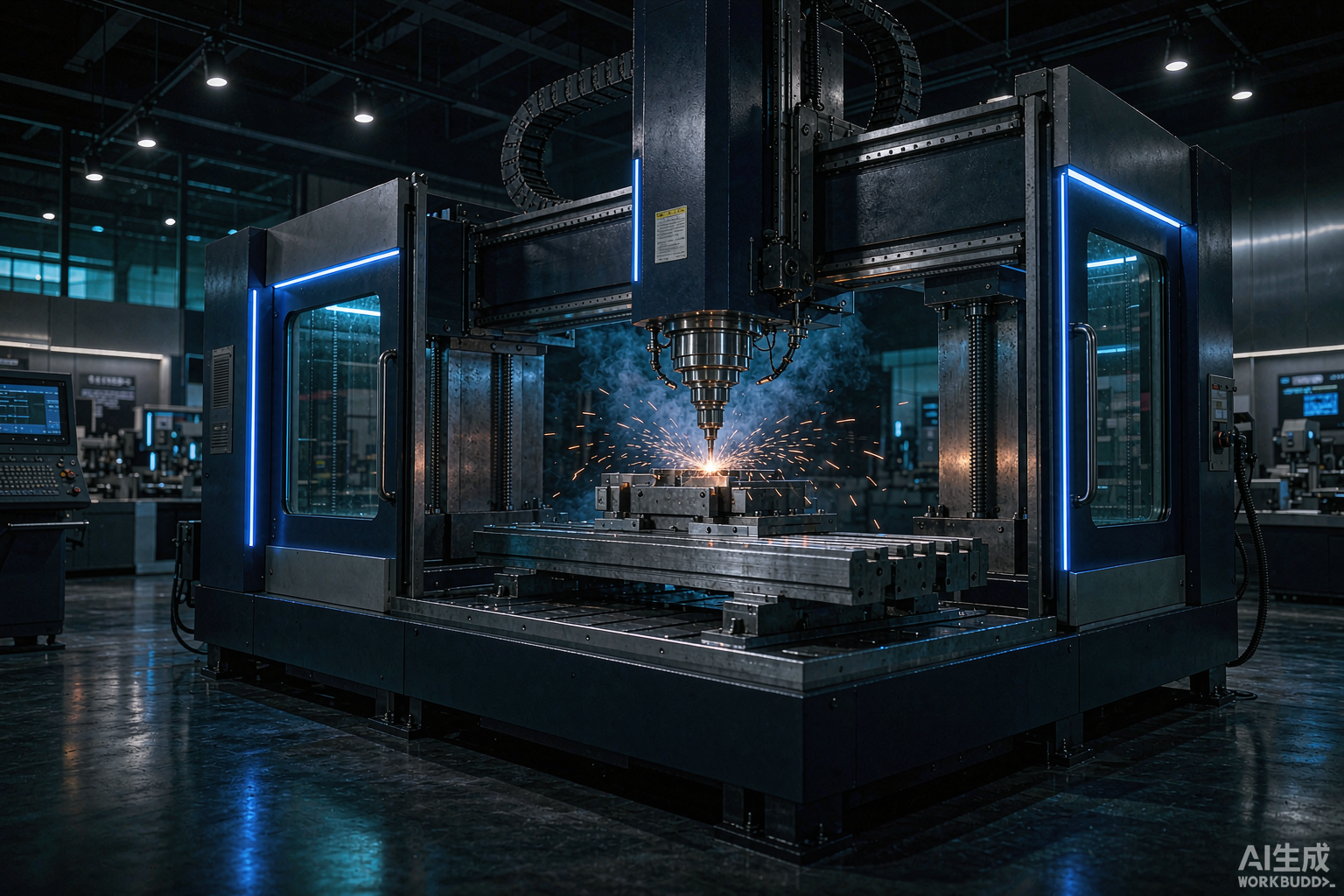
The price gap: what you actually pay
Let us start with the number everyone asks about. The table below compares representative 5-axis machining centers in the 500–800 mm work envelope — the sweet spot where both Chinese and European OEMs field strong products. Prices are estimated street prices for a comparably equipped machine (HSK-A63 / CAT50, 12,000–15,000 rpm, 40-tool magazine, basic probing, through-spindle coolant) in Western Europe, excluding installation and commissioning:
| Class | Representative model | Est. street price (EUR) | Index |
|---|---|---|---|
| European premium | DMG MORI DMU 50 / GROB G350 / Hermle C 250 | €450,000 – €650,000 | 100 |
| Japanese premium | Mazak Variaxis i-500 / Okuma GENOS M560-V 5AX | €380,000 – €550,000 | 85 |
| Chinese tier-1 | Gree GA-MV5 series / Dalian KDL / SMTCL VMC850-5AX | €180,000 – €280,000 | 45 |
| Chinese value-tier | Various VMC-with-rotary configurations | €120,000 – €200,000 | 30 |
Important caveat. These are indicative ranges for direction, not quotes. Actual pricing depends heavily on options, controller, tool changer size, automation and local service package. European OEMs routinely discount 10–25% depending on volume and deal timing; Chinese pricing is already closer to floor. Always get a detailed quote with an apples-to-apples option list before you compare.
Why Chinese 5-axis machines cost less (and what is not cheaper)
The price gap has several structural drivers — some are genuine efficiency gains, others are things you will pay for later:
30–40%
of the gap = lower labour & overhead cost in China
15–20%
= domestic supply chain (castings, sheet metal, motors)
10–15%
= lower R&D amortisation + thinner service margin
~10%
= components you may need to add later
- Labour and overhead. Chinese OEMs employ engineers, assembly technicians and quality staff at 30–50% of European cost. For a machine that requires 200–400 assembly hours, this alone is a €30,000–80,000 difference.
- Domestic supply chain depth. China produces the majority of the world's machine castings, linear guideways, ball screws, spindle motors and sheet metal. Tier-1 Chinese OEMs source most structural components domestically at lower cost, while still importing the high-precision items that matter (bearings from SKF/NSK, encoders from Heidenhain, servo drives from Fanuc/Yaskawa/Mitsubishi).
- Lower R&D amortisation. European OEMs fund deep R&D into thermal compensation, dynamics optimisation and control algorithms — and they price it in. Chinese OEMs have historically focused on executing proven designs well rather than pushing the performance envelope. That is changing fast, but the R&D cost gap is still real.
- Thinner service and application margin. This is the one that bites. European premium brands typically include 2–5% of machine price annually in service engineering, application support and training capacity. Chinese OEMs often carry a much leaner service organisation offshore — and you will feel the difference when you need a spindle rebuild or a tricky application.
Total Cost of Ownership: where the gap narrows
The sticker price is the wrong number to compare. What matters is the cost per good part over the machine's useful life. Let us walk through a 10-year TCO model for a medium-volume shop running two shifts:
| TCO component (10-year) | European premium (€) | Chinese tier-1 (€) | Difference |
|---|---|---|---|
| Machine purchase (equipped) | 550,000 | 250,000 | -300,000 |
| Installation, foundation, commissioning | 60,000 | 50,000 | -10,000 |
| Tooling, fixtures, probing (initial) | 40,000 | 35,000 | -5,000 |
| Annual service & maintenance contract | 120,000 (12k × 10) | 60,000 (6k × 10) | -60,000 |
| Unplanned downtime & repairs (est.) | 40,000 | 80,000 | +40,000 |
| Spares inventory & shipping | 25,000 | 45,000 | +20,000 |
| Operator/programmer training premium | 15,000 | 25,000 | +10,000 |
| Energy consumption (similar) | 90,000 | 95,000 | +5,000 |
| Resale value (end of Year 10) | -120,000 (22% retained) | -30,000 (12% retained) | +90,000 |
| Net 10-year TCO | 820,000 | 610,000 | -210,000 (-26%) |
What this model shows. The 55% sticker-price gap compresses to roughly 26% on a 10-year TCO basis. Two factors do most of the compression: resale value (European machines hold value much better on the used market) and unplanned downtime + spares (Chinese machines have longer service lead times and parts availability issues outside Asia). If downtime is expensive in your shop — say you bill €200+/hour on a spindle — the TCO gap closes further.
Where European machines earn their premium
The premium is not just a brand tax. European 5-axis machines deliver real advantages in specific scenarios where the cost of failure is high:
- Long-term accuracy retention. Premium European builds (GROB, Hermle, DMG MORI hi-grad series) typically hold geometric accuracy 30–50% longer between calibrations — a function of better castings, more aggressive thermal compensation, and tighter assembly tolerances. For aerospace, medical and mould work where a 5 μm drift means scrap, this alone justifies the price.
- Thermal stability and dynamics. High-end European controllers and spindle systems run sophisticated thermal-error compensation models that hold accuracy across warm-up, ambient shifts and sustained heavy cuts. Chinese tier-1 machines are catching up, but the gap is measurable on demanding 5-axis contouring work.
- Application engineering depth. If you are machining titanium aerospace structures, blisks, or complex mould cavities, the OEM's application engineering team is part of what you are buying. European brands have decades of application data, proven tooling strategies and specialist cycles — and they will fly engineers to your floor to prove the process.
- Resale value. A 10-year-old DMG MORI or GROB still commands a meaningful price on the used market (20–30% of original). A 10-year-old Chinese 5-axis is harder to sell and fetches 10–15% at best. If you cycle machines every 5–7 years, this difference alone can erase the capital savings.
- Controller ecosystem and software integration. Heidenhain TNC and Siemens 840D have decades of 5-axis optimisation, post-processor maturity and CAM integration. Most Chinese tier-1 machines offer these controllers as options — at which point the price gap narrows further.
Where Chinese 5-axis delivers genuine value
The savings are real and justifiable when your use case fits the Chinese machine's strengths:
- Production parts with clear ROI math. If you make medium-complexity 5-sided parts (aluminium housings, steel brackets, pump bodies, valve components) where cycle time and per-part cost dominate, the Chinese machine's lower capital cost lets you hit payback in 18–36 months instead of 36–60. Run the numbers with your own part cycle times and margins — this is where the case is strongest.
- Standard equipment is generous. Chinese tier-1 OEMs typically include through-spindle coolant, chip conveyors, basic probing, glass scales and 40+ tool magazines as standard. European OEMs charge extra for each. The configured-price gap is usually wider than the base-price gap.
- Fast delivery. Chinese OEMs often deliver in 8–14 weeks versus 20–40+ weeks for European premium. If you have a contract starting soon, a 6-month head start on production is worth real money.
- First 5-axis machine. If you are stepping up from 3+2 or VMC-with-rotary, a Chinese tier-1 5-axis lets you learn 5-axis programming and fixturing at lower capital risk. The machine will do everything you need to build competence — and if the volume justifies it, you can step up to European later.
- High-output, depreciated-fast environments. In job shops that run machines hard and replace them at 5–7 years, lower capital cost + aggressive depreciation + known resale downside can produce a better IRR than premium machines.
Decision framework: which side wins for your shop?
Ask yourself these questions — they tell you which side of the value curve you sit on:
- Scrap cost per bad part. If a scrapped 5-axis part costs you >€500 in material + machine time, lean European. If it is €50–200, lean Chinese.
- Tolerance band. If you hold <5 μm true position on 5-axis contouring, you almost certainly need European thermal stability. If your tolerances are 15–50 μm (most production work), Chinese tier-1 will hold it.
- Downtime cost. If a down spindle costs >€1,000/day in lost production, the European service network is worth paying for. If you have multiple spindles and can route work around, the risk is lower.
- Application complexity. Blisks, turbine blades, mould cavities, titanium structures — European. Housings, brackets, valves, 5-sided aluminium — Chinese.
- Replacement cycle. If you keep machines 10+ years, resale value matters less and TCO favours Chinese more. If you turn them every 5 years, European resale value is a big factor.
The controller question: it is more important than the iron
When comparing 5-axis machines, the controller often matters more than the castings. Here is the landscape:
| Controller | Typical on | 5-axis strength | Learning curve |
|---|---|---|---|
| Heidenhain TNC 640 | European premium, Chinese hi-end option | Best-in-class 5-axis conversational, TCPM, high-dynamics | Steep, but worth it for complex work |
| Sinumerik 840D sl | European mid-to-premium, Chinese option | Deep 5-axis cycles, shop-floor programming | Moderate for Siemens users |
| Fanuc 31i-B5 | Japanese, many Chinese machines | Reliable, rigid tapping, good 5-axis with option | Gentle for Fanuc shops |
| Mitsubishi M800/M80 | Japanese and Chinese tier-1/2 | Smooth 5-axis, good value | Moderate |
| GNC / GSK / Huazhong 8 (Chinese) | Chinese value-tier, some tier-1 base models | Improving fast, but 5-axis maturity still behind | Gentle for domestic users; sparse Western reference |
Practical tip. If you are buying a Chinese 5-axis for serious production work, spec a Fanuc, Siemens or Heidenhain controller (not a domestic Chinese one). The extra €15,000–40,000 buys you post-processor maturity, service documentation in English, and a worldwide knowledge base — all of which pay for themselves in the first six months. This is the single most important option on a Chinese 5-axis.
Red flags: when the "savings" are a trap
Honesty requires us to list the situations where buying Chinese 5-axis is usually a mistake, regardless of price:
- Aerospace / medical prime work with certified processes. Most primes require proven process capability with the specific machine model and controller. Adding an unproven machine to an approved process costs far more in validation than the machine saves.
- Mould & die with mirror-finish surfaces. The combination of long cycle times, single-piece work and surface-finish sensitivity favours European thermal stability and high-end smoothing algorithms. A single scrapped mould cavity erases the savings.
- No local service partner. If the supplier cannot name a local service engineer within 2 hours' drive with guaranteed response time, walk away. A 5-axis machine with no service support is a very expensive paperweight.
- Your first CNC machine ever. 5-axis is already a steep learning curve. Adding a new brand, a new supply chain and a new service model on top is more complexity than most first-time buyers can handle. Start with a known 3-axis brand, then step into 5-axis.
- Ultra-high precision (<3 μm total error). The top tier of ultra-precision 5-axis work is still dominated by Swiss and German builders. Chinese tier-1 machines can do 5–10 μm reliably; below that, the validation burden shifts to you.
Data credibility rating
| Claim | Source | Rating |
|---|---|---|
| European premium 5-axis €450–650K street price (500–800 mm envelope) | Public dealer listings, Machinery Values blue book, industry reports (Gardner Business Media et al.) | High corroborated across sources |
| Chinese tier-1 5-axis €180–280K comparably equipped | Import/export records, distributor quotes, industry trade data (China Machine Tool Tool & Builders' Association) | High corroborated across sources |
| 10-year TCO model with 26% net gap | Author analysis based on public cost benchmarks and operator-reported maintenance data | Medium illustrative model — plug in your own numbers |
| European machines hold 20–30% resale at Year 10; Chinese 10–15% | Used-machine marketplace data (Machinio, Surplex, MachineryTrader) | High empirical market data |
| Chinese 5-axis accuracy retention 30–50% shorter between calibrations | Comparative testing reports, end-user surveys, anecdotal industry consensus | Medium directionally correct; exact gap varies by model |
Buyer's checklist: how to compare properly
Before you write any PO, make sure you have run through this list. It will save you more than the machine price difference:
- Get two detailed quotes with identical option lists. Specify controller, spindle speed, tool magazine size, probing, TSC, chip conveyor, rotary axis spec, calibration certificate and warranty term. Do not let one vendor quote base and the other quote loaded.
- Run a test part on your material. Any serious vendor will cut a representative part on their demo floor and let you measure it. Measure both immediately after cutting and 4 hours later to see thermal drift.
- Get the local service agreement in writing. Name the service engineer, their location, response time targets, and hourly rates. Ask for two local reference customers you can call.
- Model your own TCO. Take the TCO table above and plug in your numbers: hourly machine rate, shift pattern, scrap cost, expected life, your discount rate. The answer is different for every shop.
- Check controller and software compatibility. Will the machine talk to your CAM? Your simulation software? Your DNC/MES? If not, add the integration cost to the Chinese side.
- Price a 2-year spare-parts package upfront. This is the single biggest unbudgeted cost on Chinese machines. Buy the spares package at time of purchase — it is much cheaper than sourcing emergency parts later.
- Ask about CE/UKCA certification and documentation. Make sure the machine arrives with the full technical file, EC declaration of conformity, and manuals in your language. A non-compliant machine can be blocked at customs or — worse — fail a safety audit.
Bottom line. Chinese 5-axis CNC delivers genuine value — 25–40% lower TCO over 10 years — for the right applications. It is not a "cheap knockoff" and it is not "just as good for half price." It is a different trade-off: lower capital cost and standard equipment, in exchange for less application support, longer service lead times, and lower resale value. The disciplined buyer matches the machine's risk profile to their production reality — and either choice can be the right one, as long as you go in with open eyes.
Frequently asked questions
Are Chinese 5-axis machines actually accurate enough for production work?
For medium-complexity production parts with tolerances in the 15–50 μm range — absolutely. Tier-1 Chinese OEMs build capable machines using imported bearings, linear guides and servo drives. The gap opens on ultra-precision work (<5 μm), long-duration contouring, and thermal stability across shifts. Test with your own part on a demo machine before you buy.
How important is the controller choice on a Chinese 5-axis?
Very — it is the single most important option. We strongly recommend Fanuc, Siemens or Heidenhain over domestic Chinese controllers for export machines. The extra €15–40K buys you English documentation, worldwide service knowledge, mature post-processors and proven 5-axis cycles. This is not where to save money.
What about service and spare parts? Will I be stranded?
It depends entirely on the distributor, not the OEM. Before you buy, confirm (in writing) a local service engineer within 2 hours' drive, guaranteed response times, and a stocked spare-parts location in your region. If a distributor cannot give you that, walk away — no matter the price. This is the #1 complaint from buyers who chose on price alone.
Is Gree a tier-1 Chinese CNC brand?
Gree Intelligent Equipment is a relatively new entrant in CNC machine tools (leveraging Gree Group's precision manufacturing scale), focused on 5-axis machining centers and turning centers. We are their authorised distributor — and we would rather you compare honestly than buy with inflated expectations. We are happy to arrange test cuts, factory visits and reference calls so you can judge for yourself.
When does the European premium actually pay for itself?
When (a) a scrapped part costs >€500, (b) you hold <5 μm tolerances on 5-axis contouring, (c) downtime costs >€1,000/day, (d) you do aerospace/medical/mould work with certified processes, or (e) you replace machines every 5 years and resale value matters. In any of those scenarios, the European machine usually earns its keep.
Can I retrofit a Chinese machine with better components later?
Some things — tooling, probing, coolant systems — yes. The things that matter most (spindle quality, castings, thermal compensation, control system) are essentially baked in at the factory. Buy the machine you actually need on day one; upgrading the core precision later is not cost-effective.
Related reading
Want a side-by-side quote for your specific parts?
Send your part drawing, material, tolerance and target volume — our application engineers will recommend the right machine tier (European, Japanese, Chinese), run a test cut on your material, and give you an honest TCO comparison tailored to your production reality, with no pressure to buy.