The overview this page sits inside — why the change is structural rather than cyclical.
China CNC · Trust Anchor
China Manufacturing Benchmarks: The Numbers Behind the Quality Shift
← All CNC Reports · ← GREE CNC · Data current as of 2026-09-22
Executive summary — read this first.
- China hosts 101 of the world's 224 WEF Lighthouse factories (~45%). The World Economic Forum's most recent cohort (announced January 2026) added 23 sites, 16 of them in China — the largest single national contribution. The prior milestone, set in September 2025, was 85 of 201 (~42%).
- MIIT counts 1,260 certified 5G factories — and 8,000 projects in the wider library. These are two different counts of the same build-out. Per the 5G Factory Development Report (2025): 1,260 in the formal 5G Factory Directory, 8,000 in the project library, 20,000 cumulative "5G + Industrial Internet" projects, ¥59.13bn of driven investment.
- Electromechanical exports reached US$2.3018 trillion in 2025, up 8.4% year on year, equal to 61% of China's total goods exports (59.4% in 2024). That share has climbed from roughly 42% in 2000 — a two-decade structural shift, not a one-year spike.
- None of these are Gree CNC numbers, and none of them certify a machine. They are economy-wide signals about engineering talent, connected-production maturity and export scale. A Lighthouse designation covers a factory site, not a spindle.
- Their real value to you is as question-generators. Each number converts into a specific thing to ask a supplier — and into a better acceptance protocol for a cell or turnkey line.
Why macro numbers matter to a machine purchase
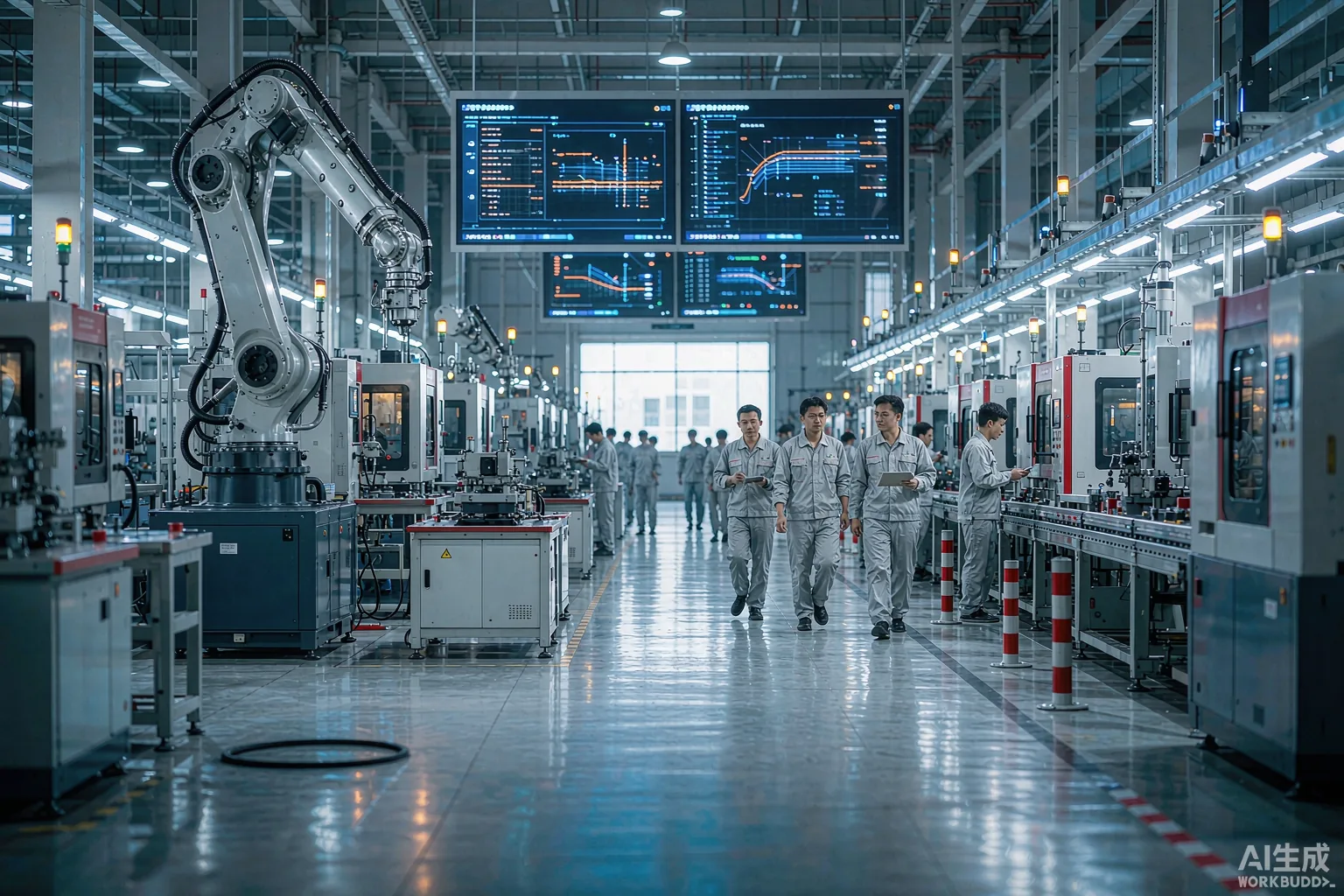
When you evaluate a Chinese machine tool, you are not only evaluating a builder. You are evaluating the ecosystem that produced it: the engineers available to it, the component vendors it can buy from, the digital infrastructure its customers expect it to plug into, and the installed base that will eventually determine whether spares and service exist near you.
That ecosystem is hard to see directly. Macro benchmarks are one of the few public ways to observe it — and they are also easy to misuse. The discipline is simple: treat every aggregate number as context, never as evidence about an individual machine. The rest of this page applies that rule to three figures worth knowing, each with the caveat that keeps it honest.
Benchmark 1 — 101 of 224 Lighthouse factories
The Global Lighthouse Network is run by the World Economic Forum with McKinsey. An independent panel designates factories and value chains that have moved fourth-industrial-revolution technologies — AI, IoT, digital twin, advanced analytics — from pilot to scale with measured results.
| Milestone | Global total | China | Share |
|---|---|---|---|
| September 2025 cohort (12 new sites, 6 in China) | 201 | 85 | ~42% |
| Most recent cohort — announced January 2026 (23 new sites, 16 in China) | 224 | 101 | ~45% |
Sources: World Economic Forum press release, 16 September 2025 (Geneva), for the 201-site milestone; China Daily, Securities Times and China Quality News reporting on the January 2026 cohort of 23 (16 in China) for the 224-site figure. WEF publishes further cohorts during the year — check weforum.org for the latest count before citing it in a formal document.
What it means for a buyer
A large, sustained Lighthouse presence implies a deep pool of engineers who have actually run connected, data-driven production — not just studied it. That pool feeds machine builders too: controls integration, probing routines, MES connectivity and process-data discipline are skills that cross from factory to factory.
WEF's own reporting on recent cohorts is also directly useful as a negotiating reference. Across newly designated sites, WEF cites average gains of roughly 40% labour productivity and 48% shorter lead times, with AI and generative-AI use cases accounting for about 50% of deployed cases, and reported reductions around 41% in defect rates, 28% in energy consumption and 44% in production cycle time. Those are WEF's published averages across designated sites — not a promise any supplier makes to you.
The honest caveat
A Lighthouse designates a factory site, not a machine or a supplier. It is not a product certificate and there is no "Lighthouse-compliant machining center." The list is also weighted toward consumer electronics, automotive and batteries — machine-tool builders themselves are under-represented. Do not let a national share stand in for a quality guarantee on the machine you are actually buying.
Benchmark 2 — 1,260 certified 5G factories, 8,000 projects
China's Ministry of Industry and Information Technology runs a tiered 5G factory programme. This is where most secondary reporting goes wrong, because there are three different counts in circulation:
1,260
sites in the formal 《5G工厂名录》 5G Factory Directory
8,000
projects in the broader 5G factory project library
20,000
cumulative "5G + Industrial Internet" projects
¥59.13bn
investment driven by the programme
The 1,260 figure is cumulative across the three directories published from 2023 to 2025, and spans 48 of the national economy's industrial categories (up from 25 in 2023). Related infrastructure figures as of end-2025: over 20,000 private 5G industrial networks built, 4.838 million 5G base stations nationwide, and "5G + Industrial Internet" applications covering all 41 industrial categories.
Sources: MIIT 5G Factory Development Report (2025), relayed by the Qingdao Municipal Bureau of Industry and Information Technology; MIIT's 《擦亮5G工厂中国品牌》 report at the 2025 Global Industrial Internet Conference (Xinhua / People's Daily, 8 September 2025); People's Posts and Telecommunications News (cnii.com.cn), March 2026.
The honest caveat
This is a policy-programme count, not an independent quality audit. "5G factory" tells you a site deployed a private 5G industrial network and connected applications. It tells you nothing about geometric accuracy, thermal stability or accuracy retention. And whenever a supplier quotes you "8,000 5G factories," ask which of the two counts they mean — the gap between 1,260 and 8,000 is the difference between certified sites and pipeline projects.
Benchmark 3 — US$2.30 trillion in electromechanical exports
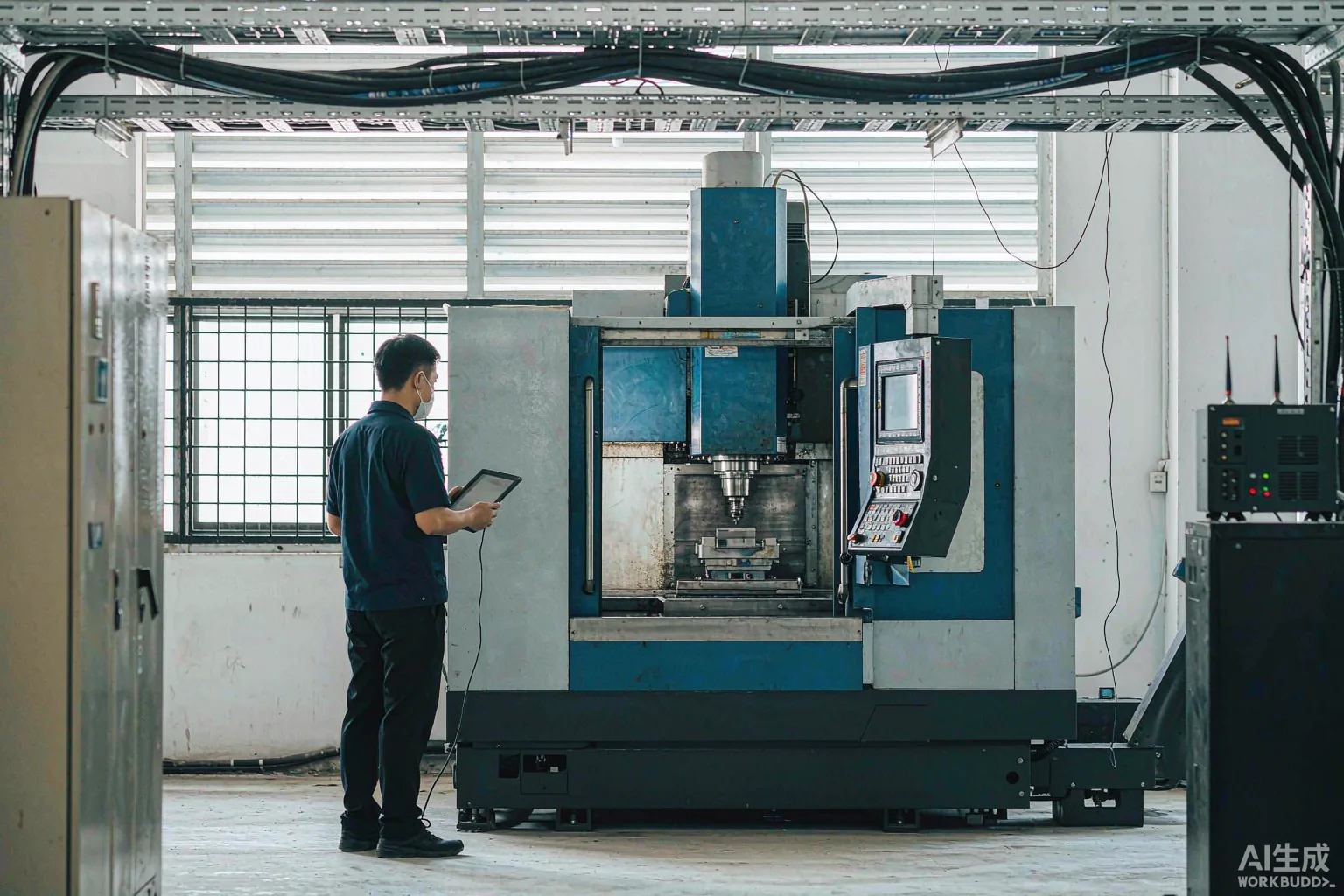
Per China Customs full-year 2025 data released in January 2026, China's electromechanical goods exports — the category that contains machine tools, industrial equipment and electronics — reached US$2.3018 trillion, up 8.4% year on year, accounting for 61% of total goods exports, up from 59.4% in 2024. The longer arc matters more than the single year: that share has climbed from roughly 42% in 2000.
Sources: General Administration of Customs full-year 2025 release (State Council Information Office briefing, 14 January 2026); State Administration of Foreign Exchange 2025 China Balance of Payments Report; China Chamber of Commerce for Import and Export of Machinery and Electronic Products.
A number to watch for. A figure of "¥9.36 trillion, +20.1%" circulates in some Chinese summaries and has been repeated in English. It conflates a half-year, RMB-denominated cut with the full-year customs release. Use the US$2.3018tn / +8.4% / 61% full-year customs figures, and note the currency and the period whenever you cite them.
What it means for a buyer
Export scale is not quality, but it is service reality. A large and growing installed base abroad is what eventually justifies local parts stock, trained engineers and shorter response times. When you are comparing a young brand's price against an established one's, this is the trend that determines whether the price gap stays a bargain or becomes downtime.
How to actually use these numbers
- Convert each benchmark into a question, not a conclusion. "Which Lighthouse or smart-manufacturing references does your company or your served customers hold — and are they in my industry?" A credible supplier answers plainly; the specific answer matters more than the badge.
- Borrow Lighthouse acceptance logic for cells and turnkey lines. WEF-designated sites define success by measurable use-case KPIs. Do the same: specify cycle time, OEE, first-pass yield and changeover time as acceptance criteria, not an equipment list.
- Specify data openness up front. Because connected production is now the norm, requiring OPC UA or MTConnect exposure, remote diagnostics and a written remote-service agreement is a reasonable, standard ask — not a premium one.
- Ask the supplier to separate macro from own. If a quotation leans on national statistics instead of the machine's own test report, that is a signal in itself.
- Verify at your level, always. Trial cuts on your parts, a third-party ISO 230-2 / GB/T 17421.2 accuracy report, certification for your market, and a priced spares package with a written response time.
Data credibility rating
| Claim | Source | Rating |
|---|---|---|
| Global Lighthouse Network reached 201 sites; 12 new (6 in China), September 2025 | World Economic Forum official press release, Geneva, 16 Sept 2025 | High first-hand |
| China at 85 of 201 (~42%) as of September 2025 | WEF release plus multiple Chinese state-media relays | High multi-source |
| 224 global sites, 101 in China (~45%), most recent cohort of 23 (16 China) | China Daily; Securities Times (stcn); China Quality News — consistent | High multi-source, non-WEF relay |
| WEF cohort averages: +40% labour productivity, −48% lead time, −41% defects, −28% energy, −44% cycle time; AI in ~50% of use cases | WEF / industry relays of the September 2025 cohort | High WEF-published, but cross-site averages |
| 1,260 5G factories in the Directory; 8,000 in project library; 20,000 cumulative projects; ¥59.13bn investment | MIIT 5G Factory Development Report (2025), relayed by Qingdao municipal industry bureau (gov.cn) | High first-hand government |
| 20,000+ private 5G industrial networks; 4.838m base stations; 41 industrial categories covered | People's Posts and Telecommunications News (cnii), March 2026; MIIT conference reporting | Medium-High state-media relay |
| Electromechanical exports US$2.3018tn, +8.4%, 61% of goods exports (59.4% in 2024) | China Customs full-year 2025 release; SAFE BoP report; CCCME | High first-hand |
| Share ~42% in 2000, rising over two decades | Long-run customs-based series, widely cited | Medium-High long-run series, verify vintage |
| "¥9.36 trillion / +20.1%" variant | Chinese summary articles, period and currency conflated | Rejected not used |
| Any inference that these benchmarks certify an individual machine or Gree CNC | — | Not claimed explicitly excluded |
Honest limitations (read before quoting any figure)
- These are aggregate, economy-wide figures — not Gree CNC metrics and not machine-tool-subsector metrics.
- They are direction-of-travel evidence. They say where an ecosystem is heading. They cannot substitute for machine-specific inspection, trial cuts and documented test reports.
- Programme counts move. WEF adds cohorts during the year; MIIT re-publishes its 5G factory directory annually. Verify the latest official release before using any figure in a procurement document.
- Sector weighting is uneven. Lighthouse and 5G factory designations cluster in electronics, automotive, batteries and consumer goods. Machine-tool building is comparatively thin in both lists.
Guidance
- Use macro numbers to form better questions, not to skip verification. The buyer who asks "which of these counts do you mean?" is already harder to mislead.
- Specify what the ecosystem now makes possible. Open data interfaces, remote diagnostics and measurable KPI-based acceptance are fair, standard requirements in 2026.
- Keep the burden of proof at the machine level. A test report, a run-off on your parts, certification for your market and a priced spares plan — those four close more risk than any national statistic opens.
- Compare suppliers on published, checkable detail. Where two builders look similar on paper, the one that publishes component origins, test protocols and service terms is the one you can plan around.
Bottom line. China's manufacturing ecosystem is measurably deeper, more connected and more export-established than it was five years ago — and all three of those things eventually show up in what a machine builder can offer you. None of them shows up automatically in the machine you receive. Use the benchmarks to decide what to ask, then let the answers, not the averages, decide the purchase.
Frequently asked questions
Is a Lighthouse factory a certification I can require from a supplier?
No. It designates a factory site's digitalization maturity, not a machine standard. Use it as a reference check on engineering environment and culture — never as an acceptance criterion.
Does a high national 5G-factory count guarantee machine accuracy?
No. Connectivity and geometric accuracy are different properties. Verify accuracy with your own measurement protocol and your own parts.
Are these Gree CNC's own numbers?
No. They are third-party macro benchmarks from WEF/McKinsey, MIIT and China Customs, provided as economy-wide context — not as Gree CNC or machine-tool-subsector metrics.
What is the difference between 8,000 and 1,260 5G factories?
Two counts of the same build-out: 1,260 sites are formally listed in MIIT's 5G Factory Directory; 8,000 are projects in the broader library. Always ask which one a source means.
How should I use macro benchmarks when sourcing a CNC machine?
As question-generators and acceptance-design inputs. Then require a run-off on your parts, a third-party accuracy report, market certification and a priced spares package.
Related reading
Want these benchmarks applied to your sourcing decision?
Send your part drawing, material, tolerance and target volume. We will tell you honestly which machine family fits — and where the macro story does and does not apply to your case.