The opportunity side of this page — why a complete cell can be quoted at all, and what export scale does for service reality.
China CNC · Sourcing Risk
The 4 Hidden Costs of a Turnkey CNC Line from China
← All CNC Reports · ← GREE CNC · Published 2026-09-24
Executive summary — read this first.
- A turnkey quote is an equipment quote wearing a different label. Unless a boundary-of-supply matrix is signed, "turnkey" means whatever the seller finds convenient on the day — usually that foundations, power, air, coolant handling and compliance are yours.
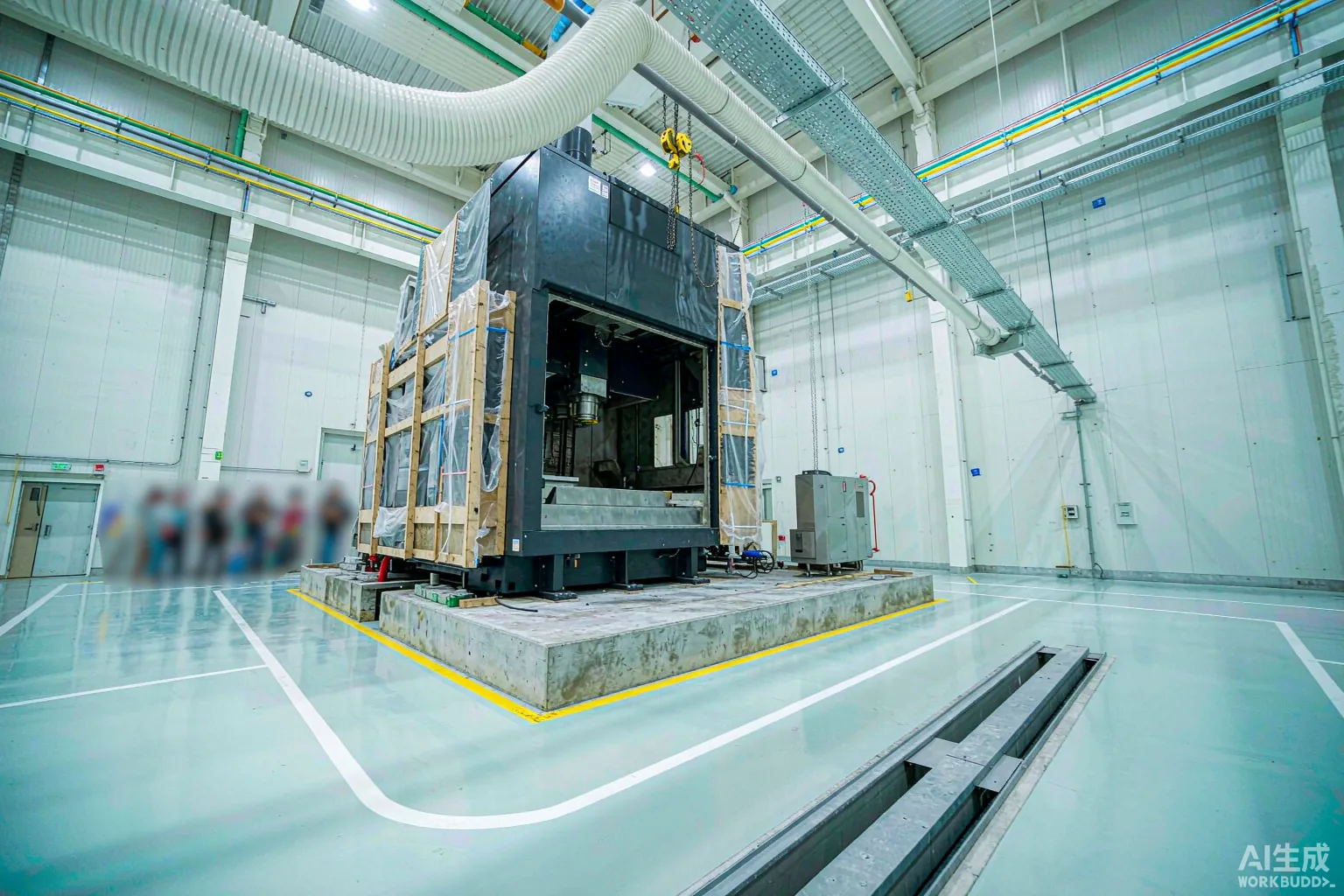
- Site readiness is the most reliably underestimated item. Machine-specific foundations, three-phase power and transformers, compressed air, coolant and chip handling, extraction and floor loading are almost always buyer-side, and on a multi-machine cell they are not a rounding error.
- Compliance is a documentation problem before it is an engineering one. A machine built for the domestic market is not automatically compliant at your door. Decide in the contract who owns CE or UKCA, UL or local electrical approval, guarding, EMC and the technical file — and who pays if inspection fails.
- "Delivered and commissioned" is not "making good parts at rate." Fixtures, holders, first tooling, probes, part programs, operator training and a KPI-based run-off are a separate scope with a separate price. Cite the ISO 230 test you will accept against.
- The largest cost is the one nobody prices: downtime after the engineers fly home. Spares lead time, written response times, remote-diagnostics access and a real service radius determine lifecycle cost far more than the capex delta ever will.
Why the quote and the budget diverge
Every capital-equipment project starts with a number and ends with a different one. The gap is rarely caused by dishonesty; it is caused by two parties pricing two different objects. The exporter prices a machine, crated and shipped. The buyer budgets a producing asset, bolted down, powered, compliant, staffed and making parts. Both are legitimate views. Only one of them is written down in the contract.
This page is the companion to our "Factory of Factories" analysis, which explains why China's full-stack manufacturing export model can deliver a complete cell at a price that surprises people. That piece covers the opportunity. This one covers the arithmetic — the four cost areas that sit outside the equipment line, and the specific documents that move each one from surprise to budget item.
None of this is an argument against Chinese equipment, and none of it is unique to China. We sell Chinese machine tools for a living. We would rather you arrive with your eyes open than discover a six-figure gap after commissioning, because the second outcome costs us a customer and costs you a quarter.
Cost 1 — Site readiness, almost always "by buyer"
A machine tool is not an appliance. It is a structure that applies cutting forces to a floor, draws serious power, consumes compressed air and coolant, produces chips and mist, and expects a defined thermal environment. On a single machine in an existing plant, this is routine. On a new cell or line, it is a construction project.
| Item | Why it is missed | Typical owner |
|---|---|---|
| Machine-specific foundations, pits, vibration isolation, grouting | Depends on the machine's own footprint and load drawing, which arrives after the quote | Buyer |
| Three-phase power, transformer, cabling, earthing | Voltage and frequency differ by market; site capacity is a local survey question | Buyer |
| Compressed air, coolant supply and return, chip extraction, mist collection | Usually quoted as "utilities by others" in one line | Buyer |
| Floor load, crane access, door widths, rigging route | Logistics detail discovered on delivery day | Shared / designated |
| Ambient temperature control and ventilation | Accuracy is specified at a reference temperature; the building decides whether you can hold it | Buyer |
The fix is one document: a boundary-of-supply matrix. Two columns, seller and buyer, every item listed, nothing left to "including installation." Where a service genuinely is shared, name the interface point — the terminal, the flange, the pit edge. If the seller will not produce the matrix, that tells you how the rest of the project will be run.
Do not use online rules of thumb for site cost. Civil work, electrical labour and utility connection charges vary enormously by country, region and building. Get a local civil and electrical quote against the machine's actual installation drawing. Any percentage you read on a website — including a "typical 10–20% of machine price" figure — is a guess applied to someone else's building.
Cost 2 — Compliance and certification the exporter does not own
This is where turnkey projects most often go wrong, because the risk sits with the buyer while the documentation sits with the seller. A machine engineered for the Chinese domestic market is not automatically conforming at your door, and "we have CE" is not a statement that can be checked.
European Union: two regimes, one cut-off date
For machinery placed on the EU market up to and including 19 January 2027, the Machinery Directive 2006/42/EC applies. From 20 January 2027, Regulation (EU) 2023/1230 replaces it. There is no parallel-transition window: it is a cut-over. The Regulation adds essential health and safety requirements the Directive did not address — notably protection against external attack (cybersecurity) and requirements for autonomous and AI-enabled functions — and it permits digital instructions and declarations of conformity for professional users under conditions.
Two practical consequences for a 2026 buying decision. First, a machine you import this year is certified under the Directive, which is correct and lawful — do not accept or demand a "2023/1230 certificate" before the date, because it does not exist yet. Second, ask what happens at the cut-over: under Article 52(2) of the Regulation, EC-type examination certificates issued under the Directive remain valid until their stated expiry, but if your certificate expires close to January 2027 you should plan recertification early, because notified-body capacity near the transition is expected to be tight.
Sources: Regulation (EU) 2023/1230 of the European Parliament and of the Council of 14 June 2023 (OJEU L 165, 29 June 2023, with corrigendum of 4 July 2023); European Commission and notified-body guidance on the 20 January 2027 application date and Article 52 transitional provisions.
Great Britain and Northern Ireland: the question has changed
If your plant is in England, Scotland or Wales, the UKCA question is no longer the blocker it was. Following the Product Safety and Metrology etc. (Amendment) Regulations 2024, CE marking is recognised indefinitely in Great Britain across 21 product regulations, including machinery, so a validly CE-marked machine can be placed on the GB market without a separate UKCA procedure. Northern Ireland is different: under the Windsor Framework it continues to follow EU rules, so CE is required there, with UKNI added where a UK body performed the third-party assessment.
Sources: UK government product-safety and metrology guidance (gov.uk) on extended recognition of CE marking in Great Britain; Product Safety and Metrology etc. (Amendment) Regulations 2024, in force 1 October 2024. Check gov.uk for the sector-specific position at the time of your import.
What to put in the contract
- Name the certificates and the standards. Not "CE" but the declaration of conformity, the directive or regulation cited, the harmonised or designated standards applied, and the notified or approved body number if third-party assessment was involved.
- Allocate failure in advance. If a unit fails local inspection — guarding, EMC, electrical approval, documentation language — who pays for the rework, the re-inspection and the delay? This single clause prevents the most common turnkey dispute there is.
- Check the technical file, not the logo. The mark is a claim; the file is the evidence. Ask to see it before shipment, not after arrival.
- Confirm the market version. Voltage, frequency, plug and protection standards, language of manuals, and safety-component sourcing all differ by destination. Machine-tool builders produce market variants; make sure yours is one.
Cost 3 — Commissioning, tooling and the first good part
Between "installed" and "producing" there is a scope that buyers routinely assume is included and sellers routinely assume is not: fixtures, workholding, holders and first tooling, probes and setter, part programs for your part family, operator and maintenance training, and the run-off that proves the cell can hit rate.
The standards to cite are not obscure, and naming them changes the conversation because it moves acceptance from an opinion to a measurement:
ISO 230-1:2012
geometric accuracy under no-load or quasi-static conditions
ISO 230-2:2014
positioning accuracy and repeatability of NC axes (Amd 1:2016)
ISO 230-3:2020
determination of thermal effects
ISO 230-4:2022
circular tests for NC machine tools (ballbar)
ISO 230-7:2015
geometric accuracy of axes of rotation
GB/T 17421.2-2019
Chinese national counterpart to the positioning test
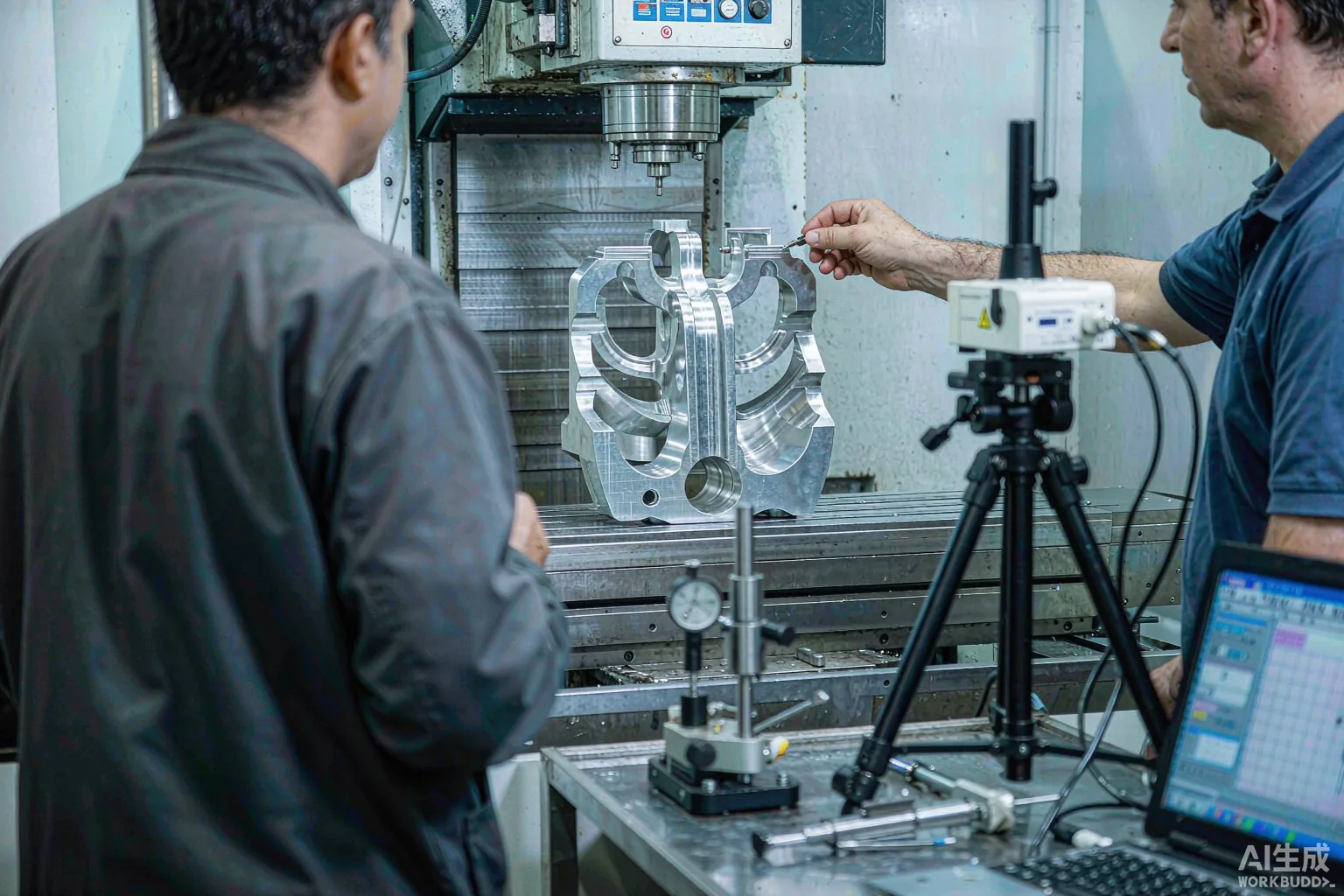
Three details make the difference between a test report and a marketing brochure. Edition — cite the year, because the method and the uncertainty treatment differ. Environment — ISO 230 testing uses a 20 °C reference, and a hot shop on a Monday morning will not reproduce a builder's result; agree the soak and stabilisation conditions. State of compensation — a machine measured with full error compensation enabled is a different machine from one measured bare, and you are entitled to know which you are buying.
FAT, SAT, and the sentence that matters
FAT (Factory Acceptance Test) runs at the builder's site before shipment; SAT (Site Acceptance Test) runs at yours after installation. FAT is valuable but it is not sufficient — it proves the machine worked in someone else's building, on someone else's power, at someone else's temperature. SAT is the one that should release final payment.
Write acceptance as measurable outcomes on your parts: cycle time, first-pass yield, and Cpk on the characteristics that matter, over a defined run length and sample size. An equipment checklist proves you received boxes. A run-off protocol proves you received capability.
Cost 4 — Downtime after the engineers leave
Of the four, this is the largest and the least quantified. It is also the one where a low purchase price most reliably becomes a high ownership cost, because the delta between a cheap line and a well-supported line is usually paid for in waiting.
- Spares lead time and price. A three-week wait for a drive, a seal kit or a spindle part is a three-week stoppage. Ask for a recommended spares package with part numbers and prices, and for the stocking location — in-country, regional, or factory only.
- Response time in writing. "We will support you" is not a commitment. A named response window, an escalation path and a named engineer are. Support across time zones and languages is a real skill; ask who answers the phone and in what language.
- Remote diagnostics. Because connected production is now routine, requiring open data access — OPC UA or MTConnect — plus a written remote-service agreement is a reasonable standard requirement, not a premium one. Confirm what data leaves your network and who can see it.
- Service radius. Distance, not price, sets real lifecycle cost. A regional service point with parts on the shelf beats a cheaper machine whose nearest engineer is a flight and a visa away. This is precisely why regional hubs exist, including our own in Malaysia.
A blunt point about our own interest. We benefit when you buy service and spares. That is exactly why you should insist these terms are written down rather than promised — a supplier confident in their support network will put response times in the contract, and one who will not has told you what you needed to know.
A pre-signature checklist
- Boundary-of-supply matrix signed — who does foundations, power, air, coolant, chip handling, extraction, rigging
- Utilities confirmed against the machine's installation drawing — voltage, frequency, air volume and pressure, floor load, ambient range
- Certificates named to the standards your site actually requires — plus who pays if local inspection fails
- Acceptance defined as a KPI run-off on your parts — cycle time, first-pass yield, Cpk, sample size, run duration, FAT and SAT both specified
- Test standard and conditions cited — ISO 230 part and edition, 20 °C reference, compensation state, who performs and who pays
- Tooling, workholding, programs and training priced as a scope — including the first-article and first-good-part milestone
- Spares package priced with lead times and stocking location
- Written service response, escalation path and remote-diagnostics agreement
- Incoterms and delivery terms explicit — cite the edition of the Incoterms rules used, and confirm who handles import clearance, duties and inland delivery
Data credibility rating
| Claim | Source | Rating |
|---|---|---|
| Machinery Directive 2006/42/EC applies until 19 January 2027; Regulation (EU) 2023/1230 applies from 20 January 2027 with no parallel window | Regulation (EU) 2023/1230 (OJEU L 165, 29 June 2023, corrigendum 4 July 2023); European Commission and notified-body guidance | High first-hand regulation |
| EC-type examination certificates under the Directive remain valid until their stated expiry under Article 52(2) | Article 52(2), Regulation (EU) 2023/1230; notified-body transition guidance | High first-hand |
| CE marking recognised indefinitely in Great Britain across 21 product regulations including machinery; Northern Ireland requires CE | UK government guidance (gov.uk); Product Safety and Metrology etc. (Amendment) Regulations 2024, in force 1 October 2024 | High first-hand government |
| ISO 230-1:2012, 230-2:2014 +Amd 1:2016, 230-3:2020, 230-4:2022, 230-7:2015 scopes | ISO/TC 39/SC 2 catalogue | High standards body |
| GB/T 17421.2-2019 as the Chinese counterpart to the positioning test | Chinese national standard, commonly mapped to ISO 230-2; compare editions and clauses before treating reports as equivalent | Medium-High mapping is conventional, not automatic |
| ISO 230 testing uses a 20 °C reference environment | ISO 230 series test conditions; builder and laboratory practice | Medium-High verify the exact part and edition for allowable gradients |
| Site-preparation cost as a percentage of machine price | — | Not claimed deliberately omitted; varies by site |
| Any claim that these costs are specific to Chinese equipment | — | Not claimed explicitly excluded |
Honest limitations
- These costs apply to any imported turnkey line, not only Chinese ones. European and Japanese suppliers can be equally vague about boundary of supply; their spares and service economics differ rather than disappear. This page is not a competitive argument — it is a budgeting discipline.
- We are a machine-tool supplier and authorised distributor, not an EPC contractor. We supply machines, cells, integration support and commissioning. For full-plant builds we scope honestly and say what is outside our scope, rather than promising a single throat to choke that we cannot actually be.
- Site and compliance costs are not generalisable. Get local civil, electrical and utility quotes. Do not use any published percentage as a budget.
- Regulations move. EU machinery rules change on 20 January 2027 and UK product regulations are updated by secondary legislation. Verify the current position with your own conformity adviser before contracting.
Guidance
- Price the transfer, not the machine. Before comparing two quotes, put both onto the same nine-line checklist above. The comparison that changes the decision is rarely the one on the first page.
- Convert every vague promise into a document. "Turnkey" becomes a boundary-of-supply matrix. "Support" becomes a response time. "Accurate" becomes an ISO 230-2 report with conditions. Each conversion removes a surprise.
- Make acceptance measurable and hold payment against it. KPI-based SAT on your parts is the single strongest clause in a turnkey contract, and it costs nothing to ask for.
- Judge the service model like a product. Stocking location, response time and engineer proximity are specifiable. Treat them as part of the machine.
- Prefer the supplier who writes things down. Where two builders look similar on paper, the one that publishes component origins, test protocols and service terms is the one you can plan around.
Bottom line. A turnkey line from China is often genuinely competitive once everything is counted — and it is never as cheap as the equipment page suggests. The four items above are not objections to buying; they are the difference between a project that lands on budget and one that lands on your quarterly results. Ask for the documents, price the scope, and let the total decide.
Frequently asked questions
Is a turnkey CNC line from China still cheaper once these four costs are included?
Often yes on total cost of ownership — but only if you price all four before you compare, not after. Most overruns come from comparing an equipment quote against an installed-cost quote, which are two different things.
Who should pay for CE or UKCA if the machine fails local inspection?
Whoever the contract names in advance. This is the single most common turnkey dispute, because the exporter controls the documentation while the buyer carries the local legal exposure. Allocate it as a line item before signature.
Which ISO standard should I cite for accuracy acceptance?
ISO 230-1:2012 for geometric accuracy under no-load or quasi-static conditions, ISO 230-2:2014 (+Amd 1:2016) for positioning accuracy and repeatability of NC axes, ISO 230-3:2020 for thermal effects, ISO 230-4:2022 for circular (ballbar) tests and ISO 230-7:2015 for rotary axes. GB/T 17421.2-2019 is the Chinese counterpart to the positioning test. Always cite the edition, the 20 °C reference and the compensation state.
Does CE marking for machinery use the Directive or the new Regulation right now?
For machinery placed on the EU market up to and including 19 January 2027, the Machinery Directive 2006/42/EC applies. From 20 January 2027, Regulation (EU) 2023/1230 replaces it, adding cybersecurity and AI-related requirements and allowing digital instructions for professional users. Existing EC-type certificates remain valid until their stated expiry under Article 52(2).
Do these hidden costs only apply to Chinese equipment?
No. All four apply to any imported turnkey line. European and Japanese suppliers can be equally vague about boundary of supply, and their service economics differ rather than vanish. The discipline is identical whoever you buy from.
Can one supplier really deliver a whole plant turnkey?
Rarely in the full engineering-procurement-construction sense. Builders and distributors normally supply machines, cells, integration support and commissioning; civil works and local electrical installation are usually buyer-side. A supplier claiming single-point responsibility for everything should be able to name the subcontractors and show the contract structure.
Related reading
Want a boundary-of-supply matrix for your project?
Send your part drawing, material, tolerance, target volume and destination country. We will tell you honestly which machine family fits, and where our scope ends and yours begins.