How Gree's five-axis VMCs and the GA-FMB3020D gantry fit together in the product line.
Gree CNC · Product Guide
Gree Gantry & Dual Five-Axis CNC: GA-FMB3020D Guide
Executive summary — read this first.
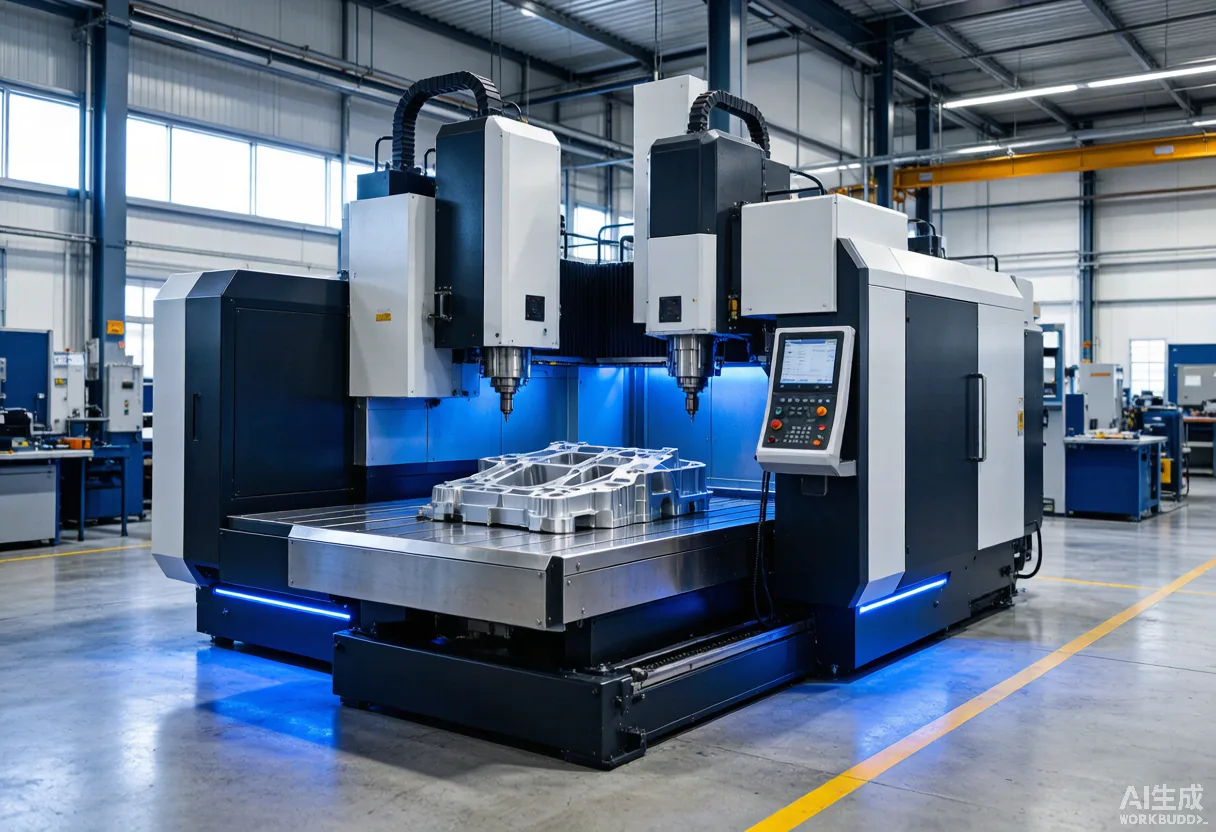
- Gree's GA-FMB3020D is a high-speed dual five-axis gantry machining center — a bridge-frame machine with two independent five-axis spindles designed for large integrated die-castings.
- It won a gold medal at the 50th Geneva International Exhibition of Inventions in April 2025, Gree's highest-profile international award for a machine tool to date.
- Published highlights: 120 m/min max rapid traverse, one-clamping six-face machining, and a standardized export figure of +25% efficiency gain over traditional single five-axis equipment on large automotive parts (Gree's domestic materials cite >80% in ideal parallel-cut conditions).
- Best fit: automakers and tier suppliers machining EV front cabins, rear floors and battery trays; less suited to small precision parts where a vertical five-axis VMC is more economical.
What a gantry machining center is — and why it matters
A gantry machining center uses a bridge-shaped frame: two vertical columns support a horizontal beam (the gantry), and the spindle assembly travels along that beam. Because the cutting forces are carried by a large closed frame rather than a cantilevered column, gantries stay rigid over long travels and heavy cuts. That makes them the default choice for big, complex parts where a conventional vertical machining center would vibrate or simply not fit.
The trade-off is size, foundation and cost. A gantry needs a level floor or isolated foundation, more floor space and a higher initial investment. The payoff is the ability to machine large workpieces — such as EV battery trays, motor housings, aerospace structures and injection-mold bases — in fewer setups.
The GA-FMB3020D: Gree's Geneva gold winner
In April 2025, Gree announced that its "high-speed double five-axis gantry machining center" GA-FMB3020D had won a gold medal at the 50th Geneva International Exhibition of Inventions. The award is significant because the Geneva expo is one of the better-known global invention shows, and the win gives Gree a third-party credential for its machine-tool program beyond domestic trade shows.
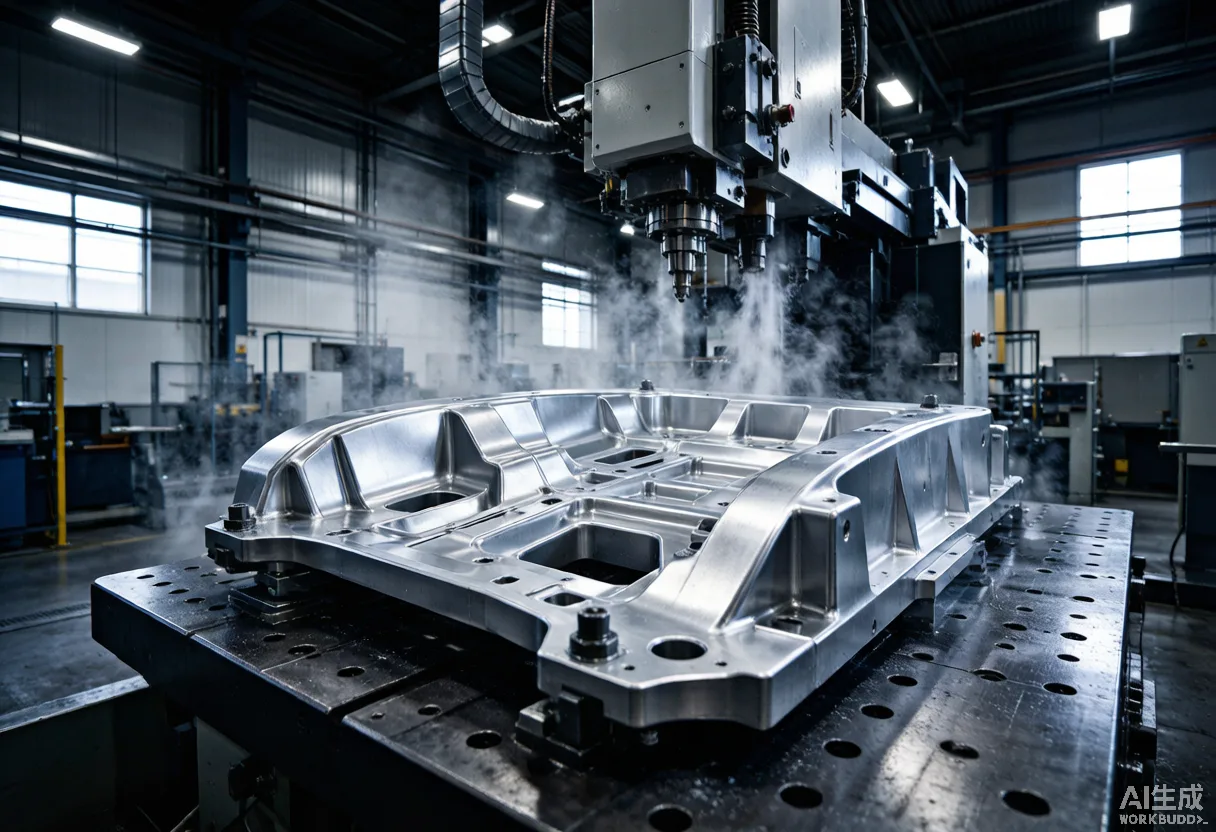
The company describes the machine as purpose-built for large integrated die-castings — the aluminum castings that replace dozens of stamped and welded parts in new-energy-vehicle (NEV) bodies. These parts are big, thin-walled and geometrically complex, which is exactly the scenario a dual five-axis gantry is meant to solve.
Published specifications
The table below consolidates figures Gree has published for the GA-FMB3020D and related gantry models. Treat them as vendor-stated performance targets rather than independently verified numbers.
| Item | Published figure | What it means in practice |
|---|---|---|
| Machine type | Dual five-axis gantry | Two five-axis spindles on one gantry frame; can machine a large part from multiple sides |
| Award | Geneva Invention Expo 2025 gold medal | Public exhibition record; credible third-party credential |
| Max rapid traverse | 120 m/min | Fast positioning between cuts — important for large work envelopes |
| Spindle max speed | 24,000 rpm (related FMD3020) | Suitable for aluminum die-castings and light alloy finishing |
| Motion technology | Direct-drive AC swing head, linear motor, high-torque rotary table | Gree's in-house motion chain; reduces mechanical backlash |
| Efficiency claim (export) | +25% improvement vs traditional single 5-axis (Gree domestic cites >80%) | Vendor claim; depends on part geometry and programming |
| Typical parts | EV front cabin, rear floor, battery tray | Large integrated die-castings; one-clamping six-face machining |
Why "dual five-axis" changes the math
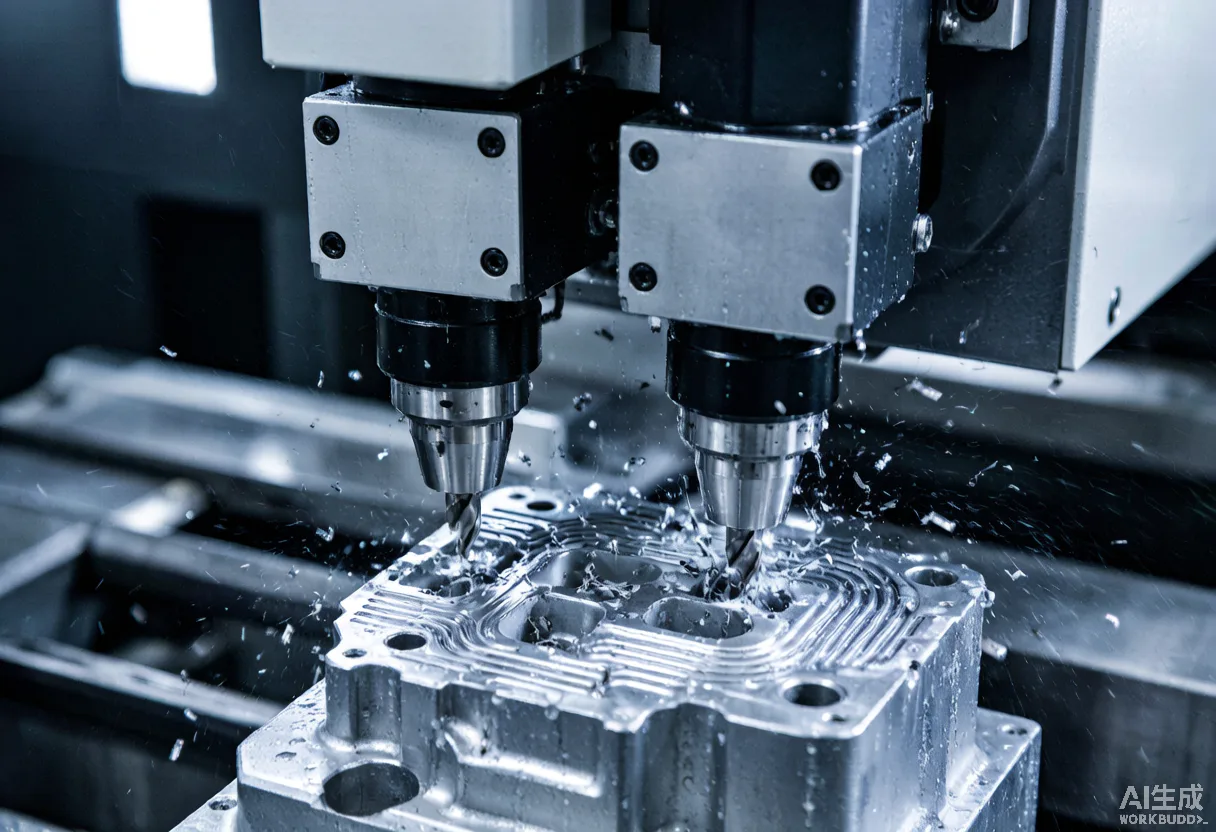
A conventional five-axis machine has one spindle and one rotary table. To machine six faces of a large part, you typically need multiple setups or a very capable trunnion. Gree's dual five-axis approach puts two spindles on the same gantry. Both can reach the workpiece from different angles, so the machine can:
- Machine two features at once on the same large workpiece, cutting effective cycle time.
- Reduce setups by accessing more faces without unclamping the part.
- Balance cutting forces across the gantry frame because both spindles share the same structure.
The +25% efficiency figure we standardize to for export is a conservative read of Gree's domestic >80% claim, which is based on this parallelism. The honest caveat is that dual spindles only save time when the part geometry and CAM program let both spindles cut productively at the same time. On some parts, the second spindle may wait while the first finishes a complex feature.
In-house motion chain — and the controller caveat
Gree emphasizes that the GA-FMB3020D uses its own direct-drive AC swing head, high-thrust linear motor and high-torque rotary table. These are the mechanical parts of the motion chain, and Gree has credible history in motor and drive development from its air-conditioner and industrial-motor businesses.
The same caveat that applies across Gree's CNC line applies here: the high-end CNC controller is an acknowledged gap area. Gree develops motion logic and servo control, but for the highest-performance controller layer the industry still looks to Fanuc, Siemens, Heidenhain or, among Chinese makers, KEDE's GNC. Do not confuse Gree's mechanical self-sufficiency with a fully proprietary CNC controller.
Where the GA-FMB3020D fits
Gree is explicit that the machine is aimed at automotive integrated die-castings. The main applications are:
- EV body Front cabins and rear floors — the large single-piece aluminum castings that form the front and rear of a unibody EV.
- Battery trays Battery enclosures — large, flat, high-precision aluminum parts that must seal and align with the pack.
- Molds Large mold bases and cavities — where the gantry's rigidity and travel help rough and finish big tooling.
For aerospace, the rigidity and five-axis reach are relevant, but buyers should validate long-term accuracy retention and process databases because Gree has less aerospace certification history than established German, Japanese or even some dedicated Chinese five-axis brands.
Gantry vs standard five-axis VMC
| Factor | Gantry (GA-FMB3020D) | Standard 5-axis VMC (e.g., GA-FA320) |
|---|---|---|
| Part size | Very large integrated castings | Smaller precision parts, robot joints, 3C frames |
| Footprint | Large; needs foundation | Compact; standard industrial floor |
| Investment | High (reportedly ~¥3.5M / ~$490k range) | Moderate |
| Best process | Roughing and finishing big aluminum castings | High-precision finishing of complex 3D surfaces |
| Throughput | Dual spindle can raise output on suitable parts | Single spindle; flexible for low-volume/high-mix |
Data credibility rating
| Claim | Source | Rating |
|---|---|---|
| Geneva Invention Expo 2025 gold medal for GA-FMB3020D | Gree official news / exhibition record | High |
| 120 m/min rapid traverse; 24,000 rpm spindle | Gree technical releases / trade-press coverage | Medium vendor-stated |
| +25% efficiency gain vs single five-axis (Gree domestic cites >80%) | Gree / export-standardized | Medium scenario-dependent |
| Price ~¥3.5M / $490k | Third-party industry media | Medium unconfirmed by Gree |
| External supply ratio >75%; NEV parts 70% of CNC output | Gree official news | Medium self-reported |
Should you consider the GA-FMB3020D?
- Strong fit if you are a tier-one automotive supplier machining large aluminum integrated die-castings, need shorter lead time than a European/Japanese gantry, and can validate the machine on your actual parts.
- Consider carefully if your work is small, high-mix or ultra-precision aerospace — a standard 5-axis VMC or an established aerospace gantry may be more appropriate.
- Always request a paid trial cut on a production-representative part before committing to volume. Dual-spindle efficiency gains are real on the right geometry, but they are not automatic.
Bottom line. The GA-FMB3020D is Gree's most credible flagship for large-part machining. The Geneva gold medal gives it external validation, but the +25% export efficiency figure (and price estimates) should be confirmed on your specific application. It is a strategic alternative to imported gantries for EV die-casting suppliers, not a universal replacement for every five-axis job.
Frequently asked questions
What is a gantry machining center?
A gantry machining center has a bridge-like frame with two vertical columns and a horizontal beam that carries the spindle. This layout gives high rigidity over a large work envelope, making it ideal for big parts such as EV battery trays, motor housings, aerospace structures and mold bases.
What makes the Gree GA-FMB3020D "dual five-axis"?
The GA-FMB3020D uses two independent five-axis spindles on a single gantry frame. Both spindles can machine the same large part simultaneously, or different faces of it, which Gree says raises efficiency by more than 80% versus a single five-axis setup on large integrated die-castings.
Is the GA-FMB3020D suitable for aerospace parts?
The machine is positioned mainly for automotive integrated die-castings and large structural parts. While its rigidity and five-axis reach could suit some aerospace applications, buyers should validate tolerance retention and process databases for flight-certified work against established aerospace machine-tool suppliers.
How does the GA-FMB3020D compare to a standard 5-axis VMC?
A standard five-axis VMC is better for smaller, precision parts. The GA-FMB3020D gantry is built for large workpieces — one-clamping six-face machining of EV front cabins, rear floors and battery trays — where its dual-spindle design and high rapid traverse are meant to cut cycle time.
Related reading
Talk to our application engineers
Send your part material, tolerance and volume — we return a recommended model, spec sheet and quote within one business day.
Request a Quote →