The wider four-way comparison this two-brand guide sits inside.
Gree CNC · Buyer Comparison
Gree CNC vs Haitian Precision: A Buyer's Comparison
Executive summary — read this first.
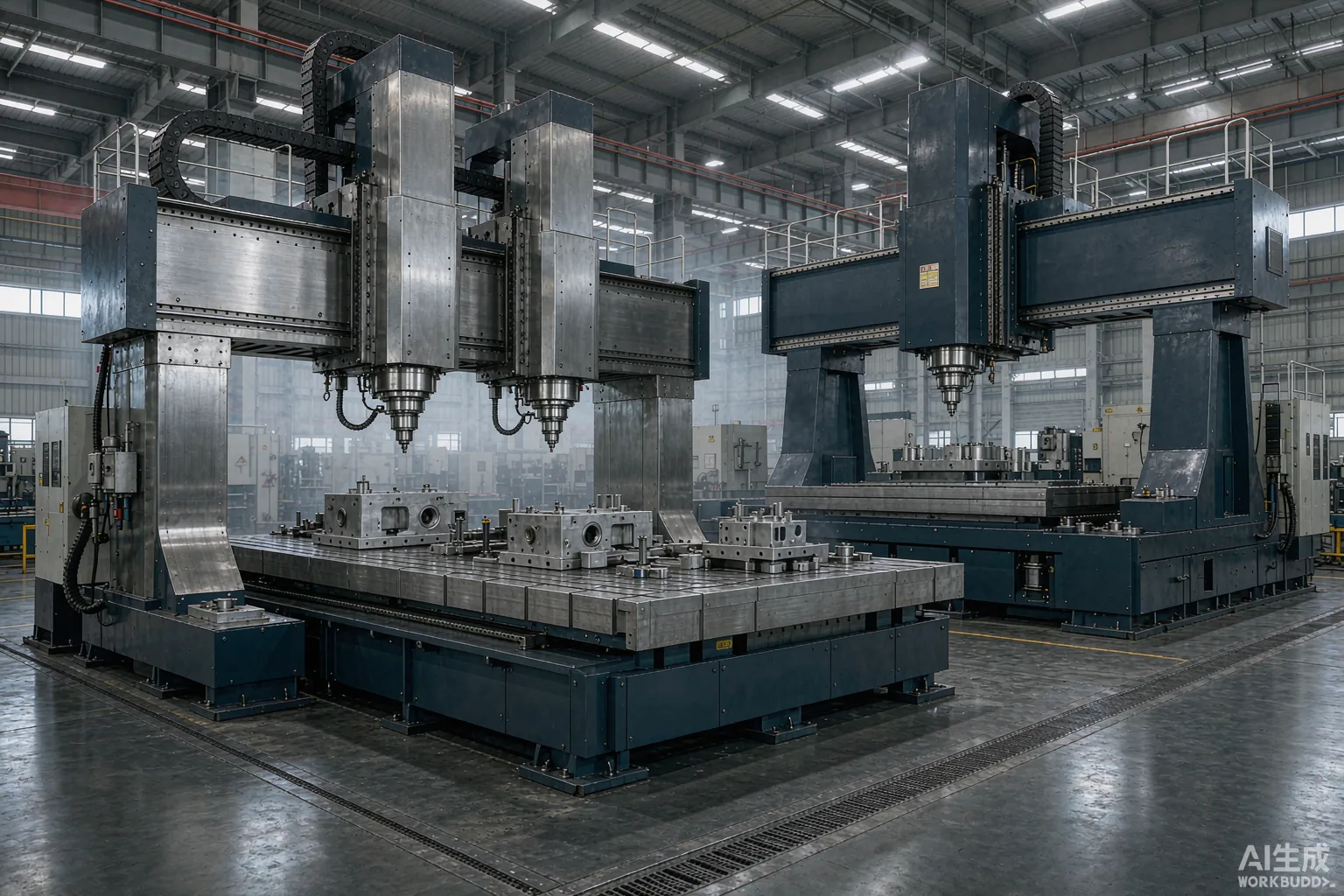
- They are not rivals for the same part. Haitian Precision is an envelope specialist: its gantry and double-column lines span X-axis travels from 1.25 m to 25 m and table loads from 3 t to 120 t. Gree is a cycle-time specialist: its flagship dual-beam, dual-spindle five-axis gantry (GA-FMB3020D) runs 120 m/min rapid traverse at 1.1 G for large aluminium die castings.
- Only one of them publishes segment numbers. Haitian is listed in Shanghai (601882) and reports revenue by product line and region. Gree's machine-tool business sits inside a diversified appliance group with no standalone CNC disclosure — so your diligence process has to be different for each.
- Haitian's 2025 accounts show a margin squeeze, not a capability loss. Revenue was roughly flat at ¥3.368 bn (+0.48%) while net profit fell 17.97% to ¥429 m, driven by domestic price competition. Gantry unit volume still grew about 15%.
- Overseas is where the growth is, for both. Haitian's overseas revenue reached ¥557.7 m in 2025, up 50.01%, at a 39.39% gross margin versus 22.82% at home. That gap is the single clearest signal of why Chinese builders are pushing abroad — and why service networks outside China are still maturing.
- Neither builds a high-end controller. Haitian specifies FANUC, Siemens and FIDIA depending on the line; Gree uses mature control products from Huazhong CNC and Siemens while developing its own spindle, linear motor, direct-drive swing head and torque table. Plan your spares and firmware questions accordingly.
Why this comparison is worth your time
Five years ago, a European or South-East Asian shop comparing Chinese machining centres was really asking one question: is it good enough to be worth the discount? That question has been answered, and the answer is yes for a large slice of aluminium and structural-steel work. The question in 2026 is harder and more useful: which Chinese builder is actually aimed at my parts?
Gree and Haitian Precision are the two names that come up most often, and they are frequently treated as interchangeable because both are Chinese, both build gantry machines, and both quote substantially below German and Japanese equivalents. They are not interchangeable. Their engineering priorities diverge sharply, their disclosure obligations are completely different, and the buyer who picks on brand familiarity rather than part geometry usually ends up with either an oversized machine running light cuts or a fast machine that cannot reach the corners of the part.
This guide is written for the person who has to sign the purchase order. It uses published numbers where they exist, says plainly where they do not, and includes a section on when to buy neither.
The two companies in one table
| Dimension | Gree CNC (Gree Intelligent Equipment) | Haitian Precision (601882.SS) |
|---|---|---|
| Corporate shape | Machine tools are one of four product domains inside a large diversified appliance and industrial group | Pure-play listed machine-tool builder; machine tools are essentially the whole business |
| Financial disclosure | None at CNC-segment level No standalone CNC revenue, margin or volume published | Full Segment revenue, gross margin and regional split in the annual report |
| Product centre of gravity | High-speed five-axis gantry cells and horizontal/vertical centres aimed at large aluminium die castings | Gantry and double-column machining centres (56.25% of 2025 revenue), VMCs, HMCs, vertical lathes |
| Envelope breadth | Focused: built around the die-casting part family | Very broad: X travel 1.25–25 m, table load 3–120 t, spindles 2,000–24,000 rpm |
| In-house content | Motion-execution chain: electro-spindle, linear motor, direct-drive AC swing head, torque table, thermal control | Functional-component programme now being commercialised; core functional parts still partly imported |
| Controller | Mature third-party products (Huazhong CNC, Siemens) | FANUC on HTM-H horizontals, Siemens options on large gantries, FIDIA C20 on the HTM-GFA five-axis gantry |
| Overseas footprint | Not separately disclosed; verify country by country | Overseas revenue 16.56% of total in 2025 (¥557.7 m, +50.01%); Brazil marketing subsidiary completed; developed-market networks described by management as being planned |
Sources: Haitian Precision 2025 annual report as reported by China Securities Journal (2026-03-24) and Securities Daily (2026-05-12); Haitian product pages (haitian-group.com); Gree figures from China Industry News (2025-07-29) and Economic Daily (2024-05-15). Credibility is rated in the table near the end of this guide.
Product architecture: envelope versus cycle time
Haitian: how much part can you put on the table?
Haitian's catalogue is organised around size. Its gantry family covers X-axis travels from 1.25 m to 25 m and table loads from 3 t to 120 t, with spindle speeds ranging from 2,000 rpm on heavy-cutting heads up to 24,000 rpm on high-speed five-axis configurations. The double-column and five-face machines (GLU, GRU/GNU, GKU, GZU, GRUE, GKUM(E) families) are designed so that a single setup can reach five faces of a large workpiece — a mould block, a locomotive frame, an aerospace structural component, an energy-sector housing.
The commercial logic is straightforward: one machine, one clamping, many different large parts. For a job shop running high-mix, low-volume large work, breadth of envelope is worth more than shaving eight seconds off a cycle.
Gree: how fast can you clear the part?
Gree's flagship takes the opposite bet. The GA-FMB3020D high-speed dual five-axis gantry uses two beams and two electro-spindles working in coordinated motion over one workpiece, with a self-developed precision direct-drive AC swing head, a high-thrust linear motor and a high-torque rotary table. Published figures are 120 m/min rapid traverse and 1.1 G acceleration, with the machine designed to complete a large die casting — front cabin, rear floor, battery pack housing — in one clamping.
The commercial logic is also straightforward: if you are running tens of thousands of large aluminium castings a year, seconds per part compound into machines you do not have to buy. Cycle time is the whole point.
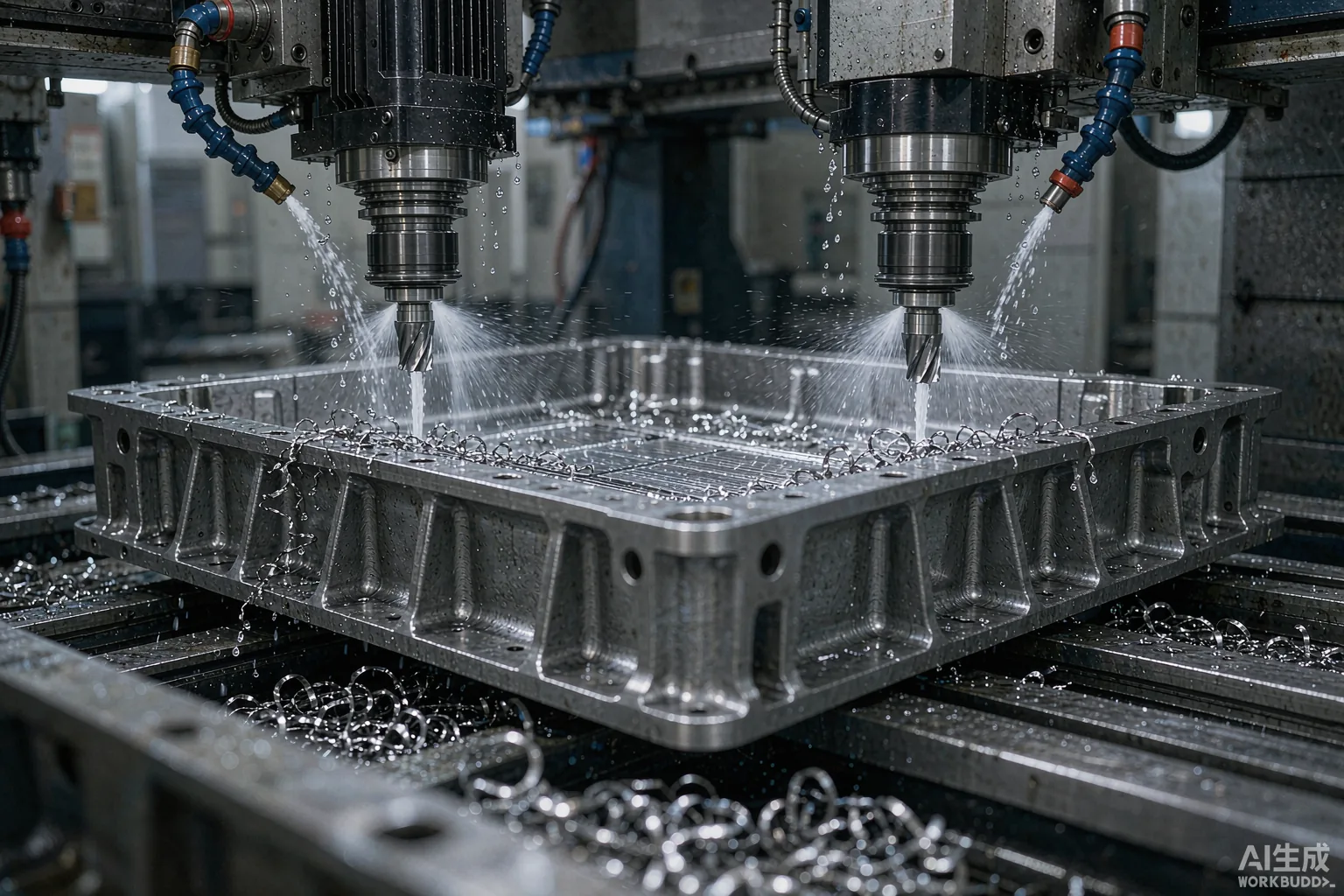
On efficiency claims. Across all of our Gree guides we use a single, deliberately conservative efficiency calibre for the dual-gantry cell: roughly +25% throughput versus a conventional single five-axis cell. Higher numbers circulate in Chinese-language vendor and media material; we do not repeat them because they are not independently verifiable, and because the achievable gain depends almost entirely on your part geometry, fixturing and tool life. Treat any efficiency number — ours included — as a hypothesis to be tested with a paid trial cut on your own casting.
What Haitian's published numbers actually say
Because Haitian Precision is listed, you can audit it in a way you cannot audit Gree. That is genuinely useful, so here is the 2025 picture in full.
| 2025 metric | Value | Year on year |
|---|---|---|
| Revenue | ¥3.368 bn | +0.48% |
| Net profit attributable to shareholders | ¥429 m | −17.97% |
| Blended gross margin | 25.70% | −1.64 pp |
| Net margin | 12.76% | −2.84 pp |
| Gantry machining centres | ¥1.895 bn (56.25% of revenue), 27.57% gross margin | +7.95% |
| Vertical machining centres | ¥841 m (24.98%), 20.50% gross margin | +6.07% |
| Horizontal machining centres | ¥400 m (11.88%), 29.74% gross margin | −30.25% |
| Domestic revenue | ¥2.744 bn (81.49%), 22.82% gross margin | −5.94% (overseas comparison basis) |
| Overseas revenue | ¥557.7 m (16.56%), 39.39% gross margin | +50.01% |
| Employees | 2,435 | +6.1% |
| Q1 2026 (partial-year update) | Revenue ¥815 m; net profit ¥111 m | +10.15% / +12.57% |
Three things in this table matter to a buyer, and none of them are about whether the machines work.
- The profit fall is a price-war story, not a quality story. Haitian's CFO attributed the 2025 decline to weak demand in traditional domestic downstream sectors and heavy product homogenisation driving price competition. Gantry unit volume grew about 15% while gantry revenue grew about 8% — implying average selling prices fell roughly 6%. Sell-side analysts note Haitian's machine prices are now below their post-2016 average, with horizontal machining centres near the 29th percentile.
- Overseas is dramatically more profitable than domestic. A 39.39% overseas gross margin against 22.82% at home is a 16.6-point gap. That is why the company is building out export channels and why export customers are, in practice, being courted hard. It also means an overseas buyer has real negotiating room — while being honest that the service network behind the discount is still being assembled.
- The recovery has started. Q1 2026 revenue and profit both returned to double-digit growth, which suggests the domestic trough was cyclical rather than structural.
Source: Haitian Precision 2025 annual report, reported by China Securities Journal / CS Smart Finance (2026-03-24); Q1 2026 and management commentary from the 2025 annual and Q1 2026 results briefing reported by Securities Daily (2026-05-12). Volume and price-percentile estimates are sell-side (Orient Securities) and carry lower weight.
The disclosure asymmetry — and how to handle it
This is the part most comparison articles skip, and it is arguably the most decision-relevant difference between the two.
Gree's machine-tool operation publishes no standalone segment. You cannot look up Gree CNC revenue, gross margin, unit volume or installed base. What Chinese industry press reported in 2025 is that 75% of Gree's CNC output is sold to outside customers rather than consumed inside Gree's own factories, and that equipment for new-energy-vehicle parts accounts for about 70% of CNC output.
Read that 75% carefully — it is not an export figure. "External supply" means machines sold to third parties rather than used in-house. It tells you Gree is a genuine merchant machine-tool supplier and not purely a captive equipment shop. It does not mean three-quarters of Gree machines ship overseas. Any English-language source that presents it as an export ratio is misreading the Chinese term, and several do.
The practical consequence: with Haitian you can do financial diligence from your desk. With Gree you have to do technical diligence instead — model datasheets, component origin lists, acceptance-test protocols, and reference visits to machines already running your kind of part. That is not a reason to avoid Gree; it is a reason to budget a different kind of effort. A supplier with no published segment numbers compensates with a written, verifiable component and acceptance package, or should not get the order.
Controllers and the honest self-sufficiency picture
Buyers arriving from the German or Japanese market often assume that "Chinese machine tool" implies "Chinese control system." It generally does not, and both of these companies are open about it in their own material.
- Haitian specifies FANUC controls on its HTM-H horizontal machining centres, Siemens options on large gantry models, and an Italian FIDIA C20 on the HTM-GFA five-axis gantry high-speed mill. For a shop already running FANUC or Siemens, that is a genuine advantage: your programmers, post-processors and maintenance habits transfer.
- Gree was reported by Economic Daily in May 2024 as using mature control products from suppliers including Huazhong CNC (HNC) and Siemens. Gree's own engineering effort goes into the motion-execution chain — electro-spindle, linear motor, direct-drive swing head and torque table — not into a proprietary high-end controller.
Where Gree's honest limitation sits: Chinese industry press reported in 2025 that ultra-precision bearings and ultra-high-accuracy grating scales remain largely imported and still account for a substantial share of machine cost (reported at over 40%), with a dedicated core-component industrial park under construction and a stated target of around 70% localisation of key functional parts by 2026. If your acceptance test depends on grating-scale accuracy, ask who makes the scale and what a replacement costs and how long it takes — for either brand.
Where each one genuinely wins
| Your situation | Better starting point | Why |
|---|---|---|
| Large die-cast EV parts — front cabin, rear floor, battery pack housing at volume | Gree | Dual-beam, dual-spindle five-axis architecture is purpose-built for exactly this part family; direct-drive swing head and linear motor remove wear parts from the fast axes |
| Mould blocks, aerospace structures, locomotive or energy housings over roughly 4 m | Haitian | Envelope breadth to 25 m X travel and 120 t table load, with five-face machining in one setup |
| High-mix job shop, part sizes vary wildly week to week | Haitian | Breadth of catalogue beats optimised cycle time when you cannot predict next month's work |
| You want a FANUC or Siemens control your team already knows | Haitian | Controls are named on the product pages and match mainstream shop-floor skills |
| You need published financials for supplier-risk approval | Haitian | Listed, with segment and regional disclosure in the annual report |
| You want to trial capacity without capital outlay | Gree | Gree has publicly promoted a machine-as-a-service model billed by machining hours |
| Tight tolerance work in aluminium with high annual volume | Gree | Cycle-time architecture and in-house motion chain are tuned for this |
| Heavy roughing in nickel or titanium with documented process qualification | Neither | See the next section |
When to buy neither
We sell Gree machines, so this section is the one we are least comfortable writing and the one you should weigh most heavily.
- Single-digit-micron accuracy held over multi-year production. Both builders are credible in the tens-of-microns range on aluminium. Sustained single-digit work on hard materials is a different discipline.
- Aerospace or medical process qualification. If your customer audits your process documentation, the established German, Japanese and Swiss builders still carry certification packages and precedent that neither Chinese builder matches yet.
- Service response measured in hours. Both companies are expanding abroad; neither has a decades-old field-service network in Europe or South-East Asia. If a two-day wait for a specialist is unacceptable, price that risk into the comparison honestly.
- Very low volume on very large parts. A dual-spindle cell only pays for itself when both spindles are cutting. At low volume you are buying capability you will not use.
Data credibility rating
| Claim used in this guide | Source | Rating | Approved wording |
|---|---|---|---|
| Haitian 2025 revenue ¥3.368 bn, net profit ¥429 m, blended gross margin 25.70% | 2025 annual report via China Securities Journal | High | Cite as reported annual-report figures |
| Haitian segment split: gantry 56.25% / VMC 24.98% / HMC 11.88%; overseas ¥557.7 m at 39.39% gross margin | 2025 annual report; Securities Daily results briefing | High | Cite as reported; note fiscal year 2025 |
| Haitian Q1 2026 revenue ¥815 m (+10.15%), net profit ¥111 m (+12.57%) | Company results briefing, Securities Daily | High | Cite as company-reported partial-year data |
| Haitian envelope: X travel 1.25–25 m, table load 3–120 t, spindles 2,000–24,000 rpm; FANUC / Siemens / FIDIA controls | Haitian official product pages (first party) | High | Cite as manufacturer catalogue |
| Gree 75% external-supply ratio; NEV-part equipment ~70% of CNC output; >40% of machine cost in imported core components; localisation target | China Industry News, 2025-07-29 | Medium | Attribute to Chinese industry press; define "external supply" explicitly; do not present as export share |
| Gree uses HNC / Siemens control products | Economic Daily, 2024-05-15 | High | Cite as state-media reporting; never claim a wholly self-developed controller |
| GA-FMB3020D: 120 m/min, 1.1 G, dual-beam dual-spindle, in-house direct-drive swing head / linear motor / torque table | Manufacturer exhibition material and industry-press coverage of CIMT 2025 | Medium | Present as manufacturer specification, verify at acceptance |
| Gree dual-gantry throughput gain | Internal uniform calibre | Calibre | Use "roughly +25% versus a conventional single five-axis cell"; do not use higher circulating figures; require trial-cut validation |
| Gantry ASP down ~6%; HMC price near 29th percentile since 2016 | Orient Securities research note | Medium | Attribute as a broker estimate, not company data |
Guidance: a seven-question diligence sequence
- Size the part before you size the brand. Write down maximum envelope, maximum table load and material removal rate for your three hardest parts. If envelope dominates, Haitian's catalogue fits; if cycle time dominates, Gree's architecture fits.
- Ask for the component origin list in writing, with approved substitutes, for whichever machine you are quoting — including who makes the grating scales and bearings.
- Request the acceptance protocol, not the brochure spec. Accuracy measured after a defined warm-up cycle, not at rated speed on a cold machine.
- Price the service, not just the iron. Ask who holds spares in your country, what the guaranteed response time is in writing, and what a field engineer day costs after warranty.
- For Haitian, read the annual report. You have that option; use it. Segment trends tell you which product lines the company is actually investing in.
- For Gree, substitute technical diligence for financial diligence. No published CNC segment means the datasheet, the component list and the reference visit are your audit.
- Run a paid trial cut with a 24-hour drift measurement before committing volume. This is the single step that converts every claim in this guide — ours included — into a fact about your part.
Start with our CNC Buyer Self-Check if you are still at the "which machine family" stage.
Frequently asked questions
Is Gree CNC better than Haitian Precision?
Not in absolute terms — they optimise for different jobs. Haitian's catalogue is built around envelope breadth, with X-axis travels from 1.25 m to 25 m and table loads from 3 t to 120 t. Gree's flagship is built around cycle time on large aluminium die castings, using a dual-beam, dual-spindle five-axis gantry at 120 m/min and 1.1 G. If your constraint is part size, start with Haitian; if it is cycle time on battery trays, front cabins or rear floors, start with Gree.
Which one is financially more transparent?
Haitian, clearly. It is listed in Shanghai (601882) and publishes segment revenue and gross margin by product line and region — gantry machining centres were ¥1.895 bn, 56.25% of revenue, at a 27.57% gross margin in 2025, while overseas revenue was ¥557.7 m, up 50.01%, at a 39.39% gross margin. Gree's machine-tool business sits inside a diversified group with no standalone CNC segment, so verification has to happen at model level.
Do Gree or Haitian build their own CNC controllers?
Neither at the high end. Haitian's product pages specify FANUC on the HTM-H horizontal line, Siemens options on large gantry models and an Italian FIDIA C20 on the HTM-GFA five-axis gantry. Economic Daily reported in May 2024 that Gree uses mature control products from suppliers including Huazhong CNC and Siemens. What Gree does develop in house is the motion-execution chain — electro-spindle, linear motor, direct-drive swing head and torque table.
What does Gree's 75% external-supply ratio actually mean?
It is not an export ratio. Chinese industry press reported in 2025 that 75% of Gree's CNC output goes to outside customers rather than being consumed in Gree's own appliance factories, and that new-energy-vehicle part equipment is about 70% of CNC output. It establishes that Gree is a merchant machine-tool supplier; it says nothing about geographic export mix, which has to be verified separately.
When should I avoid both of them?
Look elsewhere for single-digit-micron accuracy held over multi-year production on nickel or titanium, for documented aerospace or medical process qualification, or when your plant cannot tolerate a service call measured in days. Both brands are strong in aluminium and structural steel work; the top of the precision and documentation pyramid still belongs to the established German, Japanese and Swiss builders.
Related reading
Still deciding between the two?
Send us your part drawing, material, tolerance and annual volume — we will tell you honestly whether a Gree cell, a large-envelope gantry, or neither is the right answer, and quote only if we are the right answer.