The full five-axis lineup, in-house spindle / linear-motor / direct-drive architecture and where each model fits.
Gree CNC · Application Guide
Gree CNC for Humanoid Robot Components: Machines, Tolerances & the "3+2" Cost Route
← All Gree CNC guides · ← GREE CNC · Published 2026-08-03
Executive summary — read this first.
- Humanoid robots are the fastest-moving new demand pool for precision machining. Industry trackers put 2026 global humanoid shipments at roughly 50,000 units, and a single robot carries dozens of machined joint and structural parts — so a 10,000-unit programme quickly implies hundreds of thousands of precision components a year.
- The bottleneck is not machine hours, it is repeatable tolerance. Joint structural parts are typically specified around ±0.002 mm dimensional and ~0.001 mm geometric tolerance; harmonic-reducer core parts sit at IT4–IT5 grade. Most general job shops cannot hold that batch after batch.
- Gree Intelligent Equipment (Gree Electric's machine-tool subsidiary, established 2015) has made humanoid robotics one of three declared focus tracks alongside new-energy vehicles and 3C electronics, fielding the GA-FA320, GA-TMY6555, GA-MV856 and GA-FA500 for shoulder joints, elbow joints, joint mould housings and rotary shafts.
- Gree's commercial hook is the "3+2" route — three linear axes plus a tilting rotary table instead of a full imported simultaneous five-axis machine. Gree engineers quote it at roughly one third the price of imported true 5-axis equipment for the same joint-surface work.
- Honest caveat: Gree is a decade-old challenger, not a century-old machine-tool house. Its strength is the self-developed motion chain and core components plus fast local service; the high-end CNC controller remains an acknowledged industry gap for Chinese makers generally. Validate on a paid trial part before volume commitment.
Why humanoid robots need a different class of machine tool
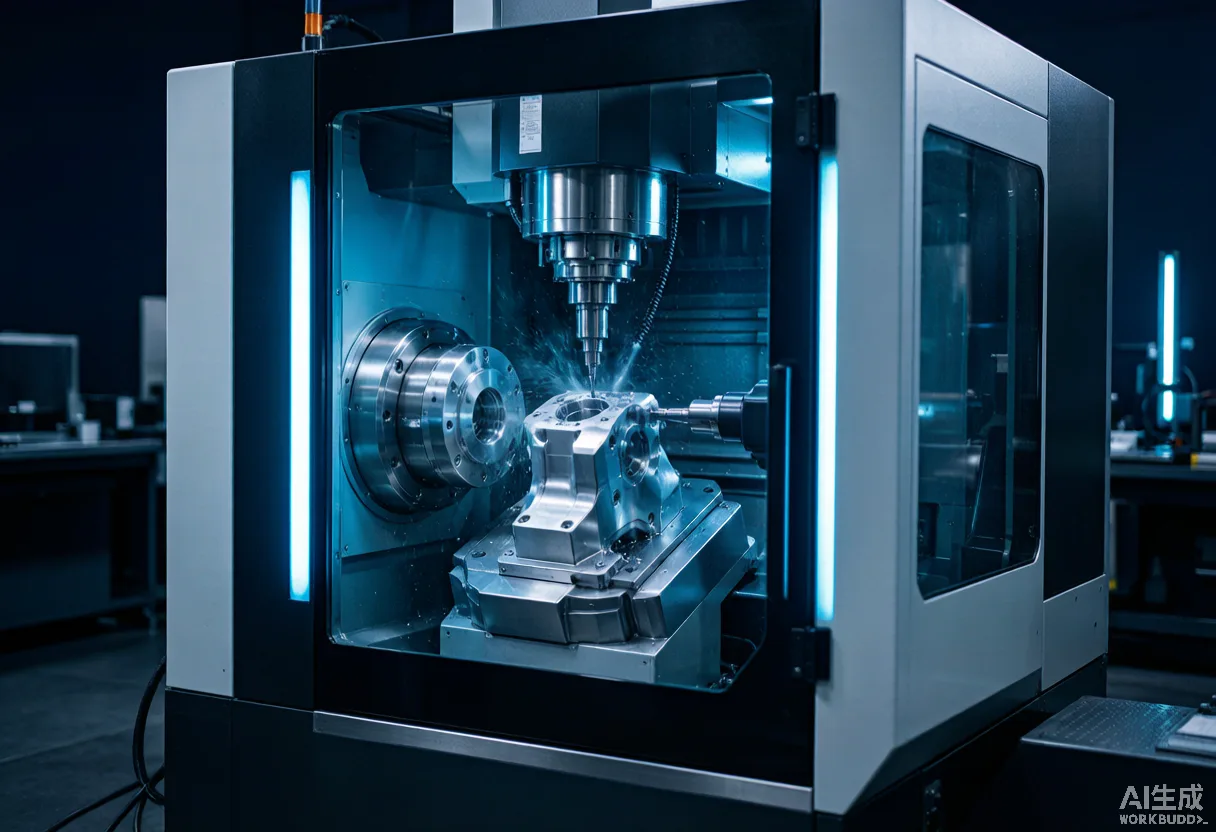
A humanoid robot is, mechanically, a stack of 28–40 actuated joints. Each joint is a small, densely packed assembly: a frameless motor, a harmonic drive (strain-wave gear — a compact zero-backlash reducer that uses a flexible toothed cup) or planetary roller screw, a cross-roller bearing, and a housing that has to hold all of them in alignment for millions of duty cycles.
That geometry is unforgiving in a specific way. If the bearing bore and the motor register drift out of concentricity by a few microns, the joint develops positional drift. If the flexspline pocket goes slightly out of round, you get backlash. Neither failure shows up on the first article — it shows up at unit fifty, or after ten million cycles on a test rig. This is why robotics buyers audit machining suppliers almost like medical suppliers: coordinate measuring machine (CMM), roundness tester and surface-roughness tester are entry requirements, and geometric tolerance capability (cylindricity, coaxiality, runout) decides supplier approval.
A Gree application engineer framed the geometry problem in a way that explains the company's angle: humanoid joint surfaces are wavy, free-form curves — structurally similar to the impeller profiles Gree already machines for air-conditioner compressors. A conventional three-axis machine simply cannot reach those surfaces in one setup, and every extra setup adds tolerance stack-up.
What actually gets machined — and to what grade
Not every robot part needs the same machine. Splitting the bill of materials into precision tiers is the single most useful exercise a buyer can do before shortlisting equipment.
| Part tier | Typical components | Precision grade (industry-typical) | Machining challenge |
|---|---|---|---|
| Tier 1 — Reducer core | Harmonic flexspline & circular spline; RV cycloidal discs | IT4–IT5 | Roundness, tooth-form accuracy, heat-treat distortion control |
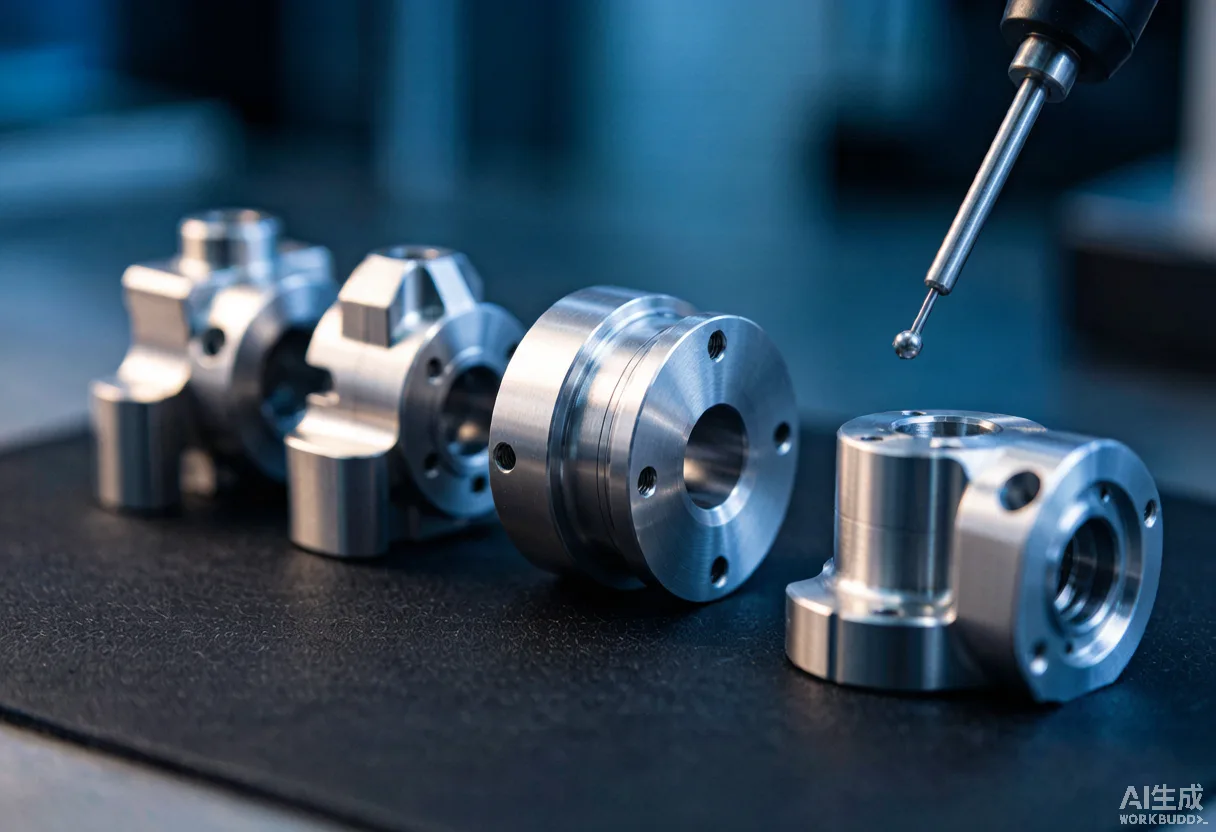
| Tier 2 — Joint module | Motor housings, output flanges, bearing seats, rotary shafts | IT6–IT7; bore-to-register concentricity commonly ~0.013 mm | Single-datum machining; thin-wall deformation |
| Tier 3 — Structure | Ankle links, finger joints, palm frames, connecting pins, sensor brackets, covers | IT7–IT8 | Complex free-form surfaces; lightweight thin-wall aluminium/titanium |
Gree's published application list — ankle connecting parts, finger joints, palm frames and connecting pins on one hand, shoulder joints, elbow joints, joint mould housings and joint rotary shafts on the other — sits squarely in Tier 2 and Tier 3. That is an honest read of where the company competes today: joint-module and structural machining at volume, rather than the Tier-1 gear-metrology end where Japanese and specialist Chinese grinders dominate.
Gree's humanoid-robot machine lineup
Gree showed a ten-machine matrix at CCMT2026 (China CNC Machine Tool Fair, Shanghai, April 2026) and named humanoid robotics as one of its three priority tracks. Four models carry most of the robotics message. Figures below are vendor-published; see the credibility table before you rely on any of them.
| Model | Type | Robot parts targeted | Published key spec |
|---|---|---|---|
| GA-FA320 | 5-axis vertical MC, full direct-drive cradle table | Ankle links, finger joints, palm frames, connecting pins | Repeatability ~0.006 mm; zero-backlash, zero-wear, maintenance-free direct drive; single-setup multi-face and free-form machining |
| GA-FA500 | 5-axis vertical MC, overhead-cradle structure, mineral-cast bed | Robot joints, impellers, moulds | Full direct-drive motion; mineral casting for damping and structural rigidity |
| GA-TMY6555 | Turn-mill CNC lathe (multi-process integration) | Shaft and disc parts, rotary shafts, irregular parts | Turning + milling + drilling/tapping in one clamping; high-rigidity bed for heavy cuts |
| GA-MV856 | Vertical machining centre | Joint mould housings, general structural parts | Positioned as the volume workhorse alongside the 5-axis machines |
The common thread is single-clamping. Every model in the list is sold on reducing the number of setups, because setups are where tolerance stack-up and batch inconsistency come from. For a deeper look at the five-axis architecture itself, see our Gree 5-axis machining centre guide.
The "3+2" route: where Gree's price argument actually comes from
"3+2" machining means three linear axes (X, Y, Z) plus two rotary axes that index and lock rather than move continuously with the cutter. The tool approaches a tilted face, the table holds that angle, and the actual cut is a three-axis operation. It is not the same as simultaneous five-axis, where all five axes move together to sweep a continuous curve.
When 3+2 is genuinely enough
- Multi-face parts with several discrete flat or lightly curved features — most joint housings and bearing seats qualify.
- Programmes where cost per machine, not cycle-time per part, is the binding constraint.
- Shops ramping from prototype to mid-volume that need several cells rather than one showcase machine.
When you still need simultaneous 5-axis
- Continuously curved surfaces where an indexed approach leaves visible facet marks or requires excessive polishing.
- Deep undercuts and tool-reach problems where the cutter must be re-angled mid-cut.
- Tier-1 reducer geometry with tight form tolerance across a full profile.
Gree's own framing is blunt and, to its credit, not overstated: the 3+2 solution costs roughly a third of imported true five-axis equipment for the same joint-surface work, and the company states the package has entered the tier-one supplier systems of several leading robot makers. Treat both the price ratio and the customer claim as vendor-stated — the ratio depends heavily on which imported machine you benchmark against.
The quiet variable: thermal stability
Micron-level tolerance is a thermal problem before it is a mechanical one. A spindle that grows a few microns over a four-hour run will walk a bore out of specification regardless of how good the machine's cold-state accuracy is. This is the one area where Gree's appliance heritage translates most directly and most defensibly: the company builds its own precision variable-frequency oil and water chillers with self-developed compressors and control systems, rated at ±0.1 °C temperature control, and supplies them as part of the machine package rather than as a bought-in accessory.
For a buyer, this is worth a specific question during evaluation: ask whether the quoted accuracy figures are cold-state or after a documented warm-up-and-soak cycle. The gap between the two is where most disappointment lives.
Honest limitations
- Controller Gree's self-development is strongest on the motion-execution chain — spindles, linear motors, direct-drive rotary tables, servo drives and thermal control. The high-end CNC controller remains an acknowledged gap across Chinese machine-tool makers broadly; Gree should not be presented as having closed it.
- Track record Development started in 2013 and the subsidiary was founded in 2015. That is a decade of machine-tool process know-how versus many decades at German and Japanese incumbents. Long-term accuracy retention data on Gree machines in the field is still thin in public sources.
- Metrology base parts Ultra-precision bearings and gratings/encoders are still partly imported across the Chinese industry — a point Gree itself has acknowledged and is investing to address.
- Overseas service Gree's stated 24-hour nationwide response is a China-market strength. International buyers should confirm parts stocking and engineer coverage in their own region before committing a production line.
Data credibility rating
| Claim | Source | Rating |
|---|---|---|
| GA-FA320 full direct-drive 5-axis cradle table; zero backlash / zero wear; ~0.006 mm repeatability | Gree Intelligent Equipment official news (gie.gree.com) + CCMT2026 trade coverage | Medium vendor-stated spec, official source |
| Gree targets humanoid shoulder/elbow joints, joint mould housings, rotary shafts with GA-FA320 / GA-TMY6555 / GA-MV856 | Gree official news + Shanghai Securities News (cnstock.com) CCMT2026 report | High consistent across official and independent press |
| 3+2 solution ≈ one third the price of imported true 5-axis | Gree application engineer quoted in trade press | Medium vendor-stated; benchmark machine unspecified |
| Entered tier-one supplier systems of leading humanoid robot makers | Gree self-reported | Medium no named customers disclosed |
| ~50,000 global humanoid shipments in 2026; 140+ Chinese humanoid OEMs in 2025 | TrendForce projection; industry counts cited in Chinese trade press | Medium forecast, not actuals |
| ±0.002 mm dimensional / 0.001 mm geometric tolerance on joint structural parts; IT4–IT8 tiering | Chinese precision-machining trade analyses | Medium industry-typical guidance, not a Gree specification |
| ±0.1 °C chiller temperature control | Gree official product materials | Medium vendor-stated |
| Any claim of a fully in-house high-end CNC controller | — | Not supported we do not make this claim |
What to check before you buy
- Run a paid trial part from your own drawing — ideally the worst part in your BOM, not the easiest. Ask for the CMM report, not a verbal pass.
- Ask for a batch, not a first article. Twenty parts machined consecutively tells you far more about production reality than one perfect sample.
- Specify the thermal condition under which accuracy is measured, and ask for a soak-test result.
- Tier your BOM first. Buy 3+2 capacity for Tier-2/3 volume and reserve true simultaneous five-axis for the parts that genuinely need it — that is where the cost argument actually pays.
- Confirm regional service — spare-part lead time and on-site engineer response in your country, in writing.
Bottom line. For humanoid-robot Tier-2 and Tier-3 parts at ramp volume, Gree offers a credible cost-and-capacity argument built on self-developed motion components, single-setup 5-axis and 3+2 configurations, and in-house thermal control. It is not the right answer for the tightest reducer-gear metrology, and its overseas service footprint is younger than its machines. Qualify it the way you would qualify any new supplier in a launch-critical programme.
Frequently asked questions
Which Gree CNC machine is used for humanoid robot joints?
Gree positions the GA-FA320 five-axis vertical machining centre as its lead machine for humanoid joint parts — ankle links, finger joints, palm frames and connecting pins — using a full direct-drive cradle table with published repeatability around 0.006 mm. The GA-FA500 covers larger joint and mould work, the GA-TMY6555 turn-mill lathe handles rotary shafts and disc parts, and the GA-MV856 vertical machining centre serves as the volume workhorse.
What is "3+2" machining and is it good enough for robot parts?
"3+2" means three linear axes plus two rotary axes that index and lock, so the cut itself is a three-axis operation on a tilted face. It is genuinely sufficient for most joint housings, flanges and bearing seats, and Gree engineers quote it at roughly one third the price of imported simultaneous five-axis equipment. It is not sufficient for continuously curved surfaces, deep undercuts, or Tier-1 harmonic-reducer gear geometry.
What tolerance do humanoid robot joint parts actually require?
Industry-typical guidance splits the bill of materials into tiers: harmonic and RV reducer core parts at IT4–IT5, joint-module parts such as motor housings and bearing seats at IT6–IT7 with bore concentricity commonly around 0.013 mm, and structural parts at IT7–IT8. Joint structural components are often specified near ±0.002 mm dimensional and 0.001 mm geometric tolerance. These are industry figures, not a Gree specification.
Is Gree a safe supplier for a humanoid robot production ramp?
Gree is credible on cost, capacity, self-developed motion components and thermal control, and it reports serving several leading robot makers — though it does not disclose customer names. Its limitations are a shorter machine-tool track record than German or Japanese incumbents, a high-end CNC controller that remains an acknowledged industry gap, and an overseas service network that is still building out. Run a paid batch trial and confirm regional service in writing before committing a launch programme.
Related reading
Machining humanoid robot parts? Send us the hard one.
Share your part drawing, material, tolerance class and annual volume — we return a recommended machine configuration, a 3+2 versus simultaneous 5-axis assessment and a quote within one business day.
Request a Quote →