The deeper guide on joint parts, tolerances and the 3+2 cost route.
Segment Landing Page · Germany & EU
Gree CNC for Robotics Component Manufacturers
Built for European robot OEMs and Tier suppliers ramping RV / harmonic reducer housings, joints and structural links. Five-axis is not optional here — it is the only way to hold the coaxial bores and free-form surfaces these parts demand. ← Back to GREE CNC
Who this page is for. A buyer-facing guide for the German and European robotics supply chain (Baden-Württemberg, Bavaria and beyond). It pairs Gree's published specs with the parts reality of robot manufacturing. Every vendor figure carries a credibility tag — we would rather you verify than over-claim.
Executive summary. Robot parts are a five-axis problem, not a 3-axis problem: reducer housings need coaxial bores on tilted faces, links and joints need free-form surfaces finished in one setup. Gree's edge is an in-house motion chain — self-developed spindles, linear motors and direct-drive rotary tables — on machines like the GA-UHD500 (rotary-table indexing 0.001°, positioning 0.004 mm), the GA-FA320 (2.5 s tool-to-tool, ~0.006 mm repeatability) and the GA-FMB3020D dual five-axis gantry for larger structural links. Gree also runs its own industrial-robot business, so it machines these parts for itself — a story a pure 3C drilling/tapping supplier cannot tell. Honest limits: tightest reducer-gear metrology, a high-end CNC controller that remains an industry gap, and an overseas service network still building out.
The European robotics opportunity — and why the timing is open
Germany concentrates robotics demand in two clusters that overlap neatly with the automotive belt:
- Baden-Württemberg (Stuttgart / Metzingen). Within ~35 km of Stuttgart sit Mercedes-Benz, Porsche and the Bosch supply circle — and NEURA Robotics in Metzingen, a fast-scaling humanoid and cobot maker that closed a large 2026 funding round and is building production capacity now.
- Bavaria (Munich). Home to Agile Robots and the BMW / Audi supply base, another dense robotics-and-automotion cluster.
The strategic point: a robot maker standing up new capacity is a greenfield purchaser. There is no legacy supplier lock-in yet, no installed-base switching cost. That is exactly the window where a credible five-axis challenger can win a first cell — provided it brings the accuracy proof and local service.
One geography, two segments. The same Stuttgart / Munich footprint buys both NEV parts and robot parts. One local agent, one service point and one sales trip can serve both ramp programmes — efficient when you are not exhibiting at trade shows in 2026.
Why robot parts need true five-axis
Robot components are dominated by three part families, and all three push past what a 3-axis VMC can hold:
| Part family | Why 3-axis falls short | Gree approach |
|---|---|---|
| RV / harmonic reducer housing | Coaxial bores on tilted / angled faces; tight concentricity. Multiple 3-axis setups distort the bore stack. | GA-UHD500 / GA-FA320 single-setup five-axis, direct-drive rotary table. |
| Joint links & fingers | Free-form surfaces, undercuts, features on 3+ faces. | Simultaneous five-axis on the FA320-class machines. |
| Structural members / frames | Large thin-wall aluminium, crash / stiffness geometry. | GA-FMB3020D dual five-axis gantry for larger envelopes. |
Where accuracy is less critical (joint-module housings, flanges, bearing seats), Gree's 3+2 route delivers the same part in one tilted setup at roughly a third of the cost of imported simultaneous five-axis equipment. Tier the BOM: buy 3+2 for volume, reserve simultaneous five-axis for the parts that genuinely need it.
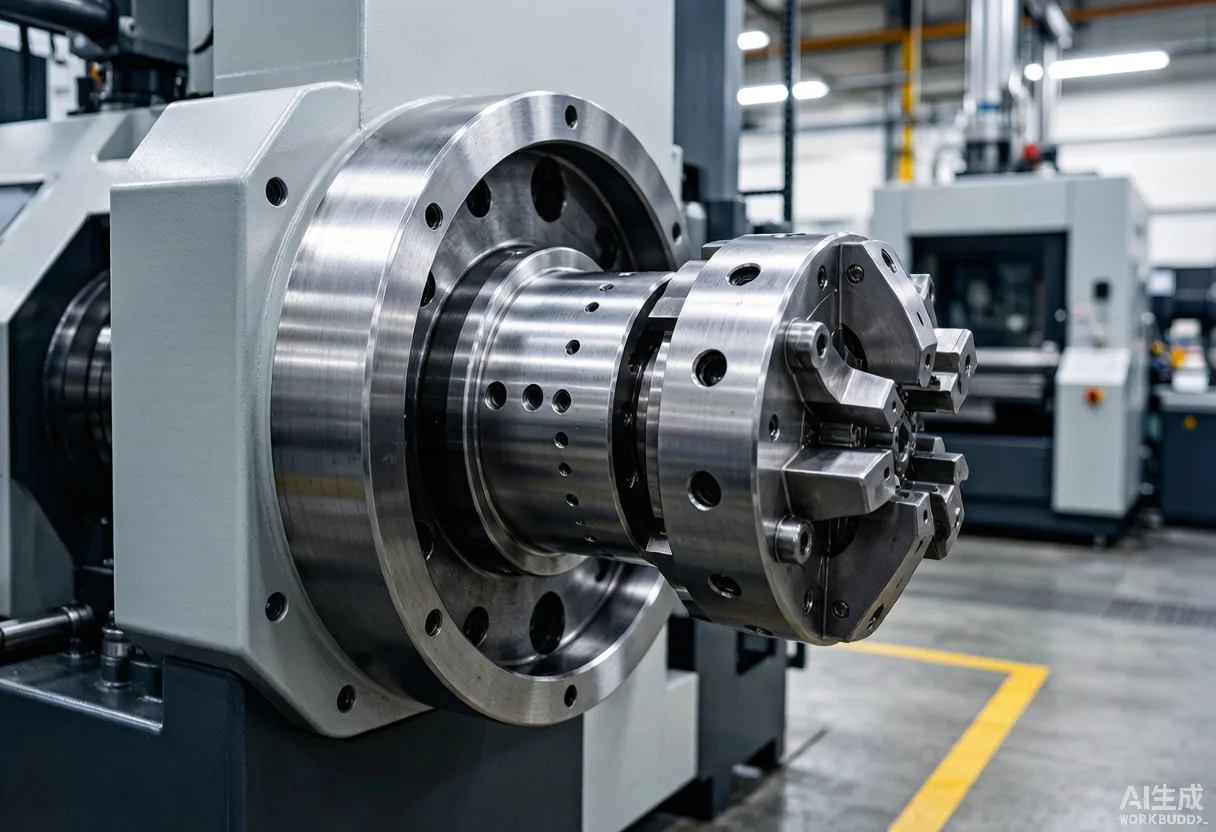
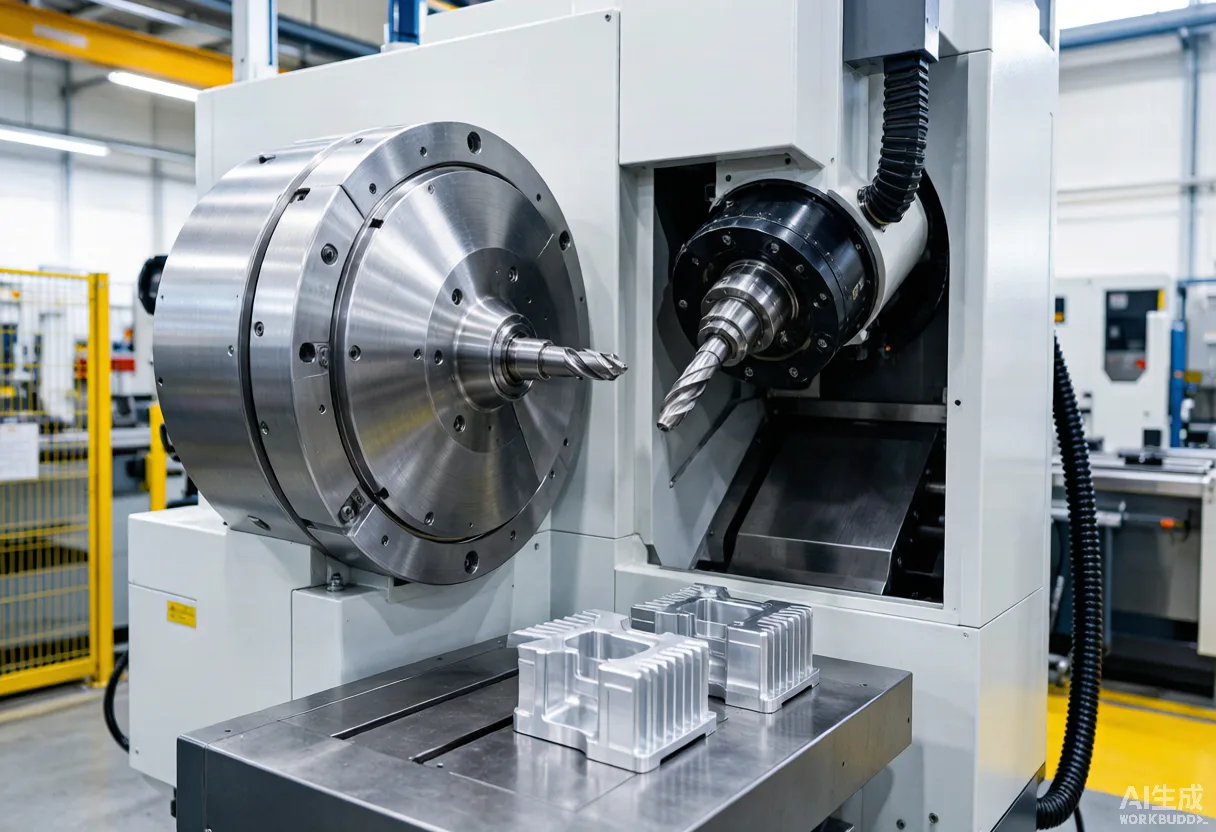
Recommended Gree machines for robot parts
| Model | Type | Best-fit robot part | Key spec (vendor-stated) | Credibility |
|---|---|---|---|---|
| GA-UHD500 | High-speed 5-axis VMC | Reducer housings, joint modules, motor parts | Rotary-table indexing 0.001°; positioning 0.004 mm; 1.5 s tool change | Medium vendor spec |
| GA-FA320 | Direct-drive 5-axis VMC | Joint links, fingers, palm frames, pins | ~0.006 mm repeatability; zero-backlash direct drive; 2.5 s tool-to-tool | Medium vendor spec |
| GA-FMB3020D | Dual five-axis gantry | Larger structural links, frames | Dual five-axis; Geneva 2025 invention gold; ~+25% efficiency vs conventional (vendor) | Medium vendor spec |
| GA-FA500 | Overhead-cradle 5-axis, mineral-cast bed | Larger joints, impellers, moulds | Full direct-drive motion; mineral casting for damping | Medium vendor spec |
| GA-MV856 | Vertical machining centre | Joint-mould housings, general structurals | Volume workhorse alongside the five-axis machines | Context |
Specs from Gree Intelligent Equipment published materials and the GREE CNC benchmark sheet; positioning / repeatability are vendor-stated and should be verified with an on-machine test report (see "Before you buy").
Why Gree is a credible robotics-parts supplier
- In-house motion chain. Self-developed spindles, linear motors and direct-drive rotary tables — fewer imported sub-assemblies, tighter control of the accuracy that robot parts live or die by.
- Gree builds robots too. Gree Intelligent Equipment runs its own industrial-robot business, so it machines reducer housings and joints for its own lines. "We understand these parts because we make them" is a differentiator a volume 3C drilling/tapping rival cannot claim.
- Proven adoption. Gree reports serving several leading robot makers (official news, 2026) — customer names are not disclosed, but the application is real, not theoretical.
- EU + NA footprint. Gree established a North America and Europe presence from around 2022, so there is a regional channel to anchor spare parts and service.
Honest limitations — read before you commit
- Tightest reducer-gear metrology. For Tier-1 harmonic / RV reducer core geometry at IT4–IT5, Gree is newer than German / Japanese incumbents. Validate with your own drawing.
- High-end CNC controller. A fully in-house top-tier controller remains an acknowledged industry gap — be explicit about which controller ships on the machine you quote.
- Young overseas service. The EU / NA service network is still building out. Confirm spare-part lead time and on-site response in writing for your country.
- Accuracy proof not yet public. Gree has not published an ISO 230-2 / VDI 3441 positioning-and-repeatability test report on greecnc.com. Request it — see below.
Versus a volume 3C drilling & tapping supplier
A common alternative for cost-driven buyers is a supplier whose strength is high-volume 3C drilling & tapping centres. That pedigree is excellent for phone / consumer-electronics enclosures and high-speed hole patterns — but it is a different muscle from five-axis robot-part machining:
| Dimension | Volume 3C drilling/tapping supplier | Gree (five-axis motion focus) |
|---|---|---|
| Core strength | High-speed hole patterns, 3C enclosures | Five-axis simultaneous, in-house motion chain |
| Robot-part fit | Limited for coaxial-bore / free-form parts | Native fit for reducer housings & joints |
| Differentiator | Price at volume | Accuracy + single-setup + self-built robots |
Translation for the buyer: if your robot parts are genuinely five-axis, judge Gree on the motion chain and the trial part — not on a drilling/tapping price sheet that does not apply to your geometry.
What to check before you buy
- Run a paid trial part from your own drawing — ideally the worst part in your BOM. Ask for the CMM report, not a verbal pass.
- Request the ISO 230-2 / VDI 3441 test report for positioning and repeatability on the exact model quoted. This is the document that opens (or closes) the door to robot-grade work.
- Ask for a batch, not a first article. Twenty parts in a row tells you more than one perfect sample.
- Specify the thermal condition the accuracy is measured under, and ask for a soak-test result.
- Tier your BOM first. 3+2 for Tier-2/3 volume; simultaneous five-axis only where the geometry demands it.
- Confirm regional service in writing — spare-part lead time and on-site engineer response in your country.
Frequently asked questions
Which Gree CNC machine is best for robot reducer housings?
The GA-UHD500 high-speed five-axis (rotary-table indexing 0.001°, positioning 0.004 mm) and the GA-FA320 direct-drive five-axis (2.5 s tool-to-tool, ~0.006 mm repeatability) are the lead choices for RV / harmonic reducer housings and joint parts, holding coaxial bores and free-form surfaces in a single setup. The GA-FMB3020D dual five-axis gantry covers larger structural links.
Is five-axis necessary for robot parts, or is 3+2 enough?
It depends on the tier. Joint-module housings, flanges and bearing seats are often fine on 3+2 at roughly a third of the cost of imported simultaneous five-axis. Continuously curved surfaces, deep undercuts and Tier-1 harmonic-reducer gear geometry need true simultaneous five-axis. Tier the BOM and buy each capacity where it pays.
Does Gree actually make robots, or just the machines?
Gree Intelligent Equipment runs its own industrial-robot business and reports serving several leading robot makers (official news, 2026; customer names not disclosed). That means Gree machines these parts for its own lines — a useful proof point that it understands robot-part geometry, not just the machine tool.
Can I trust Gree's accuracy for a robot production ramp?
Gree is credible on the in-house motion chain, single-setup five-axis and cost — but request the ISO 230-2 / VDI 3441 test report, run a paid batch trial, and confirm EU / NA service in writing before committing a launch-critical programme. Its overseas service footprint is younger than its machines.
Related reading
Machining robot parts? Send us the hard one.
Share your part drawing, material, tolerance class and annual volume — we return a recommended machine configuration, a 3+2 versus simultaneous 5-axis assessment and a quote within one business day.
Request a Quote →